Matrix Management: The Definitive Guide for Modern Organizations
What Is Matrix Management?
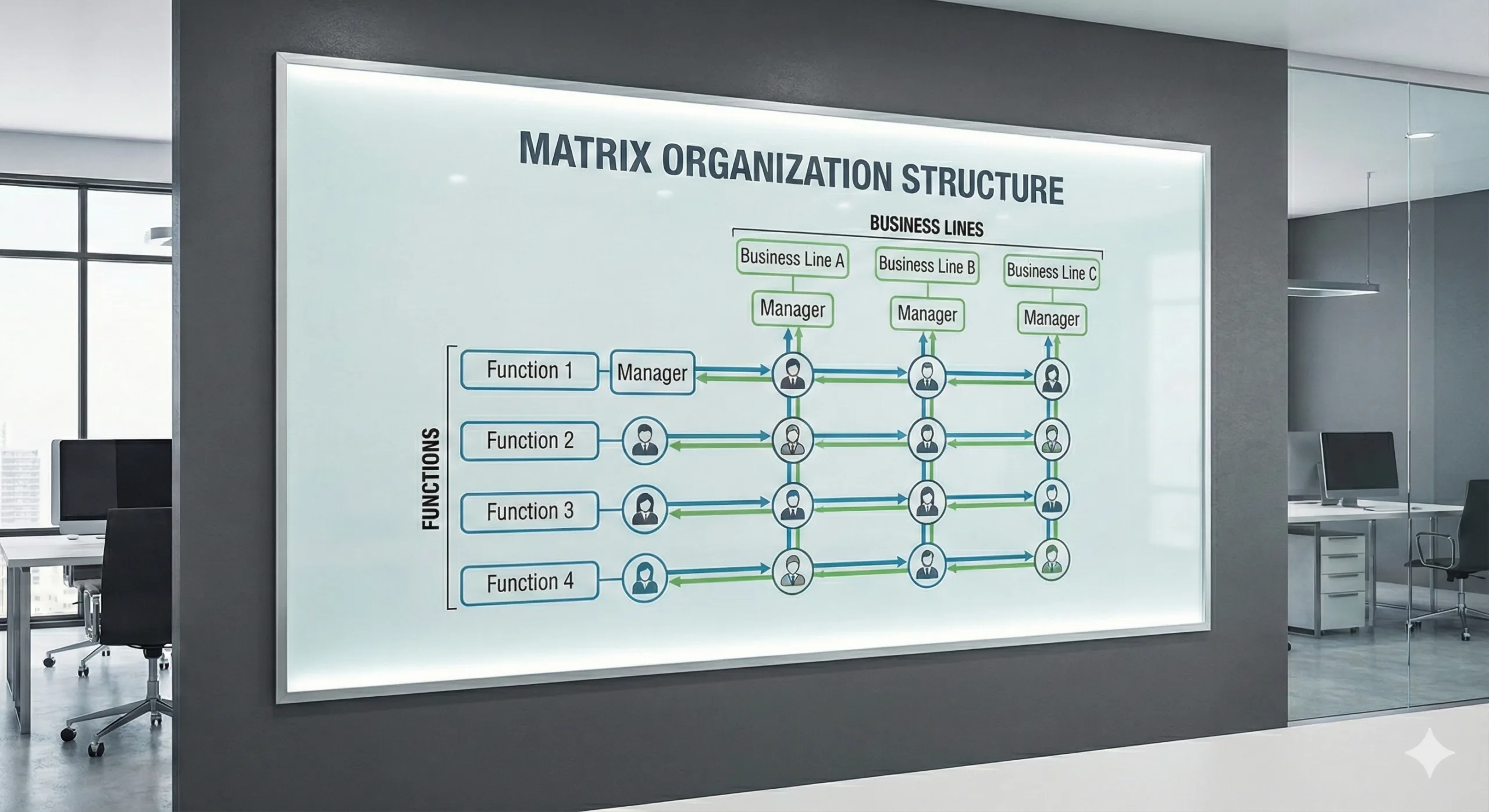
Matrix management is a multidimensional organizational structure often including functions, geographies and business units that enables companies to operate with both flexibility and integration. It breaks down traditional silos by introducing horizontal workflows and often (but not always) dual reporting lines—typically to both a functional and a process/project or business manager—allowing organizations to balance overall consistency with local agility, and to leverage talent and resources across boundaries. The matrix is essential for organizations facing complex, fast-changing environments, and is a foundational enabler of digital transformation and agile working. If you are looking to implement or improve your matrix management capability see our specific matrix management training.
What is the definition of matrix management?
Matrix management is an organizational approach where originally individuals reported to more than one manager—most commonly, both a functional manager (e.g., HR, Finance, Engineering) and a business, product, or project manager. Today people are also likely to be working in multiple teams and with multiple stakeholders, and many practitioners define this as a matrix even if there are not formal dual reporting lines. This way of working is designed to enable organizations to be good at multiple things at the same time: global and local, functional and business unit, integration and flexibility. Matrix management is more complex and needs distinctly different skills.
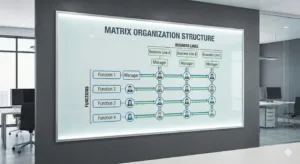
What are the key features of a matrix:
- Dual “Reporting Lines”: Employees have two or more bosses or work on multiple teams or with multiple stakeholders, creating the need to balance different priorities.
- Cross-Functional Teams: Teams are formed from multiple departments to deliver on complex, horizontal goals.
- Resource Sharing: Talent and expertise are leveraged across the organization, not locked in silos.
- Dynamic Balance: The structure is intentionally designed to allow for constant rebalancing of priorities as business needs change.
However, in our matrix management training around the world we have learned that structure is largely a distraction in matrix management. When we focus on structure we are usually thinking about power and control and these are not the best way to get things done in a modern organisation. Our advice is not to obsess on structure but to focus on quality of cross-functional collaboration.
Matrix management is not just about reporting lines—it’s about creating the matrix skills, mindset, and culture needed to succeed in a complex, interconnected environment.
An interesting finding from our 2026 matrix report was that managers with a single line reporting are the least satisfied with the matrix.
How common is the use of a matrix organizational structure?
Our internal research at global integration indicates that over 90% of large complex organisations on for example the Footsie or Fortune 50 indexes have some form of matrix structure. The ones that don’t tend to be large national organisations such as the US insurance company or ones that do something relatively simple like mining the commodity and shipping it around the world.
Any organisation that combines functions with multiple countries, regions, product groups or business lines has a de facto matrix as we people have to take these different entities into account. Not all of them have formal dual reporting lines but the skill set and challenges are similar to those described in this document.
How do managers adapt to matrix management?
Any organisational structure gives us some benefits and creates some challenges. At the start of the matrix implementation experienced managers often ask 2 questions. “How can I get things done without traditional authority”, and “How can I be accountable for results when I don’t control the resources.”
Wealthy seem initially reasonable questions both of them are based on the assumption that the best way to get things done is through control and power, but this is not usually the case with today’s skilled and educated workforces.
A small number of managers do struggle to move away a from command and control way of leadership all these individuals may not be a good match with the deeds of matrix management.
Where did matrix management come form
Origins of the matrix
Matrix management emerged in the 1950s and 1960s, initially in the aerospace and defence industries, as organizations faced increasingly complex projects that required expertise from multiple disciplines. The model spread to technology, pharmaceuticals, and global corporations in the 1970s and 1980s, as companies sought to serve global customers, coordinate international supply chains, and run integrated internal systems.
Evolution of the matrix
- 1970s–1980s: Matrix structures were adopted to break down silos and enable cross-functional (usually project) collaboration.
- 1990s–2000s: The rise of globalization and digital transformation increased the need for integrated, flexible structures.
- 2010s–Present: Matrix management is now the norm in many large organizations, supporting agile working, hybrid teams, and digital business models.
- 2020s – With the increase in horizontal digital processes cross functional working has become the norm and even quite small organisations are experiencing these matrix challenges (even though they may not have formal dual reporting)
Key Milestones:
- From Centralization to Balance: Early matrix implementations often led to centralization, but the true intent is to balance global integration with local flexibility.
- Digital Transformation: Matrix management is now seen as a precondition for successful digital transformation, enabling organizations to operate laterally and break down traditional silos.
- Virtual working; an increasing number of matrix teams are now also virtual teams with the added complexity this brings.
How does matrix management work in practice?
A matrix organization is set up to be good at multiple things at once: global and local, functional and business unit, integration and flexibility. This means employees may have:
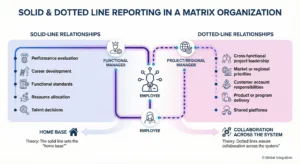
- A solid-line (primary) manager (e.g., their function)
- A dotted-line (secondary) manager (e.g., a project or business unit)
- Multiple teams, stakeholders, and reporting lines
Example: A marketing manager in a global company may report to the global marketing head (solid line) and the country manager (dotted line), balancing global initiatives with local market needs.
What do solid and dotted line managers do?
Solid line managers usually focus on functional expertise and consistency, while dotted line managers drive project or business objectives, often requiring negotiation and collaboration across boundaries.
Comparison Table: Solid vs. Dotted Line Managers in Matrix Organizations
| Aspect | Solid Line Manager (Primary) | Dotted Line Manager (Secondary) |
| Reporting Relationship | Direct, formal reporting line | Indirect, secondary reporting line |
| Typical Role | Functional manager (e.g., HR, Finance) | Project, business unit, or country manager |
| Focus | Functional excellence, consistency, standards | Activity delivery, local adaptation, agility |
| Authority | Usually has more formal authority | Influences through project or business needs |
| Performance Evaluation | Responsible for formal performance reviews | May provide input or feedback |
| Resource Allocation | Controls functional resources | Requests or negotiates resources for projects |
| Goal Setting | Sets functional goals and priorities | Sets project or business goals |
| Conflict Resolution | Resolves functional conflicts | Resolves project or cross-functional issues |
| Example | Global marketing head | Country manager (for local market needs) |
Companies may change who is the solid and who is the dotted line manager to change the balance of power and give greater priority to one part of the matrix or another. See our deeper dive into dotted and solid lines.
What are the different types of Matrix Structures?
- Weak Matrix: Functional managers retain most authority; project or cross-functional managers have limited power.
- Balanced Matrix: Power is shared equally between functional and project or cross-functional managers.
- Strong Matrix: Project or cross functional managers have more authority; functional managers provide support.
- Networked organization: Where organisations want to work in a matrixed way, but without dual reporting lines
- Platform matrix operating system: a recent development combining autonomous delivery teams, shared enterprise platforms, and matrix-style overlays for accountability, skills, and governance
Key Processes
- Goal setting, metrics and incentives: Goals, metrics and incentives come from multiple sources and can often compete for time and attention and sometimes conflict. Individuals must learn to clarify, prioritize, and negotiate their objectives and manage expectations.
- Role Clarity: Employees must take ownership of clarifying their own roles, often using tools like ARCI (Accountable, Responsible, Consulted, Informed) analysis.
- Alignment: We need to align through both vertical (within functions) and horizontal (across teams and projects) processes.
- Collaboration: Improving collaboration across silos can lead to an increase in the number of meetings and people involved indecisions. Matrix organisations need strong processes to reduce the number and improve the quality of meetings and decisions, or this can cause significant delays
What are the advantages of matrix management?
- Breaks down silos, enabling teams to work across functions, geographies, and business units.
- Resource Optimization
- Talent and expertise are shared, reducing duplication and increasing efficiency.
- Organizational Flexibility
- The matrix allows organizations to adapt quickly to changing priorities and market conditions.
- Enhanced Employee Engagement
- Broader roles and increased autonomy drive engagement, learning, and retention.
- Digital and Agile Enablement
- Matrix management is a foundation for digital transformation and agile working, supporting hybrid and virtual teams. Digital processes do not care about our legacy silos and typically cut across them requiring effective matrix working
- Broader people development
- Matrix working enables people to build a broader enterprise mindset and cross functional skill set. This is often seen as a key advantage of the matrix by people who work within it
What are the disadvantages of matrix management?
- Role Ambiguity
- Dual reporting lines can create confusion about responsibilities and authority. Interestingly this can also allow people to be more flexible and to shape their own roles.
- Potential for Conflict
- Competing goals and priorities between managers can lead to tension and slow decision-making.
- The matrix generates lower levels of conflict in general but higher levels of conflict on issues of resource allocation as there are more people competing for these resources
- Increased Complexity
- The matrix adds layers of complexity which reflect the realities of today’s multidimensional business climate, this requires new skills and more sophisticated management.
- Risk of Bureaucracy
- More meetings, alignment sessions, and communication can lead to overload if not managed well.
- Managers are held accountable for results without having direct control over all resources.
Where are the key challenges of matrix management?
Matrix organizations deliberately trade some clarity for increased flexibility. The right balance is dynamic and must be constantly managed. We need to bring clarity where we can but also get more comfortable with ambiguity
- Competing Goals and Priorities
Employees often receive competing and even conflicting goals from different managers, teams and stakeholders. The ability to negotiate, clarify, prioritize and manage expectations is essential.
- Role and Decision Ambiguity
Roles are broader and more ambiguous than in traditional organizations. Employees must take ownership of clarifying their own roles and helping clarify decision rights and involvement for themselves and others. See our detailed guide on decision making in a matrix.
- Alignment Overload
Too much time can be spent in alignment meetings, especially early in a matrix implementation. Organizations must learn to achieve “good enough” alignment quickly.
- Trust and Empowerment
Trust is harder to build in a matrix, especially in virtual and hybrid teams. Managers must learn to empower people without direct control.
Managers are often accountable for results without having full authority over resources or people. This requires new skills in influence and negotiation and means people need to get out and engage with the broader organization.
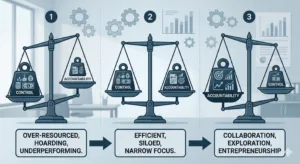
- Continuous change
Matrix organizations operate in environments of constant change. Traditional change models are often inadequate; continuous learning and adaptation are required.
in 2026 and 2026 a number of organizations are engaged in matrix simplification exercises to make their organizations easier to navigate.
What are the essential skills for matrix management
Success in a matrix environment requires a new set of matrix management skills and a shift in mindset.
- Self-Leadership and Ownership
- Take responsibility for clarifying your own goals, roles, and priorities.
- Proactively seek information and resolve ambiguity.
- Collaboration and Networking
- Build relationships across functions, geographies, and teams.
- Leverage networks to get things done.
- Simplify collaboration to get rid of unnecessary meetings and speed up decsion making (not everyone has to be involved in everything)
- Influence Without Authority
- Use persuasion, negotiation, and relationship-building to achieve results.
- Understand and use different sources of power (expertise, relationships, information).
- See more on influence without authority
- Managing Ambiguity and Change
- Be comfortable with uncertainty and rapid change.
- Use tools like ARCI analysis and alignment grids to clarify roles and goals where we can.
- Be active in building your own “good enough” clarity and alignment
- Address disagreements constructively.
- Use frameworks like ADC (Aligned, Different, Conflict) to manage differences.
- Trust Building
- Build trust quickly across distance, cultures, and time zones.
- Use quick wins, regular communication and other techniques to actively to maintain trust.
- Continuous Learning
- Embrace feedback, experimentation, and ongoing development.
- Learn from both successes and failures.
What does matrix management training involve?
Why does matrix management training matter?
Matrix management capability building is essential for equipping leaders and employees with the different skills and mindset needed to succeed in a complex, ambiguous environment.
Our training focuses on: (follow the links for detailed articles)
- Understanding the matrix structure and its rationale
- Taking ownership of clarity and managing ambiguity and continuous change
- Building alignment with others
- Exercising influence without authority
- Managing accountability without control
- Developing self-leadership and ownership
- Managing cross-functional teams
- Managing multiple bosses and multiple team membership
- Building simplified collaboration and influence skills – fewer, better meetings and faster decisions
- Trust-building and balancing control and empowerment to ensure the matrix stays flexible
It’s important to note that some of the leadership techniques from a simpler environment do not translate well into the matrix. For example, traditional leadership training focuses on making goals clear, increasing communication and collaboration. It a matrix there will always be more ambiguity and we have to manage the tension rather than find fixed clear solutions, and there is often too much communication and collaboration, but a key matrix skill is cutting through this and simplifying to achieve productivity as well as flexibility.
What are the different approaches to training in matrix management?
- Workshops and Simulations: Practice real-world scenarios in a safe environment.
- Coaching and Mentoring: Support ongoing development and application of skills.
- Online Learning: Flexible, scalable training for hybrid and remote teams.
- Peer Learning: Share experiences and best practices across the organization.
How do we measure the success of matrix management training
- Improved confidence in and acceptance of matrix working
- Improved cross-functional collaboration
- Faster decision-making and alignment
- Fewer, better meetings
- Higher employee engagement and retention
- Successful delivery of complex, cross-functional projects
Making the Matrix Work – The Agile Remix by Kevan Hall and Alan Hall is a practical guide for leaders and organizations navigating the complexities of matrix management. The book delivers actionable frameworks for balancing clarity, cooperation, control, and agility, enabling organizations to thrive in multidimensional, fast-changing environments.
What is the role of AI in supporting matrix management
Current AI technologies can play a practical supporting role in helping managers and employees navigate many of the challenges inherent in matrix management—particularly those related to complexity, ambiguity, alignment overload, and accountability without authority.
Used well, AI does not replace managerial judgement or human relationships but acts as an enabler of better matrix working.
Where specifically can AI help in matrix management?
First, AI can reduce role and decision ambiguity by helping individuals clarify and sense‑check responsibilities, priorities, and decision rights. AI tools can support the use of frameworks such as RACI, summarising inputs from multiple stakeholders and highlighting overlaps, gaps, or conflicting expectations, which is critical in environments where roles are deliberately broad and fluid.
Second, AI can help manage alignment overload and meeting proliferation, a common risk in matrix organisations. By summarising meetings, synthesising discussions across teams, and surfacing “good enough” alignment points, AI can reduce the need for excessive coordination while still supporting collaboration across silos.
Third, AI can support influence without authority by helping managers prepare clearer narratives, stakeholder maps, and evidence‑based arguments when negotiating priorities and resources. This is particularly valuable in matrix contexts where managers are accountable for outcomes but do not directly control all the resources required to deliver them.
Fourth, AI can enhance self‑leadership and ownership, a core requirement of effective matrix working. By helping individuals track competing goals, reflect on trade‑offs, and identify where they need to proactively engage others, AI reinforces the expectation that people take responsibility for creating clarity rather than waiting for it to be provided.
Finally, AI can support continuous learning and adaptation in matrix organisations by capturing patterns across projects, decisions, and conflicts, and feeding insights back into leadership development and matrix management training. This aligns with the reality that matrix organisations operate in conditions of ongoing change rather than stable, one‑off transformations.
Frequently Asked Questions
Q: Is matrix management right for every organization?
A: Matrix management is best suited for organizations facing complexity, rapid change, and the need for cross-functional collaboration. This can happen at any scale of organization but is highly likely to be needed for large complex organization in multiple geographies.
Q: How do you avoid confusion in a matrix?
A: Invest in specific matrix management training, clarify roles and goals, use tools like ARCI analysis, and foster a culture of ownership and open communication.
Q: What is the biggest challenge of matrix management?
A: Balancing clarity and flexibility—ensuring people know what to do, while enabling rapid adaptation to change.
Q: How does matrix management support digital transformation?
A: By enabling lateral processes, breaking down silos, and fostering the skills and mindset needed for agile, digital ways of working.
Conclusion
Matrix management is a powerful approach for organizations seeking to thrive in complexity. By breaking down silos, enabling cross-functional collaboration, and fostering agility, the matrix organizational structure supports innovation, engagement, and digital transformation. However, it requires new skills, a shift in mindset, and ongoing investment in training and development. Apply these principles in your organization to unlock the full potential of matrix management.
See how to build the skills of your matrix managers or contact us for a free consultation
Explore our training programs to see how we can help.
Cross functional teams Training Agile & Digital Training Matrix Management Training People and purpose Training Virtual Teams TrainingEducate yourself further with a few more of our online insights:
30 years of experience learning with a range of world class clients
We work with a wide range of clients from global multinationals to recent start-ups. Our audiences span all levels, from CEOs to operational teams around the world. Our tools and programs have been developed for diverse and demanding audiences.

Tailored training or off the shelf modules for your people development needs
We are deep content experts in remote, virtual and hybrid working, matrix management and agile & digital leadership. We are highly flexible in how we deliver our content and ideas. We can tailor content closely to your specific needs or deliver off the shelf bite sized modules based on our existing IP and 30 years of training experience.
For more about how we deliver our keynotes, workshops, live web seminars and online learning.