How to have fewer, better meetings
Fewer, better meetings are not about sort term efficiency tactics; they are a leadership capability. In matrix, cross‑functional, and hybrid organizations, meetings are where collaboration happens, if our meetings are poor, our collaboration and decision making are poor. Leaders who deliberately reduce meeting volume while improving quality create faster decisions, stronger ownership, and better outcomes across face‑to‑face, virtual, and hybrid environments. Effective meetings is one of the key skills in being sucessful in our matrix management guide.
Why are meetings a problem in matrix and cross‑functional organizations?
In complex organizations, calls multiply because work crosses functions, geographies, and stakeholder groups. Indeed, improving collaboration across the organization to connect the silos is often an explicit objective in adopting a matrix. People contribute to multiple teams, serve multiple leaders and stakeholders. In this context, meetings become the safest and most visible coordination mechanism.
When roles, priorities, or decision rights are unclear, we use collective sessions to:
- Reduce perceived risk.
- Build alignment through presence rather than clarity.
- Demonstrate involvement or commitment.
- Avoid unilateral decisions that might later be challenged.
- Stay informed and visible.
Research consistently shows that meeting overload is now one of the biggest barriers to productivity and decision quality. A large‑scale analysis by Microsoft found that this overload is the number one obstacle to productivity, with employees reporting insufficient uninterrupted focus time during the working day
Our own research for our book Kill Bad Meetings found that managers and professionals spent 2 days per week in face to face and virtual sessions and 50% of this was wasted. This is the easiest area to make productivity improvements in your most expensive people.
The latest estimates are that AI may save knowledge workers 3-5 hours per week. This following a $1Tn+ investment in AI in 2025. Stopping unnecessary meeting would save between 8 and 16 hours per week at minimal cost to implement.
In matrix environments and cross-functional teams, this problem is amplified because:
- People work in multiple teams simultaneously.
- Authority is shared rather than hierarchical.
- It can be unclear who are the decision makers and who should be involved so it is often safer to invite everyone.
Over time, this creates a reinforcing loop: more ambiguity leads to more discussions, which in turn reduces time for the thinking and clarification that would reduce ambiguity in the first place.
What is the actual cost?
The cost of meetings is not just the hours spent in the room. A well as time preparing the real impact shows up in slower decisions, weaker ownership, and reduced execution quality. In making a sustained difference we always start with a business case to justify it as a priority like any other productivity investment. The process is detailed in our book.
The direct measurable cost
Multiple large‑scale studies show how deeply this problem now dominates leaders’ time:
- Knowledge workers spend 15–17 hours per week in meetings on average, with significantly higher figures for managers and executives.
- Research summarized by McKinsey shows that when they are poorly designed, decision making becomes slower and less effective, with executives reporting that a large proportion of their decision time is wasted
- Based on our own figure of 20% of managers’ and professionals’ time spent in unnecessary sessions and at a typical cost of $100,000 per person including employment costs this is $20,000 per person per year. Find out about our free survey to get an accurate cost and diagnosis of the issues for your organization.
These figures rarely include preparation time, follow‑up, or the cost of fragmented attention.
The hidden cost
Studies on meeting recovery time show that frequent meetings fragment attention and increase cognitive fatigue, particularly when they are virtual or back‑to‑back. Employees need time to mentally reset afterwards, or performance and engagement decline.
See our blog focusing specially on engaging virtual sessions.
This hidden cost explains why leaders often feel “busy but ineffective”: time is consumed by coordination rather than progress.
If 20% of our most valuable people’s time is consumed in unnecessary meetings alone, that also means they are not working on more valuable activities. Projects can take a day per week longer and decisions can slow.
Imagine the cost on morale and engagement of spending a day a week in unnecessary work (that’s 8 years of a 40-year career!). Stopping the unnecessary meeting that everyone hates is a real win:win.
Why don’t traditional “rules” fix the problem?
Most organizations respond to meeting overload with rules:
- Shorter default meeting lengths
- Tighter agendas
- Reducing number of attendees
- Gimmicks like meeting free Fridays
These interventions help initially at the margins, but they rarely produce sustained change.
The reason is simple: the root cause of meeting overload is not technique — it is rational leadership behaviour given your corporate culture.
Harvard research on meeting overload shows that people may accept invitation due to fear of missing out, reputational risk, and hierarchy rather than genuine contribution
- Saying no can feel politically risky.
- Declining a meeting can be misinterpreted as disengagement.
- Leaders worry about decisions being made without them.
- It can be the only way to stay visible and informed if other communication channels are not effective.
As a result, meetings persist even when their value is questionable. The organization becomes optimized for inclusion rather than effectiveness. Unless we fix the underlying corporate culture challenges then reductions are impossible to sustain for long.
In our meetings culture workshops, we help identify these underlying cultural dynamics and help develop alternatives.
Why not start by improving our facilitation?
It sounds a suitable place to start but if we improve our facilitation skills first, then we only get more skilled at facilitating the 50% of session that just do not need to happen – start by cutting the unnecessary ones, then come back to facilitation skills.
How do we cut the number?
Leaders who successfully reduce meetings focus on two mutually reinforcing levers.
1. When is a meeting genuinely required?
A meeting is justified only when live, synchronous collaboration is essential.
Meeting‑worthy topics typically include:
- Decisions requiring trade‑offs across stakeholders.
- Complex problem‑solving that benefits from diverse perspectives.
- Relationship‑building, negotiation, or sensitive discussions
Many other topics — updates, reporting, information‑sharing — are better handled asynchronously.
This distinction becomes more important, not less, in hybrid environments. Research from MIT Sloan Management Review shows that virtual sessions are significantly more fatiguing than face‑to‑face ones, increasing the cost of unnecessary collaboration.
Leaders who achieve better results actively ask:
- What outcome requires us to be together, at the same time?
- What would happen if this topic were handled differently?
- What is the role of the participants? If it is only to sit and listen, then you do not need a meeting – send a document.
2. How do leaders remove unnecessary topics and participants?
A substantial proportion of meeting content does not require collective discussion. Topics are often included “just in case,” and participants are invited by default rather than design.
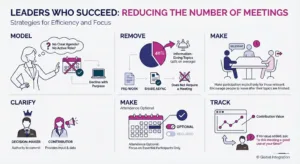
- Model turning down invitations without clear agendas and an active role for the participant.
- Remove information‑giving topics from your agenda (on average this is 40% of content and does not require a meeting. You may need to be more intentional with pre-work to achieve this.
- Make participation explicit only for those for whom the topics are relevant, encourage people to leave after their topics are finished.
- Clarify roles (decision‑maker, contributor)
- Make attendance optional.
- Track contribution and if people do not add value ask them if the meeting is an effective use of their time.
Academic research supports this approach. Studies show that relevance strongly moderates fatigue, engagement, and perceived meeting effectiveness.
This is not about exclusion. It is about respecting time, attention, and expertise and it requires specific effective facilitation skills.
Unnecessary participants often make up 10% of meeting attendees. You probably already know who they are. If not start by challenging the people who never contribute.
So now we have reduced our number of sessions by half (40% from improved relevance and taking our information giving, and 10% by reducing unnecessary attendees). It sounds simple but it requires sustained sponsorship and effort to give people the permission and the skills to do this and to sustain the change.
How do we improve the quality of the ones that remain?
We are left with a day per week of necessary meetings; we should be able to improve these by a further 10% of more.
How do we design better meetings, especially hybrid ones?
High‑quality meetings are designed around outcomes, not agendas.
Effective design answers four questions in advance for each topic in a process we call OPPT:
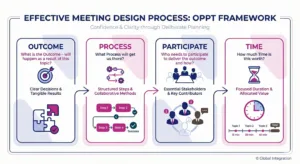
- What is the Outcome – will happen as a result of this topic?
- What Process will get us there?
- Who genuinely needs to Participate?
- How much Time is this worth?
Design discipline matters most in hybrid meetings. A growing body of research shows that hybrid meetings are harder to run well than fully virtual ones. A large ACM study found that meeting effectiveness depends heavily on facilitator capability, interaction design, and how remote participants are integrated
Without deliberate design and specific hybrid meeting training for facilitators, hybrid meetings often default to presentations for those in the room, while remote participants disengage.
In virtual meetings the risk of disengagement and distraction is higher, and we train virtual facilitators to engage remote attendees actively every 4-5 minutes to prevent disengagement.
What leadership behaviours sustain better meeting cultures?
Improved meetings are not sustained by policies alone. They are reinforced through visible leadership behaviour and setting expectations.
Leaders who successfully change meeting culture consistently:
- Model selective attendance and explain their reasoning.
- Normalize declining meetings without reputational damage.
- Decline meetings without an agenda or a clear role.
- Invest more effort in the meetings that remain.
- Shift from presentation to facilitation, especially online
Stanford research on “Zoom fatigue” confirms that meeting design, camera norms, and interaction patterns materially affect cognitive load and engagement.
In practice, this means leaders treat meetings as a scarce organizational resource rather than a default activity.
How does this differ across face‑to‑face, virtual, and hybrid meetings?
The principles apply across all formats, but the risks differ.
- Face‑to‑face meetings tend to tolerate poor design longer, masking inefficiency.
- Virtual meetings amplify fatigue and disengagement when design is weak, and it is easier for people, to multi-task if the content is irrelevant.
- Hybrid meetings require the highest level of leadership skill, as inequities between in‑room and remote participants quickly emerge.
Research shows that meeting format interacts strongly with facilitation quality. Well‑facilitated meetings can be effective in any format; poorly facilitated meetings fail faster in virtual and hybrid settings.
How is AI likely to change meetings over the next few years?
AI is already reducing the need for some meetings through:
- Automated transcription and summarisation
- Asynchronous collaboration tools
- Analytics that make meeting load and cost visible.
However, evidence suggests AI amplifies leadership choices rather than replacing them. AI can expose inefficiencies, but it cannot decide which conversations genuinely require human interaction.
Poorly designed meetings remain poor — just faster and better documented.
How does this connect to the wider leadership framework?
This challenge is one component of effective meetings in complex organizations. It links directly to broader leadership capabilities as described in our in definitive guide to matrix management and practical summary of cross‑functional team challenges, particularly around clarity, decision‑making, and influence.
How can AI enhance meeting effectiveness
Making meeting demand visible and explicit
AI can surface the true cost of meetings by analysing calendars, attendance patterns, and preparation time. Leaders can see where meetings are being used as a substitute for clarity. This helps us build a business case as above and encourages leaders treat meetings as a scarce organisational resource rather than a default activity.Challenging whether a meeting is genuinely required
AI can act as a design prompts before a meeting is scheduled, asking: What outcome requires live, synchronous interaction? It can flag topics that historically generate low interaction or decisions and suggest asynchronous alternatives such as documents, short recorded updates, or collaborative workspaces.Improving relevance through smarter participation decisions
By analysing who actually speaks, contributes, or is referenced in decisions, AI can highlight patterns of unnecessary attendance. This supports more disciplined decisions about who genuinely needs to participate, normalising selective attendance and reducing fatigue without relying on blunt “attendance limits.”Shifting information‑giving out of meetings
AI‑generated summaries, dashboards, and short briefings make it easier to remove the 30–40% of agenda time typically spent on updates. Leaders can distribute clear, digestible pre‑work and reserve live time for discussion, trade‑offs, and judgement — where human interaction adds the most value.Strengthening meeting design, not just facilitation
AI can support outcome‑based design by helping leaders structure sessions around OPPT: clarifying the intended outcome, proposing suitable processes, testing participant relevance, and stress‑testing whether the time allocated is justified. This improves quality before facilitation skills are applied.Raising the quality of hybrid and virtual interaction
In hybrid meetings, AI can monitor participation balance, track airtime, and flag when remote participants are becoming passive observers. Used well, this supports facilitators in actively re‑engaging people every few minutes and reducing the inequities that commonly undermine hybrid effectiveness.Improving follow‑through and ownership
AI can capture decisions, commitments, and rationale in real time, reducing ambiguity after the meeting. This directly addresses one of the hidden costs of poor meetings: weaker ownership and slower execution caused by unclear outcomes.Reducing cognitive load and recovery time
Automated note‑taking, summarisation, and action tracking reduce the mental overhead associated with frequent meetings. This helps leaders and teams recover faster between sessions, protecting focus time for higher‑value work.Keeping leadership responsibility where it belongs
The most important opportunity is not efficiency, but discipline. AI can expose patterns, costs, and alternatives — but only leaders can decide which conversations are worth human time and attention. Used well, AI accelerates better choices; used poorly, it simply makes bad meetings faster.
AI does not remove the need for judgement — it amplifies it. Leaders who role‑model declining low‑value meetings, designing fewer but better ones, and investing more energy where collaboration truly matters will see AI reinforce those behaviours rather than compensate for their absence.
Practical checklist: what should leaders do next?
To reduce meetings
- Develop a business case to prove the scale of the problem.
- Decline meetings without a clear collaborative outcome and an active role for you.
- Challenge information giving topics – take them outside the meeting – replace updates with asynchronous alternatives.
- Challenge participants who do not add value to the meetings.
To improve meetings
- Design around outcomes, process, participation, and time, not topics.
- Clarify roles and decision rights.
- Actively facilitate participation.
- Adapt design explicitly for virtual and hybrid formats.
Key takeaways
- Meeting overload is a leadership issue, not a scheduling issue.
- Reducing the number of meetings create capacity for better decisions.
- Better meetings are essential to good collaboration, they require design, facilitation, and courage.
- Hybrid meetings demand the highest leadership skill.
- AI brings opportunities to plan, conduct and improve meetings – stat to experiment and see what it can do
A consultative next step
If your leaders are overwhelmed by meetings across matrix, cross‑functional, or hybrid teams, this is often a signal of deeper coordination and leadership challenges.
If you would like to explore a structured leadership development pathway for improving meetings or speak with a leadership training advisor about reducing and improving meetings in your organization, we would be happy to continue the conversation.

Explore our training programs to see how we can help.
Virtual Teams Training People and purpose Training Matrix Management Training Cross functional teams Training Agile & Digital TrainingEducate yourself further with a few more of our online insights:
30 years of experience learning with a range of world class clients
We work with a wide range of clients from global multinationals to recent start-ups. Our audiences span all levels, from CEOs to operational teams around the world. Our tools and programs have been developed for diverse and demanding audiences.

Tailored training or off the shelf modules for your people development needs
We are deep content experts in remote, virtual and hybrid working, matrix management and agile & digital leadership. We are highly flexible in how we deliver our content and ideas. We can tailor content closely to your specific needs or deliver off the shelf bite sized modules based on our existing IP and 30 years of training experience.
For more about how we deliver our keynotes, workshops, live web seminars and online learning.