Accountability Without Control: The Key to Matrix Success
Accountability without control means being responsible for outcomes even when you don’t have full authority over all resources. In today’s matrix organizations, this approach drives collaboration, innovation, and engagement by encouraging teams to influence and align across boundaries, rather than relying solely on direct control.”
This blog explores why accountability should exceed control, how to structure roles, metrics and incentives for success, and practical steps for building a culture where people choose their accountabilities and drive results together.
Managing accountability without control is a key matrix management challenge, for more see our definitive guide to matrix management
What does “accountability without control” mean in a matrix organization?
Accountability is often misunderstood as synonymous with control. Many leaders new to matrix organizations lament, “I cannot be accountable for what I do not control.” But in reality, perfect alignment between accountability and control is rare—and may even signal poor performance or missed opportunities.
What is accountability?
Accountability is a about owning the responsibility for achieving a particular result. It’s about being answerable for outcomes, not just for the resources you directly manage. Ideally these are freely chosen but sometimes they will be given to you.
Control on the other side of this equation is about the level of control you have over the resources you need to deliver these accountabilities.
Why does this matter in a matrix?
In matrix structures, work often crosses traditional silos of function and geography. Leaders and teams must collaborate, influence, and persuade—rather than rely solely on hierarchical authority.
Because both work and resources span organizational boundaries it is hard to have full control over the total resources you need and it is normal to need to influence and collaborate to get things done.
How Is Accountability Traditionally Viewed—and Why Is That a Problem?
Most definitions of accountability focus on attributing responsibility or blame if something goes wrong. Regulations and governance rules, often drafted in response to failures of trust, tend to be backward-looking and designed to establish blame and sanctions. This approach can create a culture of fear and reluctance, where people avoid accountability for things outside their direct control.
Key Insight:
True accountability should be forward-looking—engaging people in creating desired results, celebrating success, learning from experience, and fostering ownership.
Why is accountability without control essential in matrix organizations?
Robert Simons’ research at Harvard Business School reveals that different levels of balance between “span of control” (resources you control) and “span of accountability” (results you’re responsible for) drives different behaviors.
Three Scenarios:
| Scenario | Description | Likely Outcome |
| More Control than Accountability | You control more resources than you’re accountable for | Over-resourced, underperforming, hoarding resources |
| A match between Accountability and Control | You’re accountable for exactly what you control | Efficient, but siloed, narrow focus |
| More Accountability than Control | You’re accountable for more than you control | Collaboration, exploration, entrepreneurship |
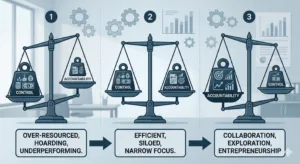
In Simons’ study, 70% of companies had jobs where accountability exceeded control—the wider the gap, the more exploration and entrepreneurship behaviors emerged.
Expert quote “Many experienced managers who are new to the matrix think that having accountability without control is a bug, a mistake in their matrix. In fact it is a feature – by deliberately creating accountabilities that are broader than control we lift people out of their silos and encourage them to explore, align and engage with others” Kevan Hall, author of Making the Matrix Work.
What are the risks and rewards of accountability without control?
Risks:
- Leaders may feel out of control, forced to achieve results through influence rather than authority.
- Lack of trust that others will deliver their responsibilities.
- Organizational cultures of blame, where accountability brings risk.
Rewards:
- Encourages reaching out, collaboration, and resourcefulness.
- Breaks down silos and fosters end-to-end ownership.
- Drives higher engagement, learning, and development.
How should managers structure roles and responsibilities?
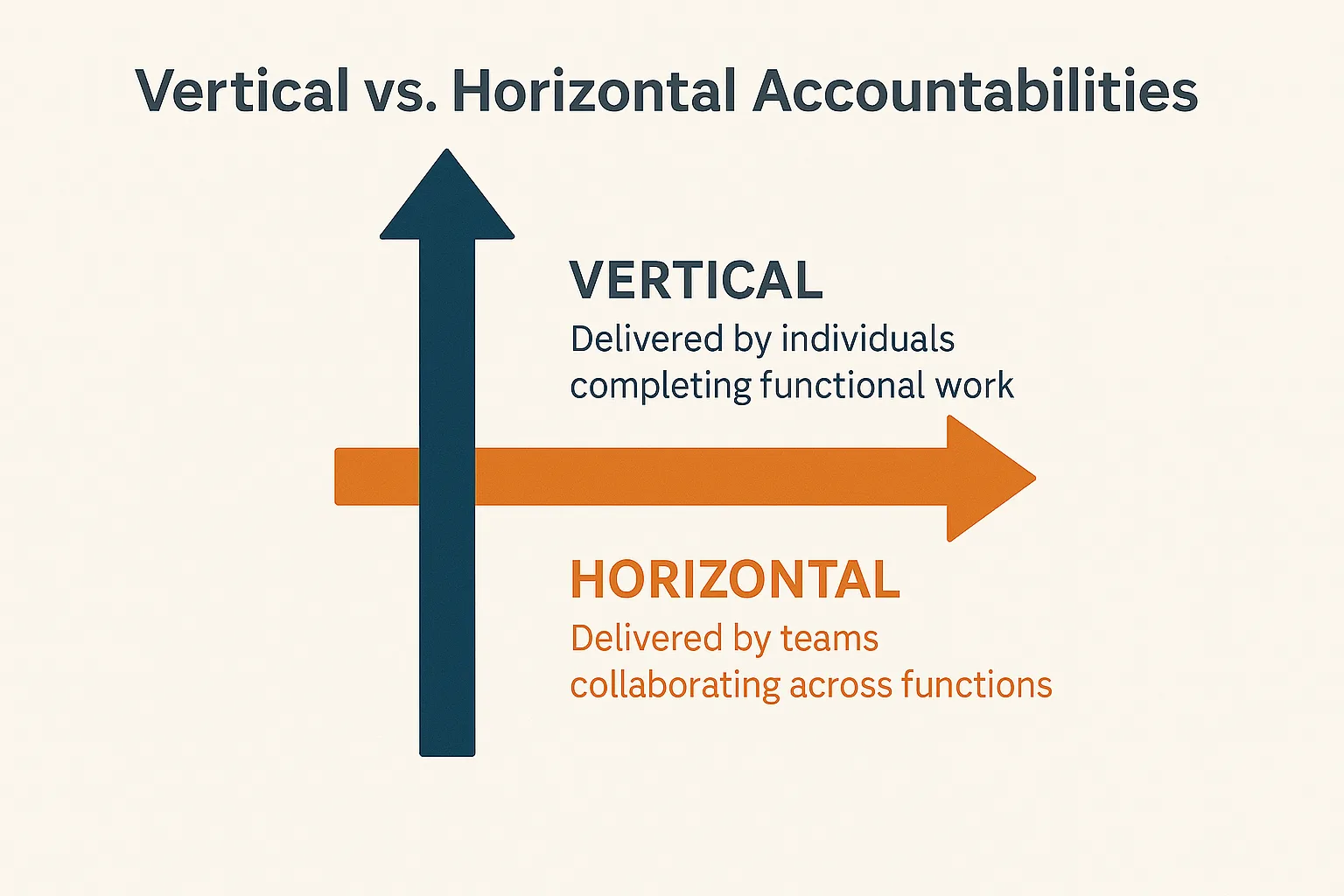
Have a blend of Vertical vs. Horizontal Accountabilities:
- Vertical: Delivered by individuals completing their own functional work. Span of control and accountability may be closely linked for efficiency but is likely to lead to siloed focus.
- Horizontal: Delivered by teams collaborating across functions. Accountabilities must be shared and broader than control to ensure end to end ownership and prevent dropped balls.

Practical Tip:
Design jobs where accountabilities routinely exceed control over resources. This encourages the behaviors needed for matrix success—exploration, cooperation, and collective achievement.
Can accountabilities be shared?
The idea of accountability stems from a single point of accountability “the buck stops here” and this is a principle of tools like RACI
However, in a matrix and cross-functional working it is rare for all accountabilities to come together until you reach a fairly senior level of the organization and if all accountabilities are set at this level then this quickly becomes a bottleneck and leads to unnecessary escalation.
The reality in a matrix and cross-functional working is that accountabilities are often shared.
Organizations who have struggled with a matrix often try to “simplify the matrix” by consolidating decision making in a single individual accountability rather than sharing accountabilities. This makes accountability clearer and decisions faster but at the expense of more senior decision makers using authority rather than building consensus (which is often OK but can become a problem).
What happens if accountabilities in a team are not shared
If accountabilities are solely individual or functional then each individual focuses on only their part of the process, so issues may “fall between the stools” or activity may be misaligned. At the extreme everyone on the team can achieve their objectives while the overall team fails.
How can leaders build positive accountability?
If we want our people to take on more accountability, we must make the experience a positive one. If it is not, then it is rational to avoid accountability.
- Make accountability positive, not punitive
Shift the focus from blame and fear of failure to recognition, celebration, learning, and motivation. Define “who gets to celebrate” success in advance to ensure recognition goes to those with real “skin in the game.” - Encourage commitment by choice
People feel highest accountability and engagement when they choose their own commitments. If goals and roles are imposed, accountability weakens. Give up control to allow individuals to choose their commitments. - Model cross-silo engagement
Matrix managers take personal responsibility for solving problems that span boundaries, they seek alliances and exercise influence to get the resources they need. - Train people in matrix management skills
How can we use AI to strengthen accountability without control
AI offers practical ways to strengthen accountability without control by augmenting, not replacing, human judgment and relationships. Used well, it increases clarity, reduces friction and supports the influence skills that matrix work demands.
AI can improve role and accountability clarity.
Generative tools can draft, test and stress‑check accountability statements, shared outcomes and success measures across functions, highlighting overlaps, gaps and unintended conflicts before work begins. This helps teams agree forward‑looking accountabilities without defaulting to control.
AI supports better decision making where accountability exceeds authority.
Decision assistants can surface relevant data, assumptions, risks and stakeholder impacts, reducing information asymmetry and bias. Scenario modelling and option framing help leaders influence with evidence rather than position power.
AI strengthens horizontal collaboration.
Intelligent summaries of meetings, chats and documents create a shared version of the truth across silos, reducing rework and dropped balls. Workflow agents can track cross‑functional commitments, signal dependencies and prompt timely conversations without escalation.
AI accelerates learning and capability building.
Personalized coaching tools can help managers practice influence, stakeholder mapping and difficult conversations, using real situations as safe simulations. Teams can capture lessons learned and convert experience into reusable playbooks.
AI frees time for the human work that matters most.
By automating analysis, coordination and reporting, leaders can focus on trust, alignment and motivation. In a matrix, AI becomes a force multiplier for accountability without control when it is used to inform, connect and enable people, not to police them at scale across complex organizations today.
What are practical steps for managers?
Checklist for Building Accountability Without Control:
- Define accountabilities that look forward—focus on recognition, celebration, learning, and motivation.
- Create shared accountabilities for teams whose outputs span organizational boundaries
- Embed this into goal setting, key metrics of success and incentives to drive the behaviors we need
- Create stretch between span of control and accountability in goal setting to get people out of their silos.
- Ensure vertical and horizontal accountabilities support matrix behaviors.
Conclusion
Embedding accountability without control in our goal setting, measures of success and incentives is a powerful way to encourage cross silo working. In the absence of this busy people will usually try to complete their work faster without engaging with others, this is the opposite of what we want in a matrix and cross-functional style of working
Why not talk to one of our specialists or dive deeper into our matrix management guide.
Explore our training programs to see how we can help.
Virtual Teams Training People and purpose Training Matrix Management Training Cross functional teams Training Agile & Digital TrainingEducate yourself further with a few more of our online insights:
30 years of experience learning with a range of world class clients
We work with a wide range of clients from global multinationals to recent start-ups. Our audiences span all levels, from CEOs to operational teams around the world. Our tools and programs have been developed for diverse and demanding audiences.

Tailored training or off the shelf modules for your people development needs
We are deep content experts in remote, virtual and hybrid working, matrix management and agile & digital leadership. We are highly flexible in how we deliver our content and ideas. We can tailor content closely to your specific needs or deliver off the shelf bite sized modules based on our existing IP and 30 years of training experience.
For more about how we deliver our keynotes, workshops, live web seminars and online learning.