Matrix organization structure: how modern companies organize for speed, scale, and cross‑functional collaboration
A matrix organization structure is an operating model where people work across multiple dimensions—typically business unit, geography, and function—creating deliberate dual reporting lines and shared accountabilities. This structure increases flexibility and cooperation, but it also introduces ambiguity, competing priorities, and decision friction. This article breaks down how matrix structures work, why they persist, and what leaders must do to make them effective.
What problem does the matrix organization structure attempt to solve?
Organizations adopt a matrix structure when the business needs to be great at more than one thing at the same time: global scale and local relevance, functional excellence and customer responsiveness, innovation and efficiency.
However, this creates several predictable pain points for leaders:
- Dual reporting lines create unclear authority
- Business units, functions, and geographies pull in different directions
- Competing goals slow decisions and dilute accountability
- Cross‑functional delivery becomes dependent on informal networks
- Virtual and hybrid working amplify coordination challenges
As Making the Matrix Work notes, the matrix “deliberately trades clarity for flexibility.” That trade‑off pays off only when leaders have the skills to operate within it—otherwise, the structure becomes a barrier to alignment, speed, engagement, and execution.
For a broader look at managing in a matrix environments.
Evolution of the matrix
- 1970s–1980s: Matrix structures were adopted to break down silos and enable cross-functional (usually project) collaboration.
- 1990s–2000s: The rise of globalization and digital transformation increased the need for integrated, flexible structures.
- 2010s–Present: Matrix management is now the norm in many large organizations, supporting agile working, hybrid teams, and digital business models.
- 2020s – With the increase in horizontal digital processes cross functional working has become the norm and even quite small organisations are experiencing these matrix challenges (even though they may not have formal dual reporting). Platforms begin to be seen as one leg of a matrix.
Key Milestones:
- From Centralization to Balance: Early matrix implementations often led to centralization, but the true intent is to balance global integration with local flexibility.
- Digital Transformation: Matrix management is now seen as a precondition for successful digital transformation, enabling organizations to operate laterally and break down traditional silos.
- Virtual working; an increasing number of matrix teams are now also virtual teams with the added complexity this brings.
What is the matrix organization structure in simple terms?
At its core, a matrix organization structure overlays two or more dimensions of the business onto each role. Instead of reporting up a single chain, people work across multiple “legs” of the organization.
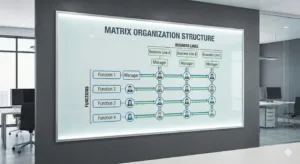
In this article we focus on the formal matrix structure but many companies and practitioners have extended the definition of the matrix to include multiple team and multiple stakeholder environments – after all if you are on 3 teams you may as well have 3 bosses!
What are the most common matrix dimensions
Most enterprise matrices combine two or more of:
- Function (e.g., HR, Marketing, Finance, Engineering)
- Business Unit / Product Group
- Geography / Region / Market
- Platforms, a recent development, see more
This creates a multidimensional organization where leaders must align across vertical and horizontal streams simultaneously.
The matrix is deliberately designed to reflect different perspectives and to be dynamic, adapting to the changing balance of focus each of these entities needs over time.
How do reporting lines actually work in a matrix organization?
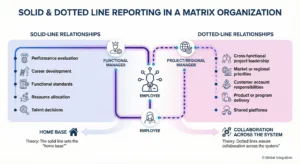
Matrix structures introduce solid‑line and dotted‑line relationships.
What are solid‑line relationships
These usually represent formal accountability for:
- Performance evaluation
- Career development
- Functional standards
- Resource allocation
- Talent decisions
What are dotted‑line relationships
These usually represent shared input and coordination, such as:
- Cross‑functional project leadership
- Market or regional priorities
- Customer account responsibilities
- Product or program delivery
- Shared platforms
In theory, the solid line sets the “home base,” while dotted lines ensure collaboration across the system. In practice, dotted lines frequently pull as strongly as solid ones—creating tension that leaders must manage intentionally.
An interesting finding from our 2026 matrix survey report is that single line managers are the ones least satisfied in the matrix.
What are the different types of matrix structures for projects?
Project management practitioners describe the matrix as: functional matrix, balanced matrix, or project/product matrix depending on the centrality of projects.
1. Functional (or weak) matrix
- Solid line to the function
- Dotted line to business unit, region, or project
- Functional priorities dominate decisions
- Suits organizations focused on quality, risk, and standardization
Risk: slow response to customer or market needs.
2. Balanced matrix
- Performance accountability is shared
- Decisions require alignment across functions and business units
- Most common modern pattern
- Enables global processes and local responsiveness
Risk: decision paralysis when leaders do not have alignment skills.
3. Strong (project or product) matrix
- Solid line to project, product, or business leader
- Dotted line to the function
- Prioritizes speed‑to‑market and customer demands
Risk: functional capabilities and standards degrade if not protected.
What is a Networked organization:
A networked organization is where organisations want to work in a matrixed way, but without dual reporting lines. They usually stick with functional reporting lines only plus projects or ad hoc teams. The skills of leading in these flexible organizations is outlined in our guide to cross-functional teams.
How do BU, geography, and function interact in a matrix?
The Three‑Leg Matrix Model – How it works in practice
- The business unit drives product, innovation, customer value
- The geography drives market execution and local relevance
- The function drives standards, expertise, and scalable capabilities
An effective matrix integrates these three perspectives into coherent decisions.
An ineffective matrix leaves teams caught in the middle.
Generally speaking a third leg to the matrix adds a lot of complexity, more legs than 3 tends not to be sustainable.
What makes matrix organization structures succeed or fail?
Common failure patterns
Matrix organizations struggle when they:
- Add structure without developing skills
- Confuse role clarity with rigidity
- Fail to align incentives and performance systems
- Over-engineer reporting lines
- Treat dotted lines as “less important”
- Assume people can self‑navigate ambiguity without support
Success patterns
High-performing matrix organizations:
- Keep the matrix “light” and focused on coordinating work, not adding bureaucracy
- Invest in matrix leadership skills (influence, alignment, decision making, and virtual collaboration)
- Build strong horizontal governance
- Use shared goals to align teams
- Develop trust quickly across locations and cultures
- Reinforce the mindset: “If not you, then who?”
As Making the Matrix Work emphasizes:
“Skilled people can make almost any structure succeed. But even the most elegant structure will fail without the skills to operate it.”
What leadership behaviors enable matrix structure success?
A 1990 study summarized it well Matrix Management: Not a Structure, a Frame of Mind
The matrix mindset we need today includes
- Translate strategic goals into practical, shared targets
- Align with stakeholders early in planning cycles
- Proactively negotiate priorities
- Make decision rights explicit
- Operating confidently with ambiguity
- Avoid over‑escalation
- Focus on progress over perfection
- Encourage teams to make informed trade‑offs
- Use currencies of influence (mutual benefit, expertise, speed, risk reduction)
- Secure alignment through relationships, not position
- Build coalitions across functions and regions
- Enabling autonomy and accountability
- Push decisions to the closest point of information
- Create confidence through coaching, not micromanagement
- Recognize that accountability ≠ control
- Strengthening connectivity and trust
- Use deliberate rituals to keep teams aligned
- Maintain reliable, predictable communication patterns
- Ensure remote colleagues get equal voice and visibility
Checklist: Are you leading effectively in a matrix organization structure?
Use this diagnostic to identify where leadership development is most needed.
Structural understanding
- I can clearly explain how BU/Geo/Function interact
- I understand the intent behind our matrix design
- I know who holds solid vs. dotted‑line accountability
Alignment & decision making
- I align goals horizontally and vertically, not just within my silo
- I negotiate priorities proactively
- I know when to escalate—and when not to
Collaboration capability
- I can influence without relying on authority
- I work effectively across distance, cultures, and virtual settings
- I build trust quickly with stakeholders I rarely meet
- I run effective meetings
Mindset & adaptability
- I am comfortable making decisions amidst ambiguity
- I help my team shape their roles and responsibilities
- I prioritize relationships alongside deliverables
Leaders who score high across these dimensions tend to thrive in matrix environments—those who struggle often default to escalation, conflict, or frustration.
Is your organization “matrix ready?”
Using AI to strengthen matrix leadership capabilities
Clarifying roles, decision rights, and accountability
AI tools can help leaders and teams surface and clarify who owns what in complex matrix environments. By analysing role descriptions, RACI charts, governance documents, and real patterns of collaboration, AI can highlight overlaps, gaps, and conflicting expectations between solid‑line and dotted‑line relationships. This supports clearer conversations about decision rights, escalation paths, and accountability without adding more structure. Used well, AI becomes a diagnostic aid that reduces ambiguity rather than another layer of bureaucracy.
Supporting faster, better‑aligned decision making
In a matrix, decisions often stall because information is fragmented across functions, geographies, and platforms. AI can aggregate and summarise inputs from multiple sources, making trade‑offs more visible and reducing information asymmetry. Leaders can use AI to test assumptions, surface risks, and explore scenarios before alignment discussions, enabling higher‑quality decisions without endless meetings. This reinforces the principle of pushing decisions closer to the information while maintaining coherence across the system.
Strengthening influence without authority
AI can act as a practical coach for matrix leaders who must influence laterally rather than rely on hierarchy. By analysing stakeholder priorities, communication patterns, and previous outcomes, AI can help leaders tailor messages, identify shared interests, and choose the right “currency of influence.” It can also support the preparation of difficult alignment conversations, helping leaders frame proposals in ways that resonate across functions and cultures.
Improving horizontal alignment and coordination
High‑performing matrix organisations pay attention to horizontal governance. AI can help monitor alignment across business units, functions, and regions by tracking goal consistency, dependency risks, and emerging conflicts. This enables earlier intervention and more proactive negotiation of priorities, rather than relying on escalation after problems surface. Over time, AI‑enabled insights can inform better planning cycles and more realistic commitments across the matrix.
Enhancing virtual and hybrid collaboration
With many matrix teams operating virtually, AI can support more inclusive and effective collaboration. Examples include summarising meetings, highlighting unresolved decisions, tracking commitments, and ensuring remote voices are captured. This reduces reliance on informal networks and helps create more predictable, transparent ways of working across distance, time zones, and cultures.
Developing matrix leadership skills at scale
Finally, AI enables more personalised and scalable development of matrix leadership capabilities. Leaders can use AI for just‑in‑time learning, reflection, and feedback on behaviours such as managing ambiguity, negotiating priorities, and building trust. Rather than generic training, AI supports continuous skill building embedded in real matrix challenges, reinforcing the mindset that structure sets the intent—but leadership behaviour determines the outcome.
Matrix organization structure is only one component of leading effectively in complex, cross‑functional companies. Structure sets the intent—but skills, behaviors, and governance determine the outcome.
This challenge is one part of effective matrix leadership. To explore the full framework, see our matrix management guide.
If your organization is transitioning to—or struggling with—a matrix environment, we can help your leaders build the skills needed to operate confidently in multidimensional structures.
Would you like to explore a structured leadership development pathway or speak with a matrix leadership training advisor?

Explore our training programs to see how we can help.
Virtual Teams Training People and purpose Training Matrix Management Training Cross functional teams Training Agile & Digital TrainingEducate yourself further with a few more of our online insights:
30 years of experience learning with a range of world class clients
We work with a wide range of clients from global multinationals to recent start-ups. Our audiences span all levels, from CEOs to operational teams around the world. Our tools and programs have been developed for diverse and demanding audiences.

Tailored training or off the shelf modules for your people development needs
We are deep content experts in remote, virtual and hybrid working, matrix management and agile & digital leadership. We are highly flexible in how we deliver our content and ideas. We can tailor content closely to your specific needs or deliver off the shelf bite sized modules based on our existing IP and 30 years of training experience.
For more about how we deliver our keynotes, workshops, live web seminars and online learning.