How matrix simplification works, and why matrix elimination never does
Despite frequent claims, large organizations almost never eliminate the matrix. What actually works—and what companies like Unilever, Citi, Novartis, and Microsoft have done—is matrix simplification. They make one axis of accountability dominant, usually a business unit, category, or asset, while redesigning other dimensions as support and governance. They also usually reduce management layers and increase spans of control This shift improves speed, accountability, and execution without sacrificing global coordination but can have serious risks if we don’t develop matrix leadership and cross-functional collaboration capability to cope, and align factors like decision rights and goal setting (the soft operating system).
Why did the matrix become the default in the first place?
The matrix did not emerge as an organizational fad. It emerged because organizations were growing and becoming more complex.
From the 1970s onward, multinational companies expanded simultaneously across products, geographies, and functions. A single hierarchy could no longer cope with this complexity. The matrix organization promised a solution: shared authority across dimensions, enabling coordination without fragmentation.
For decades, this worked reasonably well. Companies like Procter & Gamble and Unilever used matrix structures to balance global brand consistency with local market responsiveness. Pharmaceutical firms relied on matrices to integrate research, regulatory oversight, and commercialization across regions. Banks used them to manage global clients alongside local risk requirements.
However, the conditions the matrix exist in do change over time.
Digital markets now move faster than consensus processes, are naturally cross-functional and are no respecters of silos. Regulatory demands have intensified. Product lifecycles have shortened. As a result, the very structure designed to manage complexity has become a source of friction at a time when cross-functional collaboration has become ever more important..
What does the “matrix” look like today for most employees?
Today’s matrix is rarely just about having two (or more) bosses.
Instead, it is experienced through:
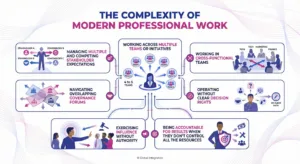
- Working across multiple teams or initiatives – most professionals now work on 4 to 5 teams.
- Managing multiple and competing stakeholder expectations
- Working in cross-functional teams
- Navigating overlapping governance forums
- Operating without clear decision rights
- Exercising influence without authority
- Being accountable for results when they don’t control all the resources needed to deliver them
An employee may formally report to one manager yet effectively serve several product leaders, regional heads, and functional owners. The result feels the same as a classic matrix: ambiguity, competing goals and complexity.
This broader definition matters because many organizations claim they have “removed” the matrix while employees still experience it daily. The issue is not reporting lines alone. It is how power and accountability are distributed. Indeed in our matrix management workshops we often explain that structure is a distraction because it is not how things really get done in a matrix. When we obsess over reporting lines we are focused on power, ownership and control – not the best way to get things done and engage people in a modern organization.
Are companies really eliminating the matrix?
Public statements often suggest they are. The reality is otherwise.
Across industries, true matrix elimination is exceptionally rare. Even the most radical restructurings retain some form of multi‑dimensional coordination. The reason is simple: scale and complexity demand flexible integration. So long as your organisation must combine the existence of functions (which exist everywhere as a base), geography, and /or some kind of business unit structure such as customer segments, traditional business units, technology groupings or whatever – then you live in a world that demands the flexibility to balance these multiple perspectives – that’s what the matrix does.
Take Novartis. In 2022, the company integrated its Pharmaceuticals and Oncology divisions into a single Innovative Medicines unit. This was widely described as simplification. Yet Novartis did not remove functional oversight, global development governance, or regulatory coordination. Instead, it clarified commercial P&L ownership while retaining strong centralized control where needed.
Similarly, when Microsoft announced its “One Microsoft” reorganization, it did not abolish cross‑functional collaboration. It replaced fragmented divisional P&Ls with a more centralized, functionally led operating model, within which cross-functional collaboration became even more important. The matrix was not eliminated; it was rebalanced.
What companies are doing is not elimination of the whole matrix operating system. It is a simplification.
The structural components of matrix simplification

Matrix intensity refers to how many dimensions have real decision‑making power.
In a high‑intensity matrix, geography, function, and product all hold comparable authority. Each can block decisions. Each controls resources. Accountability is shared, which often means diluted.
In a reduced‑intensity matrix, one axis becomes primary. Other dimensions still exist, but their role changes.
It is rare that functions are combined or reduced in number, though their status may change.
| Dimension | High‑intensity matrix | Reduced‑intensity matrix |
| Business unit | One of many voices | Final owner |
| Geography | Co‑equal authority | Execution and compliance |
| Function | Resource controller | Standards and capability |
| Governance | Multiple approvals | Clear escalation paths |
This is the pattern we see repeatedly in our work.
A matrix simplification may also involve reducing the number of entities in one of the axes, for example moving from a country to a regional structure or merging business units. In this wave of simplification, business lines seem to be taking more control.
Also note that giving a business unit primacy in a decision does not mean that they decide in isolation, for most it means that in an impasse they get the “casting vote”. It remains to be seen, and will need to be worked through, how this works out in practice.
Both of these simplifications act to increase the power of the vertical at the expense of the horizontal. There are fewer, more powerful vertical entities.
Why are companies choosing one dominant axis in the matrix?
Three forces explain this shift.
- First, speed. Citi’s 2023–2024 restructuring explicitly targeted decision delays caused by regional overlays. By removing layers and having business heads report directly to the CEO, Citi reduced the number of internal handoffs required to act.
- Second, accountability. Unilever’s move to five global business groups gave category leaders end‑to‑end P&L responsibility. Previously, performance was negotiated across regions and functions. After the change, it became owned.
- Third, cost. Philips, facing operational challenges, moved 90% of R&D resources directly into business units. This was not just about innovation proximity. It was about eliminating duplicated priorities and overhead created by competing central and regional agendas.
Across cases, their message is consistent: they believe that clarity outperforms balance.
Insight – choosing to vest decision rights more firmly in the vertical axis of the organisation at the same time that more work flows horizontally across the organisation, is likely to produce tensions with vertical decision making improving and horizontal decision-making getting more difficult
What happens to leadership and management in a simplification exercise?
What is the evidence for delayering and increasing spans of control?
- Gallup research shows that the average span of control in the U.S. increased to ~12.1 direct reports in 2025, up from ~10.9 in 2024, representing around a 50% increase compared with 2013 levels.
- Importantly, the median span remains much lower (about 5–6), indicating that the rise in the average is driven largely by a growing minority of very large teams, not a uniform increase across all managers.
- Executive structure studies show firms eliminating intermediate roles (e.g., reduced COO positions) and broadening CEO spans of control, implying fewer layers between top leadership and the front line.
- Labour‑market data (e.g., job‑posting analyses) show a large decline in middle‑management hiring since 2022.
Why is delayering happening?
- Technology adoption and improved information flows create the ability to operate with fewer hierarchical layers.
- Broader management theory documents a shift toward less hierarchical organizational forms, where authority and coordination are distributed more widely rather than layered vertically.
- Managers are expensive and delayering cuts labour costs.
What are the positives of delayering and wider spans of control?
- Flatter structures can speed up decision‑making and improve agility, because information and approvals travel through fewer layers.
- Wider spans may increase employee autonomy and empowerment, which is associated in organizational research with higher motivation and engagement. Note – this does not happen automatically we need to accompany delayering with actively delegating control.
- Engagement can be sustained under the right conditions
- Gallup’s large‑scale meta‑analysis (92,000+ teams) shows that high engagement teams perform well regardless of team size, while low‑engagement teams struggle even when small.
- Flat structures grant greater participation and autonomy. Autonomy is linked to higher engagement and productivity
- Manager behaviours matter more than span size: giving meaningful weekly feedback strongly predicts engagement, even in larger teams.
Key positive insight: wider spans can work when engagement practices, coaching, and feedback are strong. All of these rely on quality of leadership.
What are the negatives and risks of delayering and wider spans?
Larger spans do not automatically improve performance. Nearly all managers today (97%) still do individual contributor work; when this exceeds a certain level (estimated at ~40% of their time, their ability to lead larger teams deteriorates.
- Consulting and practitioner research cited notes that beyond certain thresholds (often ~7–10 direct reports, depending on complexity), managers struggle to provide coaching and feedback, weakening leadership quality.
- Expanded spans are associated with higher stress and lower job satisfaction among managers, especially when role demands rise and support is insufficient.
- When managers are overloaded, employee engagement tends to fall, even if the structure is flatter.
- McKinsey have written on how to find the right span of control for your context. work complexity matters: roles requiring frequent interaction, judgement, or development support are less tolerant of wide spans.
- Research shows an “inverted‑U” relationship between span size and performance: spans that are too narrow or too wide can both be sub‑optimal.
Insight – the benefits of delayering and increasing spans of control are conditional: flatter structures can improve agility, autonomy, and efficiency, but only if our managers are able to cope and continue to manage.
What else needs to happen for the new simplified matrix to succeed?
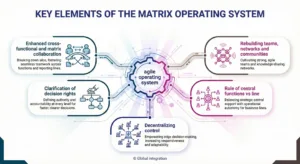
If the hard structure changes this provides a new framework for control and resource allocation, but within this we need to refine our matrix operating system, the skills and rules of management and collaboration to fit.
What is happening to the amount of cross-functional collaboration?
The Chartered Institute of Personnel and Development (CIPD) provides one of the strongest multi‑year data points showing that cross‑functional collaboration increased over time, not just in general collaboration.
- CIPD’s 2021 People Profession Survey found that around seven in ten professionals work collaboratively across business functions to meet business needs.
- In CIPD’s 2022 follow‑up research, professionals reported that cross‑functional collaboration increased compared with pre‑pandemic levels, driven by more structured cross‑functional touchpoints and communication.
- The same report explicitly states that despite decreased in‑person working, collaboration—including cross‑functional collaboration—had increased, with respondents noting stronger partnerships across functions than before the pandemic.
Cross‑functional collaboration has accelerated due to digital transformation?
The focus of the ResearchGate‑indexed study is digital transformation, it provides direct evidence that cross-functional collaboration requirements have increased as digital transformation accelerates, which itself has intensified over the past decade.
- The research concludes that increases in digital transformation efforts require expanding collaboration among IT, HR, Operations, Marketing, Finance and R&D, demonstrating that cross‑functional collaboration has become increasingly necessary over time.
- It describes a growing organizational shift where cross‑functional contact is now essential to meet emerging technological demands, suggesting a rising trend over time.
Gartner reports 84% of marketers experiencing high “collaboration drag” from cross-functional work (meetings/feedback/unclear decision rights). This is useful for “how much cross-functional work exists,” but it does not establish change over time by itself.
So although matrix structures are becoming simpler, the amount of collaboration that cuts across the organisation is increasing rapidly. Cross-functional collaboration is now the norm and we need to build the capability for this.
How do the new rules need to be negotiated?
Simply changing reporting lines and numbers of managers does not automatically change ways of working. We need to work through a series of challenges to clarify how the structure works in practice. For example
- It is easy to announce one axis has primacy – but what does this mean in practice for decisions that are impacted by functional exercise? For example will the business line have the final say on risk, legal compliance or labour law issues?
- If the power of a business line becomes primary at the same time that most work is cross-functional, how will differences of opinion and resource allocation be negotiated.
- How will we rebuild the teams, networks and communities that actually get things done across the new structure?
- How will the central functions manage their relationship with the matrix and exercise influence across the new fault lines. If each business line has primacy, how will global functions navigate providing global service? Their matrix management skills need to step up a level.
- Having fewer numbers and levels can improve empowerment only if control is then actively pushed further down the organization, if not the smaller numbers of managers become bottlenecks and slow the process down.
- Clear single authority over a business area can lead to siloed behaviour
Changing the structure is challenging but only the start of years of detailed work making this actually operate smoothly.
How has the consumer goods sector simplified the matrix in practice?
Consumer goods companies offer some of the clearest examples.
- Unilever’s shift to category‑led business groups replaced a geography‑heavy matrix with global category primacy. Regions retained responsibility for execution and market adaptation, but strategic control moved decisively to category leaders.
- Procter & Gamble followed a similar path earlier, reducing the number of business units and expanding end‑to‑end accountability within them. Over time, this reduced the power of regional and functional veto points.
Global brands became easier to manage because ownership was clear. Trade‑offs were made once, not negotiated endlessly across markets.
What about banks, where regulation could make simplification harder?
Banking shows how matrix reduction works under constraint.
- Citi’s restructuring removed regional management layers that historically held P&L influence. These were replaced with a single international governance role focused on compliance and local requirements rather than commercial control.
- HSBC followed a similar logic by consolidating governance under a tighter Group Operating Committee and reducing matrix governance structures. Sector teams were streamlined, and accountability was clarified.
In both cases, geography did not disappear. It was repositioned. Regulatory compliance remained central, but strategic authority shifted to business segments.
This distinction explains why banks talk about “simplification” rather than “de‑matrixing.” They cannot remove dimensions, but they can rebalance power.
How have technology companies approached matrix reduction?
Technology firms have simplified through product and platform ownership.
- IBM’s spin‑off of Kyndryl removed an entire axis of complexity. By separating infrastructure services, IBM reduced internal competition for capital and focus. What remained was a clearer hybrid cloud and AI strategy with simplified accountability.
- Intel’s separation of Foundry as an independent subsidiary followed a similar logic. Manufacturing and design had long been locked in a complex internal matrix. Creating distinct P&Ls reduced friction, even though performance challenges remained.
- Amazon and Google took a different route. Rather than structural separation, they flattened layers, reduced overlapping responsibilities, and reinforced single‑threaded leadership. Again, the matrix was not eliminated. It was weakened.
Does reducing matrix intensity actually improve performance?
Performance data suggests correlation, not simple causation.
Citi achieved positive operating leverage across all major segments after its restructuring. Unilever saw improved volume growth following its category shift. Philips experienced a significant share price recovery after clarifying end‑to‑end business accountability.
However, simplification rarely works alone. In almost every case, it coincided with portfolio pruning, cost reduction, or strategic refocus. Bayer’s Dynamic Shared Ownership model, for example, combined radical delayering with new ways of working.
The lesson is not that matrix reduction guarantees success. It is that without it, execution improvements can be harder to achieve.
What typically disappears when matrix intensity is reduced?
Across cases, several patterns repeat.
- Regional approval layers shrink. In Citi and HSBC, regions lost strategic veto power. They became execution and compliance entities.
- Dual P&L ownership fades. Unilever’s categories and Novartis’s commercial units gained clear financial accountability.
- Governance forums collapse. Bayer famously eliminated hundreds of internal documents as part of its reset, signalling a move away from bureaucratic coordination.
What does not disappear is cross‑functional collaboration. Central functions remain critical and may even become more global during matrix simplification. Their authority simply changes form.
How can leaders diagnose excessive matrix intensity?
Leaders often underestimate how complex their own organization has become.
Useful diagnostic questions include:
- Who truly owns results?
- How many people must agree before action?
- Where do decisions stall most often?
- How much management time is spent aligning rather than executing?
If answers vary widely by audience, matrix intensity is likely too high.
What are the most common mistakes in “de‑matrixing”?
Several predictable errors recur.
Some organizations rename the matrix without changing goal setting, metrics and incentives. Others remove layers but leave decision rights ambiguous. Some centralize functions while still expecting them to deliver business outcomes. We need to address both the structural components and the soft operating system of the new matrix.
Successful examples—like Unilever or Citi—made explicit choices about power. They did not rely on charts alone.
What practical steps can leaders take?
Matrix reduction is not an all‑or‑nothing move.
Practical leadership checklist:
- Declare one primary axis of accountability.
- Remove co‑equal decision rights elsewhere and work through decision rights in detail.
- Delayer and increase spans of control whilst investing in leadership capability
- Redesign functions as governors and guardians of functional excellence.
- Simplify approval and control forums aggressively.
- Align incentives to single‑point ownership.
- Reinforce the logic consistently.
- Improve cross-functional collaboration capability and systems
These steps reduce friction without destabilizing operations.
Should companies stop talking about “getting rid of the matrix”?
Yes—because it obscures what actually works.
The most successful organizations do not eliminate complexity. They govern it asymmetrically. They accept that some dimensions must lead while others support. The matrix, in this form, does not disappear. It matures.
Final takeaway
- Matrix elimination is rare; matrix simplification can help.
- One dominant axis improves speed and accountability, potentially at the risk of silos remerging.
- Functions and geographies still matter, but differently.
- Simplification works best alongside strategic focus.
- Clarity beats consensus in volatile markets.
- Cross-functional collaboration is a core capability.
- Decision rights need to be negotiated across the matrix
- It is not enough to align the structure, we need to adapt our soft operating system in detail.
Matrix structures are not obsolete. However, we do seem to be in a period where simplifying the matrix by making choices on decision and accountability primacy are in fashion – perhaps as a response to geopolitical and technological uncertainty
The evidence from consumer goods, banking, technology, and life sciences show that performance can improve when accountability is clear, power is asymmetric, and coordination serves execution rather than making it more complex.
The question for leaders today is how much matrix intensity they can afford.
However, and this is a big caveat, by reinforcing vertical accountability and control at the expense of horizontal power we do risk recreating vertical silos – the whole reason matrix organisations were introduced in the past. Navigating this new balance of power will require the exercise of influence across the organisation and cross functional collaboration – despite the structure which may increasingly get in the way.
Time will tell. If you need to build cross functional capability or simplify your matrix way of working why not have a conversation with one of our specialists.

Explore our training programs to see how we can help.
Cross functional teams Training Agile & Digital Training Matrix Management Training People and purpose Training Virtual Teams TrainingEducate yourself further with a few more of our online insights:
30 years of experience learning with a range of world class clients
We work with a wide range of clients from global multinationals to recent start-ups. Our audiences span all levels, from CEOs to operational teams around the world. Our tools and programs have been developed for diverse and demanding audiences.

Tailored training or off the shelf modules for your people development needs
We are deep content experts in remote, virtual and hybrid working, matrix management and agile & digital leadership. We are highly flexible in how we deliver our content and ideas. We can tailor content closely to your specific needs or deliver off the shelf bite sized modules based on our existing IP and 30 years of training experience.
For more about how we deliver our keynotes, workshops, live web seminars and online learning.