How does stakeholder management work in a matrix organization?
Stakeholder management in a matrix organization—where people work across teams, functions, and geographies, often with multiple reporting lines—requires clarity, structured engagement, and influence without authority. This guide explains how to map stakeholders, prioritize engagement, and overcome common challenges, providing actionable tools and checklists for managers navigating today’s complex corporate environments.
What makes stakeholder management challenging in a matrix organization?
Matrix organizations are designed for agility and collaboration, but they introduce complexity. Employees may report to more than one manager and collaborate with diverse teams. This means stakeholders—anyone who can affect or is affected by your work—are more numerous and varied than in traditional hierarchies. Managing them effectively requires a structured approach to avoid confusion, conflict, and misalignment.
What is a matrix organization?
A matrix organization extends beyond just having more than one boss. It includes anyone working in multiple teams or with multiple stakeholders, as these individuals face similar challenges. This broader definition is crucial for understanding the stakeholder landscape. See our definitive guide on matrix management. See our comprehensive article on managing in a matrix
Why use a stakeholder power / interest grid?
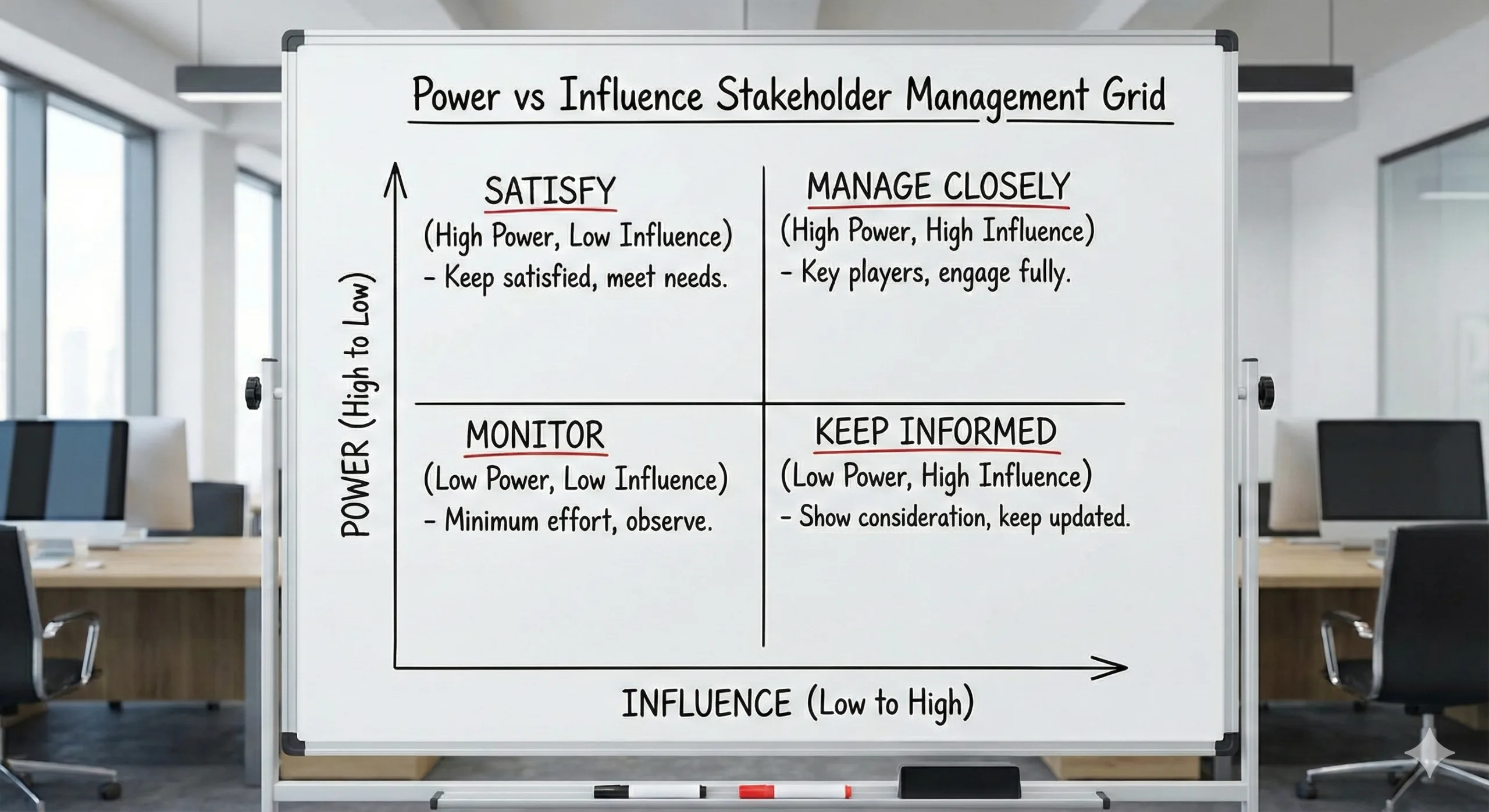
A stakeholder power interest grid is a visual tool that helps you map stakeholders based on their influence and interest. By categorizing stakeholders into four quadrants—manage closely, keep satisfied, keep informed, and monitor—you can tailor your engagement strategies and focus your efforts where they matter most. This approach reduces risk, clarifies communication, and ensures that key players are neither overlooked nor over-engaged.
How Does the Power interest grid?
| Influence/Power | High Interest | Low Interest |
| High | Manage Closely | Keep Satisfied |
| Low | Keep Informed | Monitor |
This table provides a quick reference for prioritizing stakeholder engagement.
How do you build and use a power interest grid?
1. Who are your stakeholders?
List everyone who has a stake in your project or team—bosses, peers, direct reports, clients, and external partners.
2. How do you assess influence and interest?
Evaluate each stakeholder’s power to affect outcomes and their level of interest in your work. Go speak to the ones where you do not know the answer.
3. How do you map stakeholders?
Place each stakeholder in the appropriate quadrant of the matrix.
4. What engagement strategies should you use?
- Manage Closely: Provide regular updates, involve in decisions, and seek feedback.
- Keep Satisfied: Offer concise updates and address concerns proactively.
- Keep Informed: Share progress and invite input where relevant.
- Monitor: Maintain minimal engagement, but don’t ignore these stakeholders.
5. How do you influence without authority?
Stakeholder management often requires influencing others without formal authority. Building trust, demonstrating expertise, and aligning interests are key. For more, see our detailed article on influence without authority.
6. How often should you review and update your matrix?
Stakeholder positions can shift as projects evolve. Revisit your matrix regularly to stay aligned.
What are the main challenges in matrix stakeholder management?
- Misaligned priorities or interest levels. Clarify positions early. Use tools like RACI matrices to define responsibilities.
- Communication overload: Streamline channels and tailor messages to each stakeholder group.
- Resource and expectation conflicts: Negotiate transparently and document agreements.
What Practical Tools and Checklists Can Managers Use?
Stakeholder Management Checklist
- Map all stakeholders and their influence/interest.
- Clarify your objectives and involvement rights and align with key players.
- Use the power interest grid to prioritize engagement.
- Get trained in and practice influence without authority.
- Communicate proactively and adapt your approach as needed.
- Review and update your stakeholder engagement plan regularly.
What Are the Key Takeaways for Matrix Leaders?
- Matrix environments multiply stakeholder complexity—structure is essential.
- The power interest grid is a powerful tool for clarity and focus.
- Proactive, tailored engagement prevents conflict and builds support.
- Influence without authority is the key skill.
- Regular reviews keep your strategy relevant as projects and people evolve. [
Where Can You Learn More?
- Mastering Stakeholder Management in Matrix Organisations
- Stakeholder Matrix: A Quick Guide With Free Templates
- For more on our influence without authority a and other matrix management training.
Who Is the Author?
Written by Kevan Hall. Matrix Management Expert, Author, and Corporate Trainer
“In today’s matrix organizations, the ability to manage stakeholders and influence without authority is not just a skill—it’s a necessity for success.” — Kevan Hall
Frequently Asked Questions (FAQ)
Q: What is a power interest grid?
A: It’s a tool for mapping stakeholders by influence and interest, helping managers prioritize engagement.
Q: How often should I update my stakeholder engagement plan?
A: Review it regularly—at least at major project milestones or when key stakeholders change.
Q: What if I have no formal authority over stakeholders?
A: Use influence strategies: build trust, communicate clearly, and align interests.
Practical Application Table
| Step | Action Item | Frequency |
| Identify stakeholders | List all relevant parties | Project start |
| Assess influence & interest | Evaluate and categorize | Project start |
| Map stakeholders | Place in power interest grid quadrants | Project start |
| Develop engagement strategies | Tailor communication and involvement | Ongoing |
| Review & update engagement plans | Adjust as projects and people evolve | Regularly |
Explore our training programs to see how we can help.
Cross functional teams Training Agile & Digital Training Matrix Management Training People and purpose Training Virtual Teams TrainingEducate yourself further with a few more of our online insights:
30 years of experience learning with a range of world class clients
We work with a wide range of clients from global multinationals to recent start-ups. Our audiences span all levels, from CEOs to operational teams around the world. Our tools and programs have been developed for diverse and demanding audiences.

Tailored training or off the shelf modules for your people development needs
We are deep content experts in remote, virtual and hybrid working, matrix management and agile & digital leadership. We are highly flexible in how we deliver our content and ideas. We can tailor content closely to your specific needs or deliver off the shelf bite sized modules based on our existing IP and 30 years of training experience.
For more about how we deliver our keynotes, workshops, live web seminars and online learning.