How can we reach alignment in a matrix organization: creating clarity, collaboration, and results?
Alignment in a matrix organization is both essential and challenging. Unlike traditional hierarchies, matrix structures require managers and teams to synchronize goals, decisions, and actions across multiple reporting lines, teams, and stakeholders both vertically and horizontally. Achieving “good enough” alignment—where everyone reasonably understands the purpose, strategy, and priorities, and can act without waiting for perfect clarity—is the key to unlocking agility, innovation, and strategic execution. This blog explores why alignment matters, the unique challenges of matrix environments, and practical steps for managers to foster clarity, collaboration, and results.
What is alignment in a matrix organization—and why does it matter?
Alignment means that all elements of the organization share a clear understanding of its purpose, culture, and strategy. In matrix organizations, this goes beyond vertical alignment (top-down) to include horizontal alignment—across teams, functions, geographies, and projects. When individual strategies, actions, and decisions synchronize with organizational purpose, people pull in the same direction, reducing waste, duplication, and conflict.
Key benefits of alignment:
- Improved strategic execution.
- Faster, better decision-making
- Enhanced employee communication
- Reduced duplication and resource disputes
- Increased productivity and engagement
Table: Alignment vs. Agility in Matrix Organizations
It can be challenging to combine alignment and agility at scale across an organization because alignment prioritizes clarity and agility prioritizes flexibility. It is hard to have both clarity and flexibility at the same time.
| Alignment | Agility |
| Shared understanding of goals | Rapid adaptation to change |
| Synchronized action | Flexibility in execution |
| Clear priorities | Empowered teams |
| Reduced duplication | Innovation through diversity |
Why is alignment in a matrix organization difficult?
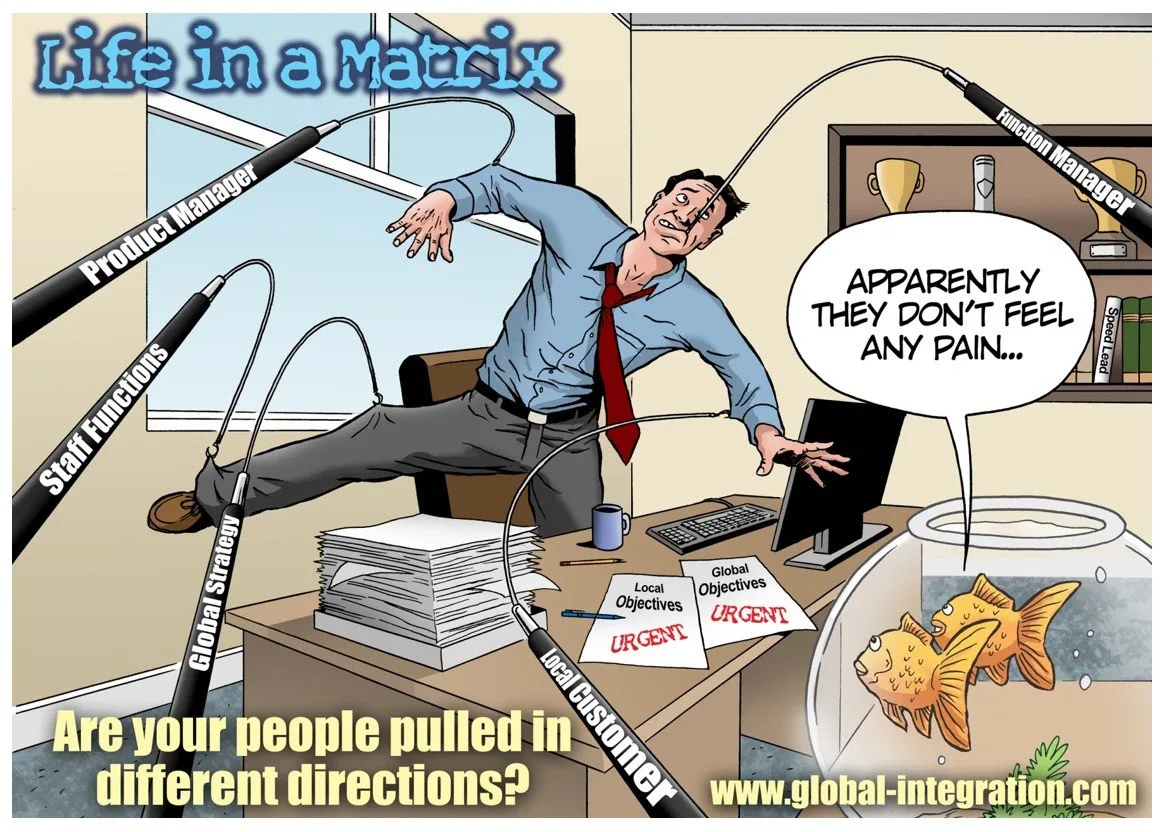
Matrix organizations are dynamic, they are intended to reflect different priorities, business interests, and perspectives. They are designed for flexibility and collaboration, but this creates complexity. Employees often report to multiple managers, work across several teams, and face competing demands. Unlike traditional structures, where clarity can be cascaded from the top, matrix environments require ongoing negotiation and realignment both vertically and horizontally.
Imagine the complexity of a large organization aligning perfectly vertically through the functions and geographies and horizontally through cross-functional teams, business units, customer segments etc. Now imagine that priorities or plans change – do we go back and realign everything? In practice we will always have a certain level of misalignment in complex multi-dimensional organizations, waiting for perfect alignment is usually not an option.
Common challenges in matrix alignment:
- Competing priorities: Multiple sets of objectives from different reporting lines, teams, and stakeholders often without clear mechanisms for resolution
- Role ambiguity: Unclear, competing, or conflicting goals, roles, and responsibilities, leading to confusion and slow decision-making.
- Resource misallocation: Goals set without full understanding of team capacity across matrix commitments.
- Diminished engagement: Teams feel disconnected from goal setting, weakening commitment to outcomes.
- Implementation gaps: Leadership may set targets without having understood cross-functional constraints or competing initiiatives.
- Alignment passivity: teams or individuals using a lack of perfect alignment to excuse not making progress, rather than actively pursuing, and accepting good enough alignment.
Statistic:
A recent MIT Sloan Management Review study found that actual strategic alignment among employees, managers, and executives was two to three times lower than perceived alignment. In other words, many organizations think they are aligned, but different people have widely different understandings.
How much alignment is “enough” before acting?
Perfect clarity and alignment are myths in complex, matrixed environments. The pursuit of absolute clarity can consume resources and slow decision-making. Organizations benefit more from “good enough” alignment that enables action, rather than waiting for every ambiguity to be resolved. Accepting a degree of uncertainty allows teams to move forward and adapt as circumstances change.
Checklist: Signs you have too little alignment
- Silo behavior
- High levels of escalation
- Gaps, overlaps, or duplication in work.
- Resource disputes
- Unsynchronized processes
- Conflicting goals, metrics, and incentives
- Slow decision-making
- Constant change in prioritization
What are the main causes of misalignment in a matrix organization?
- Multiple reporting lines: Employees may have solid-line and dotted-line managers, and multiple teams and stakeholders each with their own priorities.
- High rate of change: Goals can quickly become outdated as business needs evolve.
- Complex environment: Teams span functions, geographies, and business units, each with unique perspectives.
- Limited time together: Virtual and hybrid teams have less face-to-face time to achieve clarity.
Expert quote: “Ever since we introduced the matrix, I spend most of my time in alignment meetings. That cannot be right, can it?” — Marketing Director, Packaged goods, USA quoted in Making the Matrix Work
How can managers create clarity and alignment in a matrix team?
- Define roles and responsibilities:
Use frameworks like RACI (Responsible, Accountable, Consulted, Informed) at a high level to clarify who does what. But also help people become comfortable with ambiguity and accountability without control. - Encourage ownership:
Empower team members to proactively clarify their own goals, roles, and priorities. Build “enterprise thinking” so they understand interdependencies with others. - Regular alignment meetings:
Use structured check-ins to resolve conflicts and manage expectations before they become roadblocks. - Initiative alignment groups:
Executive teams should coordinate major projects to avoid overload and ensure effective resource allocation. Ask “how much change can the organization deliver.” - Clarify decision rights:
Push decisions as close to the action as possible. Use frameworks like the ADC (Aligned, Different, Conflict) tool to focus discussions and speed up resolution. - Foster a collaborative culture:
Promote focused collaboration (not everyone being involved in everything, open communication, and a shared sense of purpose. Recognize and reward collaborative efforts. - Invest in talent development:
Provide training, mentoring, and forums for sharing best practices in matrix management.
What does recent research say about alignment in a matrix organization?
- McKinsey’s Organizational Health Index: Clear and accountable roles are among important drivers of organizational health. Role ambiguity is a common problem in matrix organizations, impacting engagement and performance.
- MIT CISR: High-performing matrix organizations clarify decision rights, standardize collaboration, and invest in shared digital information. Decision rights outrank reporting lines—clarity fixes more than 50% of friction.
- Harvard Business Review: Actual strategic alignment is often much lower than perceived. Leaders must focus strategies on driving customer value, weave those strategies into daily work, and develop priorities through collaborative dialogue.
What are the best practices for achieving alignment?
- Align structure with strategy: Facilitate execution of strategic initiatives and adaptability to market changes.
- Communicate a shared vision and purpose: Articulate mission, values, and goals. It is not enough to circulate a PowerPoint deck; this requires conversations and linking strategy to individuals’ day to day goals.
- Define “clear enough “roles and responsibilities: Specify decision-making authority and expectations for collaboration but set the expectation that things will change and the capability to respond flexibly.
- Establish decision-making processes: Create frameworks, decision and involvement rights and escalation paths for cross-functional collaboration.
- Create escalation and conflict resolution processes: Designate leaders or teams as arbitrators. Enable and empower autonomous teams to handle more issues for themselves.
- Foster a collaborative culture: Encourage focused collaboration and open communication.
- Invest in talent development: Provide training and support for matrix management skills.
- Continuously monitor and adapt: Track metrics and proactively adjust.
Named models and frameworks:
- McKinsey 7-S Model: Aligns strategy, structure, systems, skills, staff, style, and shared values for organizational effectiveness.
- ADC Framework: Identifies where the team is Aligned, Different, or in Conflict to focus discussions and speed up resolution.
How can managers balance alignment and agility?
Alignment is essential for coordinated action, but too much alignment can stifle agility and innovation. “Healthy misalignment”—where diverse perspectives and constructive conflict are encouraged—can be a source of strength. Managers should aim for “good enough” alignment, using agile practices like regular stand-ups, Kanban boards, and visual tools to maintain alignment while celebrating course corrections.
Key takeaways:
- Alignment in a matrix organization is a continuous process, not a one-time event.
- “Good enough” clarity enables action and adaptation.
- Decision rights and accountability frameworks are critical.
- Collaboration and communication are the foundation of success.
- Managers must balance alignment with agility to drive innovation and results.
Internal and external links for further reading
- Matrix Management: The Definitive Guide for Modern Organizations – Global Integration
- Making the Matrix work – book
- The Cascade-First Paradox: Rethinking Goal Alignment in Matrix Organizations – Caldwell Allen Consulting
- Is Your Company as Strategically Aligned as You Think It Is? – Harvard Business Review
- The McKinsey 7-S Model for Organizational Alignment and Success – TSI
Author:
Author:
Written by Kevan Hall. Matrix Management Expert, Author, and Corporate Trainer
Explore our training programs to see how we can help.
Cross functional teams Training Agile & Digital Training Matrix Management Training People and purpose Training Virtual Teams TrainingEducate yourself further with a few more or our online insights:
30 years of experience learning with a range of world class clients
We work with a wide range of clients from global multinationals to recent start-ups. Our audiences span all levels, from CEOs to operational teams around the world. Our tools and programs have been developed for diverse and demanding audiences.

Tailored training or off the shelf modules for your people development needs
We are deep content experts in remote, virtual and hybrid working, matrix management and agile & digital leadership. We are highly flexible in how we deliver our content and ideas. We can tailor content closely to your specific needs or deliver off the shelf bite sized modules based on our existing IP and 30 years of training experience.
For more about how we deliver our keynotes, workshops, live web seminars and online learning.