Global leadership: balancing control and empowerment in complex teams
Global leadership is the ability to deliver results across distance, cultures, time zones, and organizational boundaries, often without relying on direct authority. It demands a shift from control-based management to influence-driven leadership, where outcomes depend on collaboration, clarity, and trust rather than proximity or hierarchy. This article explores why global leadership is a challenge in complex organizations, why the problem persists, and what effective leaders do differently.
Executive summary: why global leadership breaks down in complex organizations
Global leadership is consistently undermined by five structural barriers that leaders cannot remove through effort or experience alone. Distance limits visibility and connection. Cultural differences distort intent and expectations. Time zones fragment decision-making and collaboration. Technology mediates relationships rather than strengthening them. Organizational boundaries dilute accountability.
These challenges persist because many leadership models still assume physical proximity, shared context, and formal authority. In contrast, effective global leaders work through influence, design for ambiguity, and deliberately balance control with empowerment. They shift their attention from managing people to enabling systems of collaboration that function across complexity.
Why is global leadership so hard in modern organizations?
Global leadership does not fail because leaders lack commitment or capability. It fails because the operating environment has fundamentally changed.
Global leaders today are expected to:
- Lead global virtual teams with limited opportunities to get face-to-face
- Be accountable for results without direct control over resources
- Influence colleagues who do not report to them
- Navigate a global matrix or network organization
- Manage across cultures and time zones
- Work primarily through technology rather than shared physical space
These conditions are no longer exceptional. They are now the default context for leadership effectiveness.
To understand why global leadership remains so challenging, it is useful to examine the five key barriers to global leadership success.
What are the five key barriers to global leadership success?
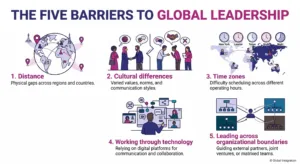
1. How does distance undermine global leadership?
Distance reduces more than physical proximity. It weakens shared understanding, informal learning, and trust.
When leaders rarely meet their teams face-to-face, they lose access to:
- Informal conversations that surface risks early
- Contextual cues that clarify intent and build trust
- Opportunities to build personal credibility
- Visibility on performance
As a result, global leaders often overcompensate by increasing control. They add more meetings, more reporting, and more oversight. Ironically, this creates friction rather than alignment and slows delivery rather than accelerating it.
Effective global leadership does not attempt to eliminate distance. Instead, it accepts distance as a constraint and designs leadership practices that work despite it.
2. Why do cultural differences complicate leadership decisions?
Managing across cultures is not simply about national differences. It includes professional identities, functional cultures, and organizational norms that shape how people interpret leadership behavior.
In global environments, leaders routinely face situations where:
- Agreement does not mean commitment
- Silence does not mean consent
- Directness may be seen as clarity or disrespect
- Status may be given and expressed differently
- Language difficulties can dilute communication clarity
Without a shared cultural frame, even well-intentioned leaders can misread signals and unintentionally erode trust.
Global leadership therefore requires more than cultural awareness. It demands cultural adaptability: the ability to adjust leadership style without losing consistency or credibility.
How do time zones disrupt accountability and momentum?
Time zones fragment work in ways that traditional leadership models are not designed to handle.
When teams are distributed globally:
- Decisions stretch across days rather than hours
- Urgent issues escalate unpredictably
- Accountability becomes diffuse
Leaders are often held responsible for outcomes that depend on colleagues who are offline, unavailable, or operating under different priorities.
This creates a tension between control and empowerment. Too much control creates bottlenecks. Too much empowerment without clarity creates misalignment.
Strong global leadership focuses on decision clarity, not decision centralization.
4. Why does working through technology weaken leadership impact?
Technology is essential to global leadership across distance, but it also introduces friction.
Leaders are expected to:
- Create engaging communication through digital channels
- Run effective online meetings with diverse groups, often in a hybrid meeting
- Maintain visibility without micromanaging
- Build relationships without physical presence
- Overcome potential proximity bias
However, technology strips away context. Messages become easier to misinterpret. Meetings become transactional. Participation becomes uneven.
Global leadership effectiveness depends on how leaders use technology, not how much they use it. Participative online meetings, deliberate communication design, and consistent rhythms matter more than tools.
5. How do organizational boundaries limit leadership authority?
Global leaders rarely operate within a single reporting line. Instead, they work across:
- Matrix structures
- Networked organizations
- Multiple teams and stakeholders
They are expected to deliver results without direct authority over resources, priorities, or performance management.
This is where many leadership models fail. They assume authority is the primary lever for accountability. In global organizations, influence replaces authority as the dominant leadership mechanism.
This challenge sits at the heart of our guide to managing in a matrix organization, where leadership effectiveness depends on clarity, alignment, and trust rather than position.
What makes global leadership different from traditional leadership?
Traditional leadership models assume:
- Clear hierarchy
- Stable teams
- Shared context
- Physical proximity
Global leadership operates under the opposite conditions.
Leaders must influence without authority, align without control, and deliver results through systems they do not own. Attempting to lead global teams using authority-based approaches creates friction, resistance, and slow execution.
Effective global leadership is therefore not about doing more. It is about leading differently.
How do effective leaders balance control and empowerment globally?
The central tension in global leadership is control versus empowerment.
Too much control creates dependency, disengagement, and delays. Too much empowerment without structure creates inconsistency and risk.
High-performing global leaders resolve this tension by shifting focus from people to conditions.
They invest time in:
- Clarifying outcomes rather than prescribing methods
- Defining decision rights rather than approving decisions
- Establishing shared principles rather than enforcing rules
- Building trust
- Developing global leadership skills
This approach enables speed without sacrificing alignment.
What leadership behaviors support global leadership effectiveness?
Global leaders who succeed are explicit about:
- What success looks like
- Where decisions sit
- How conflicts are resolved
They reduce ambiguity where it matters and tolerate it where it does not.
Clarity replaces control as the primary coordination mechanism.
How do leaders build influence without authority?
Influence in global leadership is earned through:
- Consistency of intent
- Reliability of follow-through
- Fairness across boundaries
Leaders who rely on positional power quickly lose credibility in matrix and virtual environments. Those who invest in relationships and mutual accountability gain discretionary effort. See our detailed guide on influence without authority
This challenge directly connects to the discipline of virtual team working, where leadership visibility and trust must be built deliberately rather than assumed.
How do leaders run participative online meetings?
Participative online meetings are not about engagement for its own sake. They are about ownership.
Effective global leaders:
- Design meetings around decisions, not updates
- Encourage contribution across time zones
- Use structure to balance voices
- Close meetings with explicit commitments
This turns meetings from coordination overhead into leadership leverage. See more on running fewer, better meetings
How do leaders cut through complexity to deliver results faster?
Complexity slows organizations when leaders attempt to manage it centrally.
Global leaders accelerate delivery by:
- Simplifying interfaces between teams
- Reducing dependencies where possible
- Making escalation safe and early
- Accepting that progress is non-linear
They focus less on control mechanisms and more on flow.
Why does this challenge persist despite experience?
Many global leaders have decades of experience yet still struggle. The reason is not individual capability. It is systemic misalignment.
Organizations often promote leaders based on success in environments that reward control, presence, and authority. Those same behaviors fail in global, matrixed, and virtual contexts.
Without structured development, leaders are left to learn through trial and error, often at the cost of performance and engagement.
A consultative next step for leaders and L&D teams
If your organization expects leaders to deliver results across global, matrixed, or virtual environments, this tension between control and empowerment cannot be left to chance.
Structured leadership development helps leaders:
- Shift from authority-based habits to influence-based behaviors
- Build clarity and accountability without adding friction
- Lead confidently across distance, cultures, and boundaries
Exploring a global leadership development pathway or speaking with a leadership training advisor can help translate these challenges into practical capability at scale.

Explore our training programs to see how we can help.
Cross functional teams Training Agile & Digital Training Matrix Management Training People and purpose Training Virtual Teams TrainingEducate yourself further with a few more of our online insights:
30 years of experience learning with a range of world class clients
We work with a wide range of clients from global multinationals to recent start-ups. Our audiences span all levels, from CEOs to operational teams around the world. Our tools and programs have been developed for diverse and demanding audiences.

Tailored training or off the shelf modules for your people development needs
We are deep content experts in remote, virtual and hybrid working, matrix management and agile & digital leadership. We are highly flexible in how we deliver our content and ideas. We can tailor content closely to your specific needs or deliver off the shelf bite sized modules based on our existing IP and 30 years of training experience.
For more about how we deliver our keynotes, workshops, live web seminars and online learning.