Decision making in a matrix – does it have to be so slow?
Matrix organizations are designed for flexibility and collaboration, but decision making in a matrix often becomes slow, ambiguous, and frustrating. This blog unpacks the root causes of “decision drag” in matrix environments, shares proven frameworks (RAPID, RACI, OODA, Pre-Mortem), and provides actionable strategies for leaders to clarify decision rights, reduce stakeholder bloat, and build a faster, better decision culture for 2026 and beyond.
Why is decision making in a matrix organization so challenging?
Matrix organizations promise flexibility, cross-functional collaboration, and rapid response to change. Yet, matrix decision making comes with persistent challenges that undermine speed and quality of decisions:
- Unclear Decision Rights: Authority and workflows are distributed across functions, regions, and projects, blurring the line between input and approval authority. This creates governance vacuums and decision churning.
- Stakeholder Bloat: Excessive involvement leads to watered-down outcomes and slow progress. Decision velocity and quality drops as group size exceeds about seven participants.
- Chronic Revisiting: Decisions are reopened repeatedly, eroding trust and momentum.
- Information Overload: Managers spend more time gathering data than making decisions, leading to analysis paralysis.
- Cognitive Biases: Confirmation bias, sunk cost fallacy, anchoring, and overconfidence distort judgment.
- Data Trust Gap: Reluctance to trust algorithmic recommendations slows adoption of decision intelligence tools.
See more about the challenges of matrix management in our comprehensive guide to matrix management or in our book Making the Matrix work.
How can leaders clarify decision rights in a matrix?
Why is clarity of decision rights so critical?
In our matrix workshops, a recurring issue is the lack of clarity about who should be involved in matrix decisions, the process to be followed and who gets to make the final decision.
Because of the interconnected nature of the matrix potentially many people can be involved in some way in decisions, and everyone has an opinion. Without clarity on decision rights, too many people get involved, and the process becomes slow and bureaucratic.
Organisations use processes like ARCI (or RACI) to help clarify decision rights, and adding a “D” for decision maker can further sharpen accountability. Unfortunately conducting a full racy analysis is extremely time consuming and bureaucratic and so it is rarely possible.
What are the four main ways decisions are made in a matrix?
| Decision Type | Who Decides? | Basis | Example | |||
| Boss’s Decision | Leader | Authority | CEO makes a strategic call | |||
| Collegiate Decision | Leader after consult | Authority + Input | VP consults team, then decides | |||
| Empowered Individual | Expert/Owner | Expertise/Role | Product manager owns feature call | |||
| Collective Decision | Group | Consensus/Voting | Cross-functional project team | |||
- In a healthy matrix, decision making should flow to those with the expertise, not just positional authority.
- Without clarity, organizations often default to collective decision making, which is slower and more complex. This is particularly prevalent in consensus oriented corporate and national cultures or where people feel unable to have the tough conversations that tell people, “You are not the decision maker.”
- Sometimes consensus is needed, but often empowered individuals can act faster and better. Expert quote Kevan Hall, “It cannot be right that the average of the views of the one person who does know and the six who do not is the way the decisions are taken!”
Why does stakeholder bloat slow down decision making in a matrix?
What is stakeholder bloat and why does it matter?
As organizations emphasize inclusion, teamwork, democracy and risk mitigation, the number of people in decision meetings balloons. Beyond 5–7 participants, each additional person adds complexity but little insight. The result is “death by committee,” where decisions are watered down and progress stalls.
Most research and practitioner advice converge on the idea that decision-making groups should be kept lean—ideally under seven people—to maximize quality, speed, and engagement.
How can you reduce stakeholder bloat?
- Apply the Vroom-Yetton model to determine who really needs to be involved.
- Use Amazon’s “Two-Pizza Rule”: Teams should be small enough to be fed by two pizzas.
- Limit decision teams to under seven participants and avoid unnecessary pre-meeting meetings.
How can you prevent chronic revisiting of decisions in a matrix?
Why do decisions get revisited so often?
Chronic revisiting occurs when decisions are officially made but not psychologically or politically committed to. This erodes trust and creates “zombie decisions”—initiatives that shuffle forward without real support.
It may also happen when people make a decision, they did not have the right to make, or where they have failed to consult with the right stakeholders in advance.
What are practical steps to improve decision velocity?
- Establish a “disagree-and-commit” culture: Debate before the decision, but unity after.
- Use Amazon’s One-Way vs. Two-Way Door framework to distinguish reversible from irreversible decisions.
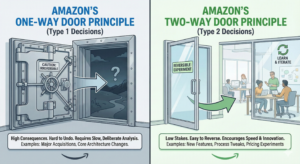
- Keep a decision log and set “tripwires” for revisiting only when significant new information emerges. Review this decision log for any decisions that are revisited to see if there is underlying root cause.
How Do You Cut Through Information Overload?
Why is information overload such a problem?
In 2026, the challenge for middle managers has shifted from obtaining data to curating it. We can generate a 15-page report in seconds from AI on any topic we choose. The challenge now is to ask the right questions, and to make sense of the mass of information we get as an answer which may be of very valuable quality.
Managers also often use data as a “shield” to justify a pre-decided path, rather than a “lamp” to find a new one.
What are the solutions to information overload?
- Design dashboards for clarity, not just volume.
- Apply the Cynefin framework (link below) to categorize problem complexity.
- Use the Pareto principle: Focus on the 20% of data that drives 80% of value.
- Train managers in query design—asking the right question before looking at the dashboard.
- Train managers in dealing with too much collaboration in meetings and decisions as part of our matrix management course.
How can teams mitigate cognitive biases in decision making?
Cognitive bias is a mental shortcut or pattern that causes people to think or make decisions in ways that are not always logical or accurate. These biases can lead us to misinterpret information, overlook facts, or make poor choices without realizing it.
What are the most common cognitive biases?
- Confirmation Bias: Seeking data that supports pre-existing beliefs.
- Sunk Cost Fallacy: Continuing to invest in a losing proposition because you have already spent a lot on it, even though future prospects do not justify further investment.
- Anchoring: Relying too heavily on the first piece of information you see to set the baseline or direction of your thinking.
- Overconfidence: Assuming timelines and synergies will be met without evidence.
How can you address these?
- Use Pre-Mortem Analysis: Imagine failure before it happens to expose risks.
- Encourage Red Teaming: Assign a group to challenge the prevailing consensus.
- Train teams to recognize biases and encourage devil’s advocacy in meetings.
What is the human-data trust gap in decision making in the matrix and how do you bridge it?
Why are managers reluctant to trust AI in decision making?
Despite the availability of advanced AI tools, leaders often hesitate to cede agency to algorithms. “Black box” anxiety means that even when AI generates a solution in seconds, teams spend weeks validating it, negating the speed advantage.
How can you build trust in AI?
- Start with AI support tools for routine decisions.
- Build trust through transparency—explain how recommendations are generated.
- Gradually delegate routine decisions to AI while maintaining human oversight.
What are the most common barriers to high-velocity decision making in a matrix?
| Rank | Challenge | Organizational Impact | Solutions & Core Models | Sources & Links |
| 1 | Ambiguous Decision Rights | “Decision Drag” stalls initiatives | RAPID, RACI | Bain RAPID Model / Atlassian RACI Guide |
| 2 | Revisiting Syndrome | Team fatigue, loss of momentum | Type 1 vs. Type 2 Decisions | HBR: Stop Revisiting Decisions / AWS Decision Framework |
| 3 | Information Overload | “Analysis Paralysis” | Cynefin Framework, Pareto Principle | Cognitive Edge: Cynefin / What is data driven decision making IBM |
| 4 | Stakeholder Bloat | Watered-down consensus, slow progress | Rule of 7, Two-Pizza Rule | GITLAB: Decision Velocity |
| 5 | Cognitive Biases | “Throwing good money after bad” | Pre-Mortem, Red Teaming | McKinsey: Bias Guide for Leaders |
How can leaders build a high-velocity decision culture?
What practical steps can leaders take?
- Clarify roles and decision rights using RAPID or RACI.
- Keep decision teams lean (under 7 participants).
- Establish disagree-and-commit norms to prevent chronic revisiting.
- Design dashboards for clarity and action—focus on leading indicators.
- Train teams to recognize and mitigate cognitive biases.
- Leverage AI for insight but maintain human judgment.
- Set tripwires for revisiting decisions only when necessary.
What are the key takeaways in decision making for corporate leaders?
- Decision velocity is a competitive advantage. Organizations that make fast, high-quality decisions outperform their peers.
- Ambiguity, bloat, and bias are the main barriers. Address these with clear frameworks and cultural discipline.
- Use data to inform decisions, not to justify opinions.
- Practical frameworks and checklists drive results. Use RAPID, RACI, OODA, and Pre-Mortem to clarify, accelerate, and de-risk decisions.
Practical checklist on improving decision making in the matrix.
[ ] Clarify decision rights (RAPID/RACI)
[ ] Limit decision teams to 7 or fewer
[ ] Establish disagree-and-commit norms.
[ ] Use dashboards for clarity, not just data.
[ ] Train teams on cognitive bias
[ ] Leverage AI for routine decisions
[ ] Set tripwires for revisiting decisions only when necessary.
Author: Kevan Hall CEO of Global Integration and author of Making the Matrix Work. Author, keynote speaker, and trainer in matrix management for over 30 years.

Explore our training programs to see how we can help.
Cross functional teams Training Agile & Digital Training Matrix Management Training People and purpose Training Virtual Teams TrainingEducate yourself further with a few more or our online insights:
30 years of experience learning with a range of world class clients
We work with a wide range of clients from global multinationals to recent start-ups. Our audiences span all levels, from CEOs to operational teams around the world. Our tools and programs have been developed for diverse and demanding audiences.

Tailored training or off the shelf modules for your people development needs
We are deep content experts in remote, virtual and hybrid working, matrix management and agile & digital leadership. We are highly flexible in how we deliver our content and ideas. We can tailor content closely to your specific needs or deliver off the shelf bite sized modules based on our existing IP and 30 years of training experience.
For more about how we deliver our keynotes, workshops, live web seminars and online learning.