Working with specialists and generalists in cross-functional teams
Working with specialists and generalists in cross-functional teams is one of the hardest leadership challenges in complex organizations. When depth and breadth collide, teams slow down, fragment, or default to hierarchy. Research shows this tension is structural, not personal—and that performance depends on how leaders design collaboration, decision-making, and translation across expertise boundaries. This is just one of the challenges outlined in our complete guide to cross-functional teams.
Why do cross-functional teams struggle to collaborate across expertise boundaries?
In matrix and cross-functional environments, work rarely sits neatly inside one function. Product launches span engineering, marketing, finance, compliance, and operations. Customer initiatives cut across data, technology, service, and commercial teams. Yet while the work has become integrated, leadership and collaboration habits have often not kept p.
Most collaboration problems in cross-functional teams are not caused by poor intent or weak capability. They stem from the collision between specialists and generalists. Specialists bring depth, standards, and risk awareness. Generalists bring integration, pace, and a system-wide view. Each group experiences the other as a constraint.
From the specialist’s perspective, collaboration can feel rushed, superficial, and dangerously vague. From the generalist’s perspective, it can feel slow, technical, and overly defensive. As a result, teams struggle to agree, decisions stall, and accountability blurs.
This tension is not accidental. Research published in Academy of Management Discoveries shows that cross-functional collaboration fails when organizations assume that more integration is always better. In fact, forcing constant interaction across expert domains can reduce innovation. Teams perform best when functional depth is respected and deliberately integrated, rather than collapsed into a single undifferentiated conversation (Larson et al., 2023)
This directly limits leaders’ ability to deliver effective cross-functional team working, particularly when authority is distributed and outcomes depend on contribution rather than control. Decision speed drops, alignment weakens, and teams default to escalation instead of ownership.
These differences can be magnified by functional cultural differences.
The depth–breadth integration model
Cross-functional performance breaks down when depth (specialist rigor) and breadth (generalist integration) stay in conflict instead of being converted into a designed cycle of translation, decision, execution, and learning.
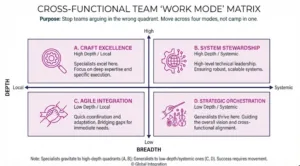
How to use it: Start key work with: “Which quadrant are we in right now, and which should we be in for this decision?”
Peer‑reviewed research on cross-functional teams shows that forcing constant cross-boundary integration can hurt outcomes; purposeful structuring of expert subgroups plus planned synthesis can improve innovation—consistent with using the 2×2 to decide when to diverge and when to integrate.
Executive summary: what leaders need to know
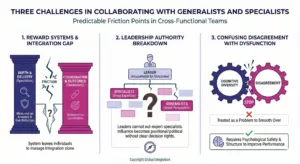
Collaborating with specialists and generalists in cross-functional teams can go wrong for three predictable reasons.
- First, organizations reward depth and delivery, but not integration or translation. Specialists are measured on accuracy and risk reduction. Generalists are measured on coordination and outcomes. The system creates friction, then leaves individuals to manage it alone.
- Second, traditional authority-based leadership breaks down. Leaders cannot out-expert specialists, yet they remain accountable for outcomes. Without clear decision rights and collaboration discipline, influence becomes positional or political.
- Third, teams confuse disagreement with dysfunction. Cognitive diversity is treated as a problem to smooth over rather than a capability to design for. Large-scale research shows that diversity only improves performance in complex work when leaders actively manage the conditions for it—especially psychological safety and decision structure (Wallrich et al., 2024):
Effective leaders do something different. They make expertise visible, trade-offs explicit, and decision ownership clear. They design collaboration deliberately instead of hoping goodwill will carry the load.
What does collaborating with specialists and generalists actually mean?
Collaborating with specialists and generalists in cross-functional teams is not about harmony or consensus. It is about productive tension.
Specialists safeguard quality, feasibility, and risk. They know which constraints are non-negotiable and which shortcuts create long-term debt. Generalists integrate across functions, frame decisions, and keep attention on system-level outcomes.
Research on cognitive diversity shows why this tension matters. Teams with different ways of thinking are better at spotting blind spots, stress-testing assumptions, and generating robust options—but only when leaders prevent dominance, silence, or premature convergence (Edmans, 2025).
The collaboration challenge arises because each group optimizes for a different horizon. Specialists optimize locally and deeply. Generalists optimize systemically and quickly. Both perspectives are necessary. Neither is sufficient alone.
Why do authority-based leadership approaches fail here?
In cross-functional settings, authority is fragmented by design. Leaders often depend on expertise they do not personally hold, while specialists depend on decisions they do not control.
Harvard Business Review cited research shows that leaders who attempt to operate as “pseudo-experts” consistently make poorer decisions than those who acknowledge the limits of their expertise and focus on framing, judgment, and evaluation instead (Atir & Dunning, 2024):
When authority is unclear, teams fall into two traps. Either specialists become gatekeepers, blocking progress in the name of rigor, or generalists override concerns in the name of speed. Both patterns create rework, resentment, and risk.
Effective collaboration requires leaders to shift from being decision-makers of content to designers of conditions. Their role is not to judge the quality of the code, analysis, or model, but to ensure the quality of the thinking, trade-offs, and alignment behind it.
How does this tension show up in day-to-day work?
Most leaders recognize the symptoms even if they struggle to name the cause.
Meetings oscillate between high-level strategy and deep technical debate, with neither side satisfied. Specialists feel unheard or misrepresented. Generalists feel bogged down in detail. Decisions are revisited because assumptions were never surfaced.
Research into large, interdisciplinary teams shows that without clear integration mechanisms, expertise fragments into parallel conversations rather than converging into shared decisions (Nature Humanities & Social Sciences Communications, 2024).
Over time, trust erodes. Specialists retreat into functions. Generalists carry the burden of integration without authority. Collaboration becomes performative rather than productive.
A practical “misalignment → intervention” map
| What you observe in the team | What it usually is | Intervention |
| Specialists say “can’t” and block progress | Gatekeeping + risk compression | Option crafting protocol (3 options + triggers) |
| Generalists push speed, specialists push rigor | Unnamed trade-offs | Three panes exercise (speed vs risk vs balanced) + record in decision log |
| Meetings oscillate between zoom-out and zoom-in | Wrong work mode | 2×2 quadrant reset (“where are we / where should we be?”) |
| Decisions keep getting relitigated | No durable rationale | One-page decision log + “won’t be re-decided elsewhere” norm |
| People stop challenging specialists | Low psychological safety | Leader models “I don’t know”; structured airtime; safety-building behaviors supported by RCT evidence |
| Too much cross-functional noise, not enough synthesis | Over-integration | Deliberate subgroup work + planned integration (supported by cross-functional structure research) |
Signals leaders can measure to show the approach is working
These are operational indicators (not abstract culture measures):
- Decision velocity: time from “Translate” to “Decide” decreases over quarters (track by decision log timestamps).
- Re-litigation rate: % of decisions reopened drops (a direct outcome of the one-page decision log).
- Option quality: decisions presented with 2–3 viable options increases (option crafting adoption).
- Early-risk surfacing: risks raised earlier in lifecycle (your “risk window” logic and specialist foresight).
- Voice participation: more balanced airtime and questioning behaviors (linked to psychological safety interventions).
What behaviors enable effective collaboration across expertise?
Effective collaboration between specialists and generalists does not emerge organically. It is built through consistent leadership and collaboration behaviors.
First, leaders make translation explicit. They require specialists to explain not just what they recommend, but why it matters to customers, cost, time, and risk. They require generalists to restate technical input accurately before moving on. See more about the four key communication roles in cross-functional teams.
Second, leaders normalize options instead of answers. Research on decision-making in complex systems shows that option-based framing improves decision quality, reduces escalation, and prevents false certainty (Hallo et al., 2020):
Third, leaders clarify decision rights early. They distinguish input, decision ownership, and execution—preventing endless consultation and emotional overload.
Fourth, leaders actively protect psychological safety. A large randomized controlled trial across 1,000+ teams shows that psychological safety is driven primarily by leader behavior, not personality or team composition—and is essential for experts to speak up and be heard (Castro, Englmaier & Guadalupe, 2022).
Find out more about the four key cross-functional communication roles that can help.
How can leaders evaluate specialist input without being experts themselves?
When leaders cannot judge the content, they must judge the quality of reasoning.
Research on expert decision-making shows that expertise is reliable only under specific conditions—and that leaders add value by testing assumptions, feedback loops, and decision logic rather than outcomes alone.
This reframes leadership credibility. Leaders are not validating answers; they are validating thinking.
Developing enterprise thinking and cross-functional breadth are important pats of building a cross-functional career.
How does this connect to broader cross-functional effectiveness?
Collaborating with specialists and generalists in cross-functional teams is one critical component of effective cross-functional team working. Without it, decision-making, accountability, and influence without authority remain fragile.
This challenge sits inside a wider system of cross-functional execution, where collaboration, decision rights, and leadership capability reinforce each other rather than compete.
It helps to give the team specialist training in cross-functional teams skills.
A final thought for leaders
Collaborating with specialists and generalists in cross-functional teams is not a soft issue. It is a core leadership capability in complex organizations.
When done well, it increases decision speed, reduces rework, and improves accountability. When ignored, it quietly erodes performance while leaders chase symptoms elsewhere.
Research is clear: the tension between depth and breadth is unavoidable. The choice leaders face is whether that tension becomes friction—or fuel.
See more in our comprehensive guide to cross-functional teams or talk to one of our specialists about your challenges.

Explore our training programs to see how we can help.
Cross functional teams Training Agile & Digital Training Matrix Management Training People and purpose Training Virtual Teams TrainingEducate yourself further with a few more of our online insights:
30 years of experience learning with a range of world class clients
We work with a wide range of clients from global multinationals to recent start-ups. Our audiences span all levels, from CEOs to operational teams around the world. Our tools and programs have been developed for diverse and demanding audiences.

Tailored training or off the shelf modules for your people development needs
We are deep content experts in remote, virtual and hybrid working, matrix management and agile & digital leadership. We are highly flexible in how we deliver our content and ideas. We can tailor content closely to your specific needs or deliver off the shelf bite sized modules based on our existing IP and 30 years of training experience.
For more about how we deliver our keynotes, workshops, live web seminars and online learning.