Cross-functional team communication: the key team capability
Cross-functional team communication is not about sharing more information. It is about ensuring understanding, alignment, and coordinated action when work spans functions, expertise domains, and reporting lines. In cross-functional teams, communication replaces authority as the primary leadership mechanism. This article explains why communication fails in cross-functional environments and introduces four practical communication roles that enable leaders to deliver results without control. Communication just one of the challenges covered in our practical guide to cross-functional teams.
Why is cross-functional team communication a challenge?
Cross-functional teams exist because modern work cuts across functions, geographies, and specialist domains. Strategy execution, innovation, regulatory change, and digital transformation all require people to collaborate beyond their functional boundaries.
However, most organizations experience a predictable pattern once work becomes cross-functional:
- Information travels, but meaning does not
- Meetings increase, but alignment weakens
- Decisions slow despite high engagement
- Accountability becomes blurred rather than shared
The root cause is not poor intent or low capability. It is that communication models designed for functional hierarchies are applied to environments where authority is distributed and priorities compete.
Research from Gartner reported in HBR describes this as collaboration drag, where unclear decision authority, excessive coordination, and misaligned expectations slow execution across functions
This is why cross-functional team communication must be treated as a specific leadership and team discipline.
Early in most cross-functional initiatives, leaders recognise that “communication is an issue.” What they often underestimate is that communication becomes the operating system for the work itself. How leaders communicate determines how fast decisions move, how risks surface, and how trust is built or eroded.
This challenge sits at the core of cross-functional team working, where execution depends less on hierarchy and more on coordination across boundaries.
Why does this challenge persist?
Cross-functional communication problems persist for three structural reasons:
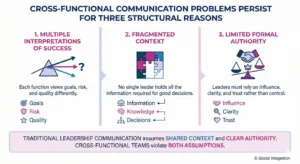
- Multiple interpretations of success. Each function views goals, risk, and quality differently.
- Fragmented context. No single leader holds all the information required for good decisions.
- Limited formal authority. Leaders must rely on influence, clarity, and trust rather than control.
Traditional leadership communication assumes shared context and clear authority. Cross-functional teams violate both assumptions.
You will probably also be managing the challenges of a team made up of both generalists and specialists from a range of functions which bring ther own communication challenges.
What effective leaders do differently?
Leaders and team members who succeed in cross-functional environments do not communicate more. They communicate differently. They deliberately adopt distinct communication roles that ensure clarity, alignment, and learning across the system.
Rather than relying on position or escalation, they use communication to:
- Translate expertise into shared understanding
- Maintain two‑way information flow
- Surface misalignment early
- Integrate feedback into better execution
These capabilities can be described clearly through four communication roles.
Why does authority-based communication fail?
In functional teams, communication is reinforced by hierarchy. Instructions are accepted because authority is clear. In cross-functional teams, the same message is filtered through functional priorities, incentives, and risk perceptions.
McKinsey’s work on cross-functional collaboration shows that fragmented ownership and siloed expertise slow execution when communication does not explicitly bridge these divides.
As a result, leaders must design communication to travel across functions, not down reporting lines.
Communication as an enabling system
In cross-functional teams, communication performs four system-level functions:
- Creates shared meaning
- Enables coordination without control
- Anticipates and prevents conflict
- Supports continuous learning
These functions are operationalised through four clearly defined communication roles that need to be executed by all cross-functional team members.
The four cross-functional team communication roles
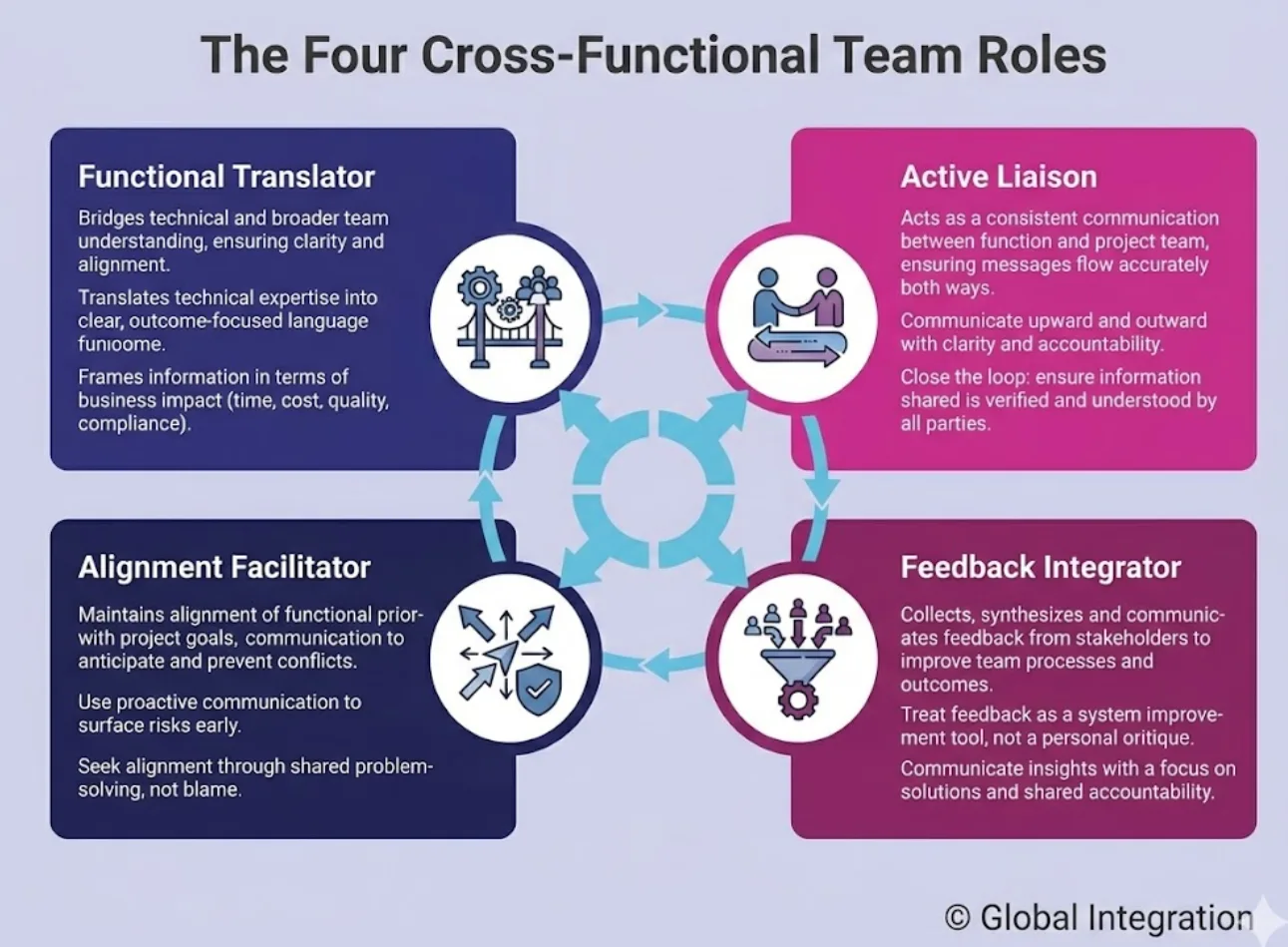
This framework defines four practical communication roles that consistently appear in effective cross-functional teams. These roles are not job titles. They are leadership and collaboration behaviours that can be developed and applied regardless of formal position.
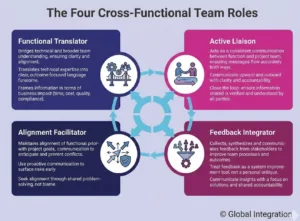
| Role Name | Role Summary | Principles |
| Functional Translator | Bridges technical and broader team understanding, ensuring clarity and alignment. | Translate technical expertise into clear, outcome-focused language. Frame information in terms of business impact (time, cost, quality, compliance). |
| Active Liaison | Acts as a consistent communication channel between function and project team, ensuring messages flow accurately both ways. | Communicate upward and outward with clarity and accountability. Close the loop: ensure information shared is verified and understood by all parties. |
| Alignment Facilitator | Maintains alignment of functional priorities with project goals, using communication to anticipate and prevent conflicts. | Use proactive communication to surface risks early. Seek alignment through shared problem-solving, not blame. |
| Feedback Integrator | Collects, synthesizes, and communicates feedback from stakeholders to improve team processes and outcomes. | Treat feedback as a system improvement tool, not a personal critique. Communicate insights with a focus on solutions and shared accountability. |
This table provides a practical diagnostic tool for leaders and L\&D teams assessing communication effectiveness in cross-functional work and forms part of our cross-functional teams training.
How do these roles show up in day-to-day leadership behaviour
Functional Translator: from expertise to enterprise impact
Cross-functional teams do not fail because expertise is lacking. They fail because expertise is not understood. The Functional Translator ensures that specialist knowledge is framed in terms that others can act on.
This role is critical whenever technical, regulatory, or specialist functions are involved. Without translation, teams either defer decisions unnecessarily or make them on flawed assumptions.
Active Liaison: keeping the system connected
The Active Liaison role prevents the silent drift that often occurs between meetings. Leaders and individuals who perform this role ensure that decisions made in one forum are understood, interpreted correctly, and acted on elsewhere.
This role is especially important in matrix environments where people belong to multiple teams and functions and priorities shift rapidly. A decision made in one forum needs to be rapidly communicated to the others who are impacted.
Alignment Facilitator: surfacing issues before they escalate
Misalignment is inevitable in cross-functional teams. What matters is how early it is surfaced. The Alignment Facilitator uses communication proactively to identify competing timelines, priorities, and risks.
This behaviour reduces escalation by making trade-offs explicit rather than political.
Feedback Integrator: turning insight into improvement
Feedback in cross-functional teams often arrives fragmented and emotionally charged. The Feedback Integrator treats feedback as a system signal rather than a personal critique, synthesising input into constructive, solution-focused communication.
This role underpins trust and continuous improvement across functions.
Why communication technology does not replace these roles
Digital tools increase speed and transparency, but they do not replace leadership communication roles. Without Functional Translation, technology accelerates misunderstanding. Without Active Liaison behaviour, updates are seen but not absorbed.
Cross-functional team communication fails not because tools are inadequate, but because leadership and collaboration behaviours and expectations are undefined.
Current opportunities to use AI to strengthen cross-functional communication
Turn specialist language into shared meaning (Functional Translator)
Use AI to convert technical, regulatory, or functional updates into plain-language summaries tailored to each audience. You can generate two versions of the same message: one for senior sponsors focused on business impact (time, cost, quality, compliance) and one for delivery teams focused on next actions and dependencies. This reduces the common pattern where information travels but meaning does not.
Create a reliable “decision trail” across forums (Active Liaison)
Apply AI note-capture to meeting outputs, then auto-draft a short “what we decided / what changes / who is impacted” brief for the other functions not in the room. Pair this with an AI-generated list of stakeholders to notify and a draft update message per function. The aim is to prevent silent drift between meetings and ensure decisions are interpreted consistently.
Surface misalignment earlier through pattern detection (Alignment Facilitator)
AI can scan recurring status updates, risk logs, and action lists to flag emerging inconsistencies: conflicting timelines, duplicated work, unresolved ownership, or “stuck” decisions. Use this to prompt targeted alignment conversations (“Where do we disagree on success?” “Which trade-off is implicit?”) before issues turn political or require escalation.
Integrate feedback into learning, not noise (Feedback Integrator)
Cross-functional feedback often arrives fragmented and emotionally loaded. AI can cluster comments by theme (process, decision quality, handoffs, clarity), separate signals from repetition, and draft a neutral synthesis that focuses on system improvement. You can then turn that synthesis into a small set of experiments (e.g., new briefing format, clearer decision rights, tighter closure loops) and track whether outcomes improve.
Build better messages faster with role-based prompts
Create lightweight prompt templates aligned to the four roles: “Translate this into enterprise impact,” “Draft the two-way update I must send back to my function,” “Write an alignment pre-brief that makes trade-offs explicit,” and “Synthesize stakeholder feedback into improvement actions.” This turns the roles into repeatable behaviours, not good intentions.
Strengthen capability with AI-supported practice
Use AI to rehearse high-stakes cross-functional moments: challenging a risk assumption, negotiating priorities, or reframing disagreement into shared problem-solving. Ask for alternative phrasings, likely objections from different functions, and questions that test understanding. Done well, this accelerates skill-building while keeping ownership of judgment and relationships with the team.
How does this fit into the wider cross-functional teams challenge
This communication challenge is one component of effective cross-functional leadership and team collaboration. For a complete framework, see our full guide on cross-functional team working, which integrates structure, leadership capability, and execution discipline.
Practical checklist for leaders and L&D teams
To assess cross-functional team communication capability:
- Are team members and leaders expected to act as Functional Translators for the team and the function, not just subject experts?
- Is two-way communication actively maintained across functional boundaries?
- Are alignment risks surfaced early through proactive conversation?
- Is feedback integrated into learning rather than treated defensively?
Where gaps exist, training should focus on role clarity, expectations and behavioural practice, not generic communication skills.
Why does this matter now?
As organizations run more complex initiatives involving multiple functions, the cost of poor cross-functional team communication continues to rise. Gartner reports that many initiatives now span five to eight functions simultaneously, magnifying coordination demands (Harvard Business Review, 2024).
Leaders who cannot master cross-functional become bottlenecks. Those who can become integrators of enterprise performance.
If your organization needs to improve execution in cross-functional teams, start by making communication roles explicit and developable. Leadership development pathways that embed these four roles help leaders move from reactive coordination to disciplined delivery.
Speaking with a leadership training advisor can help you assess where your current cross-functional communication capability supports — or limits — enterprise outcomes.
Explore our training programs to see how we can help.
Virtual Teams Training People and purpose Training Matrix Management Training Cross functional teams Training Agile & Digital TrainingEducate yourself further with a few more of our online insights:
30 years of experience learning with a range of world class clients
We work with a wide range of clients from global multinationals to recent start-ups. Our audiences span all levels, from CEOs to operational teams around the world. Our tools and programs have been developed for diverse and demanding audiences.

Tailored training or off the shelf modules for your people development needs
We are deep content experts in remote, virtual and hybrid working, matrix management and agile & digital leadership. We are highly flexible in how we deliver our content and ideas. We can tailor content closely to your specific needs or deliver off the shelf bite sized modules based on our existing IP and 30 years of training experience.
For more about how we deliver our keynotes, workshops, live web seminars and online learning.