What are matrix teams and how can we make them work in 2026?
Matrix teams – where people work across multiple teams, projects, and stakeholders, and often report to more than one manager – are now the norm in complex organizations. In 2026, over 80% of employees spend at least some of their time working in a matrixed way, driven by the need for agility, cross-functional perspectives, innovation, and customer focus. This guide explains what matrix teams are, why they matter, and how leaders and matrix team members can overcome their unique challenges with practical tools and strategies and supplements our more detailed guide to matrix management.
What is a matrix team and why are they so common today?
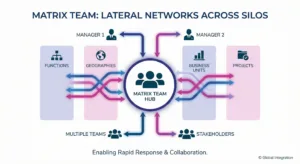
A matrix team is a group where members work with multiple managers, teams, and stakeholders—across functions, geographies, or projects. This way of working cuts across silos, enabling organizations to respond rapidly to change. Unlike traditional teams with a single reporting line, matrix teams operate laterally, fostering collaboration and flexibility.
In today’s fast-paced, global business environment, matrix teams are essential for digital transformation, customer-centricity, and leveraging “liquid talent.” Matrix teams are also known as “cross-functional teams” and are common even in organizations that do not have a formal matrix structure.
Table: How do matrix teams compare with traditional teams?
| Feature | Matrix Team (multiple teams/managers) | Non-Matrixed Team (single manager) |
| Reporting Lines | Multiple (matrixed or cross-functional) | Single (hierarchical) |
| Collaboration | Cross-functional, lateral | Vertical, within function |
| Decision-Making | Shared, negotiated | Top-down or expertise driven, clear authority |
| Flexibility | High, adaptable | Lower, more stable |
| Accountability | Shared, sometimes ambiguous | Clear, direct |
Why are matrix teams on the rise?
They are a recognition that work no longer fits neatly within the traditional vertical silos of function and geography. Solutions to today’s complex business problems require horizontal collaboration across the organization and require both cross-functional design and execution.
At the same time functions are essential for capability development and functional excellence ,so it’s not a matter of moving everyone into horizontal teams. The fact that we need, for example, both to build the next generation of engineers or finance people and set their standards, and to harness them into value creation that cuts across the organisation, means that dual reporting, whether formal or informal, is often required.
Recent research shows that 72–84% of employees now spend at least part of their time working in some form of matrix or cross-functional team.
What are the main advantages of matrix teams?
- Fundamentally work has become more horizontal, cutting across the traditional silos of function and geography. This requires teams with similar capabilities.
- Processes and projects have often become too complex for single functions to complete.
- Agility: Teams can quickly reallocate resources and expertise as needs change.
- Resource Optimization: Access to a broader pool of cross-functional skills and knowledge.
- Innovation: Diverse perspectives drive more creative solutions.
- Customer Focus: Teams are structured around customer needs, not just internal functions, leading to better service and outcomes.
How does this compare with non-matrixed teams?
- Clarity: Clear reporting lines and accountability.
- Speed of Decision: Less negotiation, faster (though potentially narrower) decisions.
- Simplicity: Easier to manage for tasks that don’t require cross-functional input.
What are the biggest challenges of matrix teams?
- Ambiguous Roles: Employees may not know who their “real” boss is, and may play multiple roles on different teams, leading to confusion about priorities.
- Competing Goals: Different managers, teams and reporting lines may have conflicting objectives.
- Communication Overload: More meetings, emails, and coordination sessions.
- Accountability Gaps: Unclear ownership.
- Slow Decision-Making: Consensus is often required, which can delay action.
- Establishing sufficient autonomy to prevent the need for constant functional escalation and subsequent delay.
See more about matrix challenges and solutions in our comprehensive guide to matrix management.
How can leaders create clarity and alignment in matrix teams?
- Define roles where we can: Use RACI at a high level to clarify who is Accountable, Responsible, Consulted, and Informed for major tasks or decisions.
- But at the same time help people become more comfortable with ambiguity and accountability without control.
- Help team members develop “enterprise thinking” so they have an end-to-end understanding of the work they do and the interdependencies with others.
- Regular Alignment Meetings: Use structured check-ins to resolve conflicts and manage expectations before they become roadblocks.
- Initiative Alignment Groups: Executive teams should coordinate major projects to avoid overload and ensure effective resource allocation.
Research insight: Improving role clarity and accountability boosts employee engagement and business performance (Consultancy.uk). However full clarity may not be possible in a dynamic fast-changing environment, so matrix team members need to operate with “good enough” clarity.
How does accountability work in a matrix?
- Accountability without control is normal and healthy in a matrix.
- Empower Individuals: Encourage ownership of commitments, not just compliance.
- Celebrate Successes: Recognize and reward those who take initiative and deliver results.
- Shared Accountability: Responsibility is distributed, so leaders must reinforce positive behaviors and clarify expectations.
- Make taking on accountability a positive experience by managing failures effectively and celebrating successes.
- Create learning loops to drive continuous improvement.
How can you accelerate decision-making in matrix teams?
- Delegate Authority: Push decisions as close to the action as possible.
- Clarify decision and involvement rights, how will specific decisions be made and who gets to make them?
- Use the ADC Framework: to identify where the team is Aligned, Different, or in Conflict to focus discussions and speed up resolution.
- Empower Sub-Teams and individuals: Allow empowered individuals or smaller sub-groups to make decisions within their scope.
- Review any decisions that are subsequently revisited to find out the reasons and prevent in future.
See our more detailed guide to decision making in the matrix.
What practical tools and frameworks help matrix teams succeed?
Table: Matrix team challenges and solutions
| Challenge | Solution/Tool | Example Practice |
| Role Ambiguity | ARCI/RACI, “Islands of Clarity” | Role-mapping workshops |
| Conflicting Goals | Alignment Meetings, ADC | Monthly cross-functional sync |
| Slow Decisions | Decision rights, involvement rights | Empowered sub-teams |
| Communication Overload | Meeting discipline, asynchronous tools | Shared dashboards |
| Accountability Gaps | Empowerment, recognition, continuous learning loops | Peer-nominated awards |
What does recent research and expert opinion say about matrix teams?
- Gallup: The Matrix: Teams Are Gaining Greater Power in Companies
- Expert Quote: “The matrix can be a web you get caught in or a network you use to get things done. Which it is for you depends on your leadership mindset and skillset.” – Kevan Hall.
Are matrix teams right for every organization?
No. Matrix teams work best in complex, fast-changing environments where agility and cross-functional collaboration are essential. Having said that cross-functional teams are now the norm even in organizations that would not describe themselves as having a matrix.
How do you know if your matrix team is working?
Look for good enough clarity, fast decisions, low escalation, high engagement, and measurable results.
How AI can enhance matrix team practices and skills in 2026
Role clarity, faster (RACI) drafts
Use AI to create a first-pass RACI from project charters, meeting notes, and team operating model documents. This accelerates role-mapping workshops and helps you find the “islands of clarity” that reduce conflict—while still allowing for the “good enough clarity” a matrix needs.
Priority negotiation and trade-off support
In a matrix, competing goals create overload. AI can summarise requests from multiple stakeholders, highlight conflicts, and propose options (e.g., impact/effort, risk, customer value). Used well, it strengthens enterprise thinking and makes alignment meetings more productive.
Decision-rights and ADC diagnostics
AI can turn long email threads and chat discussions into a structured decision brief: decision to be made, who must be involved, what has already been agreed, and where the team is Aligned, Different, or in Conflict (ADC). This reduces circular debate and speeds decisions without removing accountability.
Meeting discipline and asynchronous coordination
AI note-taking and action capture can reduce communication overload by producing crisp outcomes, owners, and next steps, plus short updates for those who were Consulted or Informed. Pair this with an “async-first” habit: AI-generated weekly status summaries and exception-only escalation.
Coaching for influence without authority
Matrix success depends on influence skills. AI can provide role-play practice (e.g., negotiating priorities with a functional lead), draft stakeholder messages in your tone, and suggest questions that de-escalate tension—supporting accountability without control.
Learning loops and recognition signals
Use AI to spot patterns in reworked decisions, recurring blockers, and handoff delays, then propose small experiments for improvement. It can also help leaders capture and share success stories, reinforcing the behaviours that make the matrix a network for results.
What’s the biggest risk in matrix teams?
Failing to clarify roles and goals between functional and matrix team goals -ambiguity is inevitable but should be managed where we can.
What practical steps can leaders take for matrix team success?
Checklist for leaders:
- Define and communicate roles and goals.
- Use light touch ARCI/RACI frameworks to establish “good enough clarity”.
- Schedule regular alignment meetings.
- Empower individuals and celebrate initiative.
- Streamline communication and reduce meeting overload.
- Invest in matrix leadership and teams training.
Key takeaways for leaders
- Matrix teams offer agility and innovation but require new leadership and collaboration skills.
- Good enough clarity, alignment, and empowerment are essential for success.
- Invest in training and continuous improvement to make your matrix a network for results—not a web that traps you.
Why not explore other matrix management challenges in our definitive guide or speak to a specialist.
Explore our training programs to see how we can help.
Virtual Teams Training People and purpose Training Matrix Management Training Cross functional teams Training Agile & Digital TrainingEducate yourself further with a few more of our online insights:
30 years of experience learning with a range of world class clients
We work with a wide range of clients from global multinationals to recent start-ups. Our audiences span all levels, from CEOs to operational teams around the world. Our tools and programs have been developed for diverse and demanding audiences.

Tailored training or off the shelf modules for your people development needs
We are deep content experts in remote, virtual and hybrid working, matrix management and agile & digital leadership. We are highly flexible in how we deliver our content and ideas. We can tailor content closely to your specific needs or deliver off the shelf bite sized modules based on our existing IP and 30 years of training experience.
For more about how we deliver our keynotes, workshops, live web seminars and online learning.