How to make the matrix simpler
lot of matrix literature focuses on organization structure and how we can make the matrix simpler. It is an obvious difference and a concrete topic to study and describe but in a matrix organization the structure itself solves nothing. A formal structural response to change tends to be slow and inflexible. The rate of change in many organizations is faster than our ability to change structure.
True flexibility requires flexible networks and ways of working that enable fast response – it is the quality of matrix management skills, matrix teams and matrix working that means the difference between success and failure.
Why structure is a distraction in the matrix
An over- focus on structure can lead to constant reorganizations in the search for the ‘magic bullet’ structure that will solve all of our problems. Not only do these structural reorganizations rarely work, but they also actually make things worse by disrupting the networks and relationships that actually get things done.
When we have got two, three, or maybe more reporting lines in a matrix organization, we are moving beyond the limits of structure. These lines are no longer helping us to get things done.
We do not get more flexibility by adding more structure. So how can we make things simpler and still reach our objectives without unnecessary structure? Start by making sure we only use the matrix where the value is higher than the complexity it brings.
Three critical groups to make the matrix simpler
In Making the Matrix Work, I wrote about three distinct groups within any large, complex organization.
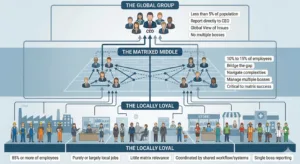
- The global group – the small number of leaders at the very top of the organization who head up major business units, regions and functions. These individuals tend to report directly to the CEO. They do not have multiple reporting lines above them. These are the people who should consistently take a global view of issues. Even in the most international organizations they will be less than 5% of the total population.
- The locally loyal – the people who have purely or largely local jobs. These are the people who work in factories, shops, offices and service centres. Even in highly integrated global organizations, these people are the vast majority of our employees – typically 85% or more of our people. These are jobs where the matrix really has little relevance and only introduces complexity. These people may work as part of global systems or share information with colleagues in other cultures, functions and locations, but co-ordination of their work can be achieved through shared workflow or systems, or even virtual teamwork, and doesn’t require the complexity of multiple bosses.
- The matrixed middle, the leaders in the centre of the organization who bridge the gap between the global group and the locally loyal. Typically, no more than 10% to 15% of your employees, this group are critical to the success of your matrix. These are the people that have to navigate the complexities of matrix management
This is great news! Many organizations come to us thinking they have a problem that affects the whole organization and quickly learn that it’s a much smaller issue than they feared. It is a valuable realization that 85% or more of your people can and should be insulated from the matrix.
Here is an example from a company I used to work in. The structure is relatively flat but not particularly unusual. The organization worked off a typical ‘span of control’ of eight people.
The structure looked like this.
- 1 CEO.
- 10 global, function and business unit heads (not matrixed all reporting directly to the CEO)
- 80 divisional heads – matrixed
- 640 departmental heads – matrixed
- 5,000 first line managers – some matrixed
- 41,000 non-management employees – not matrixed
If you can limit the matrix to the divisional and departmental heads only, then only 1.5% of your employees need to be matrixed. If you include all first line managers, this increases to 12% of your employees.
Matrix management is a significant step up in complexity in the way we lead people and work with colleagues. Multiple bosses, competing goals and higher levels of ambiguity mean that a matrix managers require a high level of skills and capabilities that can take time to acquire.
By limiting matrix management to the ‘matrixed middle’ group, we can constrain the impact of this complexity of the organization as a whole and in particular keep it simple for operational people.
It also makes it a more manageable population in most organizations when we focus on matrix management training and skills development.
See more on matrix organization structures or speak to a specialist about developing your matrix management skills.

Explore our training programs to see how we can help.
Cross functional teams Training Agile & Digital Training Matrix Management Training People and purpose Training Virtual Teams TrainingEducate yourself further with a few more of our online insights:
30 years of experience learning with a range of world class clients
We work with a wide range of clients from global multinationals to recent start-ups. Our audiences span all levels, from CEOs to operational teams around the world. Our tools and programs have been developed for diverse and demanding audiences.

Tailored training or off the shelf modules for your people development needs
We are deep content experts in remote, virtual and hybrid working, matrix management and agile & digital leadership. We are highly flexible in how we deliver our content and ideas. We can tailor content closely to your specific needs or deliver off the shelf bite sized modules based on our existing IP and 30 years of training experience.
For more about how we deliver our keynotes, workshops, live web seminars and online learning.