The Role of the Function and the Team: How Leaders Build Clarity and Power Balance in Cross Functional Environments
In cross-functional teams it is essential to create clarity on the respective role of the function and the project or cross-functional team leader. This blog defines how expertise, accountability, and decision authority are balanced in cross‑functional environments. In a matrixed organization – where people work across multiple teams, stakeholders, and priorities – clarity between functional and team responsibilities becomes essential for speed, alignment, and performance. This blog explores how leaders intentionally design that balance to strengthen execution in cross-functional team working.
What problem are organizations solving here?
Modern organizations rely heavily on cross‑functional teams to deliver customer outcomes, manage complexity, and accelerate execution. Yet most employees still belong to a function that manages capability, performance, functional excellence, and long‑term development.
This dual structure creates a predictable leadership challenge:
When role of the function and the team are unclear, leaders struggle with:
- Slow or inconsistent decision‑making.
- Confusion about authority and prioritization
- Conflicts over resources and workload
- Misaligned performance expectations
- Individuals caught between contradictory demands
Even high‑performing managers can unintentionally reinforce ambiguity when functional and cross‑functional responsibilities evolve faster than governance structures.
This is why understanding the role of the function and the team is a foundational capability for how cross-functional teams work. Leaders must design the balance of power deliberately — not let it emerge accidentally.
Why this issue undermines cross‑functional working.
When people receive direction from both a functional manager and a cross‑functional team lead, they often lack clarity about whose priorities matter most. Without explicit agreements:
- Functional leaders may continue to drive decisions rooted in legacy authority.
- Cross‑functional leaders may struggle to influence without formal power.
- Individuals operate defensively or escalate small issues.
- Decision speed decreases, and accountability dilutes.
Why this persists.
The tension is structural, not personal. Functions exist to build expertise, standards, and capability. Cross‑functional teams exist to deliver outcomes, solve problems, and innovate quickly. These two logics come into natural friction unless leadership roles are clearly negotiated.
Additionally:
- Legacy power structures tend to favour functions.
- Teams often gain authority only gradually.
- Leaders assume shared understanding that does not exist.
What effective leaders do differently?
High‑performing matrix and cross‑functional organizations make the division of roles explicit. They treat power balance as a leadership design choice—not an unspoken assumption. They clarify who owns what, when, and why, and they communicate this consistently.
What exactly is the role of the function in today’s matrixed organization?
As people spend more time in cross‑functional teams, the function’s role shifts from day‑to‑day supervision to long‑term capability building.
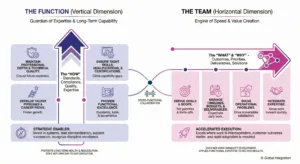
The function becomes the guardian of expertise and capability.
Functions—such as Finance, HR, IT, Marketing, or R\&D—are responsible for:
- Maintaining professional depth and technical quality – today and for the future
- Ensuring people have the right skills, qualifications, and certifications.
- Identifying future capability gaps
- Developing talent pipelines and career paths
- Providing functional excellence – standards, tools, and governance
In this model, the function protects the “how”:
- How we maintain quality
- How we ensure compliance
- How we uphold professional standards
- How we grow expertise across the organization
This protects long‑term organizational health and reduces risk.
The function also acts as a strategic enabler.
Functional leaders:
- Approve and invest in systems and tools used in the function.
- Lead standardization efforts to improve efficiency.
- Support succession planning and mentoring.
- Recognize professionals for discipline‑specific excellence.
They provide input into cross‑functional goals but do not own day‑to‑day execution.
This enables individuals to contribute deeply and sustainably across multiple initiatives.
What is the role of the team – the horizontal dimension?
Cross‑functional teams, projects, and product groups exist to deliver outcomes, coordinate work, and solve problems across disciplines.
Teams own the “what” and “why.”
Their responsibilities include:
- Defining goals and scope
- Setting priorities and making trade‑offs
- Managing timelines, budgets, and deliverables
- Coordinating daily work
- Solving operational problems
- Driving stakeholder satisfaction
Teams integrate expertise to move work forward quickly. Boundary spanning team behaviours correlates with project performance.
They do not own capability development or standards — that remains with the function. Instead, they apply functional expertise to deliver business results.
The horizontal dimension is about speed and value creation.
Teams typically excel where:
- Work is interdependent.
- Customer outcomes matter more than functional optimization.
- Rapid adaptation is required.
- Innovation or experimentation is needed.
When empowered, teams accelerate execution and reduce organizational drag.
Why power balance — not equality — is the challenge.
Many leaders incorrectly assume the goal is “equal power” between the function and the team.
The right balance depends on factors such as:
- The nature of the work (standardization vs. innovation)
- Risk tolerance
- Regulatory requirements
- Customer proximity
- Organizational maturity
- Talent depth
- Scale and coordination needs.
High‑risk, compliance‑heavy functions (Finance, Legal, Medical Affairs) must retain stronger authority when topics touch on their domains.
Fast‑moving, customer‑facing teams require greater autonomy.
This is why rigid, one‑size‑fits‑all approaches fail.
What leadership behaviors support a healthy role of the function and the team?
For clarity and execution, leaders must model specific behaviors that reinforce alignment and reduce conflict.
1. Make the implicit explicit
Leaders should jointly define:
- Who sets goals?
- Who evaluates performance?
- Who allocates resources?
- Who approves work or standards?
- Who resolves conflicts?
- Who decides trade‑offs?
This reduces emotional friction and avoids escalation cycles.
2. Focus on tasks, not reporting lines
Over‑emphasis on “solid line” vs. “dotted line” often leads to power struggles. Mature organizations focus instead on:
- Decision rights
- Accountability mechanisms
- Information flows
- Collaboration patterns
Reporting lines are only one part of leadership architecture—and often the least meaningful.
3. Embrace shared leadership where necessary
Some tasks naturally require dual ownership, such as:
- Performance evaluation
- Goal setting
- Development and coaching
- Resource negotiation
- Recognition and rewards
- Conflict resolution
Instead of avoiding overlap, great leaders design it.
4. Support individuals navigating dual expectations
Employees working in cross‑functional settings must:
- Manage time and priorities proactively.
- Clarify expectations early.
- Keep both leaders informed.
- Manage ambiguity.
- Resolve conflicts without immediate escalation.
- Balance functional depth with cross‑functional breadth
Leaders must equip people with permission and capability to operate independently.
How can leaders identify their current balance of power?
Leaders can assess where they currently sit on key dimensions such as:
- Decision authority
- Resource control
- Performance management
- Governance and escalation
- Culture and identity
- Role clarity
A structured assessment reveals whether the organization is:
- Function‑dominated
- Balanced
- Team‑dominated
This helps leaders adjust their operating model intentionally.
What gets in the way? Legacy power and leadership maturity
Many organizations historically operated through strong functional authority. Shifting toward cross‑functional working requires functional leaders to relinquish some control — which is often uncomfortable.
Common barriers include:
- Fear of losing influence
- Confusion about the new role
- Lack of visibility into cross‑functional work
- Unclear expectations from senior leadership
- Insufficient investment in leadership capability
If functional leaders feel their new role is less valued, they may resist or inadvertently undermine collaborative decision‑making.
Leaders must position functional roles as strategic, high‑impact, and future‑focused to prevent this.
When we do not want balance in the role of the function and the team
Certain roles must remain firmly functional:
- Financial controllers safeguarding compliance.
- Medical or scientific advisors protecting safety and ethics in pharmaceutical development teams.
- HR safeguarding confidentiality and discipline standards
In these cases, the function must retain primacy to manage risk and uphold integrity.
This is not an exception but a deliberate design choice.
How can we use AI to help
Clarifying decision rights and authority in real time
AI tools can be used to document, surface, and reinforce agreed decision rights between functions and teams. By analysing meeting notes, charters, and operating models, AI can highlight ambiguity, flag overlapping ownership, and prompt leaders to make the implicit explicit before confusion turns into conflict or delay.
Making power balance visible rather than assumed
AI‑supported diagnostics can help leaders assess where authority actually sits across decisions, resources, and performance management. Rather than relying on perception or hierarchy, leaders gain evidence‑based insight into whether their organisation is function‑dominated, team‑dominated, or intentionally balanced—and where adjustments are needed.
Improving decision speed without undermining governance
AI can support faster cross‑functional decisions by structuring options, trade‑offs, and risk considerations in a consistent way. This allows teams to move quickly on the “what” and “why,” while ensuring functional expertise is applied appropriately to the “how,” particularly in higher‑risk or regulated domains.
Reducing escalation by strengthening shared understanding
By summarising agreements, highlighting dependencies, and tracking unresolved tensions, AI can reduce unnecessary escalation. Leaders and team members are better equipped to resolve issues at the right level, with clearer information and less emotional friction, rather than defaulting to hierarchy when pressure increases.
Supporting individuals working across multiple priorities
AI assistants can help employees navigate dual expectations by clarifying priorities, managing workload trade‑offs, and preparing conversations with functional and team leaders. This builds confidence and independence, reducing the personal cost of ambiguity that often sits at the heart of matrix frustration.
Accelerating leadership learning in matrix environments
AI enables leaders to practise difficult conversations, test role‑clarity scenarios, and reflect on real cross‑functional challenges. Used well, this turns matrix leadership from an abstract concept into a practical, learnable capability—reinforcing the behaviours required to sustain clarity, trust, and performance at scale.
How does this fit into the broader cross‑functional leadership framework?
This challenge is one essential component of effective matrix management. A clear understanding of functional and team roles supports a broader capability set that includes:
- Decision‑making in ambiguous environments
- Accountability without control
- Influence across boundaries.
- Governance in complex organizations
For a complete model on managing these challenges within a matrix structure, visit our full guide on matrix management.
Midway through the article, as you explore structural clarity, you may also find value in related principles discussed in our /matrix-management/ hub.
Build clarity and power balance across your matrix.
If your leaders are struggling with functional–team conflicts, unclear decision authority, or slow cross‑functional execution, you are not alone. These issues are structural — but the solutions are behavioural and learnable.
We help organizations build leadership capability in:
- Defining and negotiating role clarity
- Improving decision speed
- Strengthening cross‑functional alignment
- Reducing conflict and duplication
- Equipping employees to succeed in dual‑reporting environments
If you would like to explore a tailored cross-functional leadership development pathway or speak with a specialist about your team’s needs, our advisors are here to help.

Explore our training programs to see how we can help.
Virtual Teams Training People and purpose Training Matrix Management Training Cross functional teams Training Agile & Digital TrainingEducate yourself further with a few more of our online insights:
30 years of experience learning with a range of world class clients
We work with a wide range of clients from global multinationals to recent start-ups. Our audiences span all levels, from CEOs to operational teams around the world. Our tools and programs have been developed for diverse and demanding audiences.

Tailored training or off the shelf modules for your people development needs
We are deep content experts in remote, virtual and hybrid working, matrix management and agile & digital leadership. We are highly flexible in how we deliver our content and ideas. We can tailor content closely to your specific needs or deliver off the shelf bite sized modules based on our existing IP and 30 years of training experience.
For more about how we deliver our keynotes, workshops, live web seminars and online learning.