Managing your meetings and time when you work on multiple teams
Managing your meetings and time when you work on multiple teams sounds operational, but in matrix management and cross-functional teams it is a leadership issue. How you spend your time is your strategy. When leaders work across functions, geographies, projects, and reporting lines, communication quickly becomes noisy, fragmented, and expensive.
The temptation is to communicate more or work harder. The actual solution is to create the right rhythm of communication across multiple teams so people know what matters, when to engage, and how decisions will be made. See how this fits into matrix management in our definitive guide.
Effective leaders design communication on purpose. They decide which forums matter, and which do not or can be delegated, what each forum is for, who needs to be present, and what should happen asynchronously.
Why managing your meetings and time when you work on multiple teams has become a leadership problem
In a traditional hierarchy, communication usually follows reporting lines. In a matrix, work flows sideways in addition to vertically. Today many leaders also split their time between being leaders and personal delivery of activity on multiple teams. Participants on our matrix management training tell us, on average, they are part of between four and five teams.
Leaders are expected to coordinate across functions, influence peers, align specialists, and keep several initiatives moving at once. That means they are managing several communication systems simultaneously, not just one team meeting.
It is also rare that team leaders scheduling the communication cadence for their team take into account the schedules for all the other teams their people are part of.
This is where many experienced leaders get trapped. They rely on habits that worked in simpler structures: frequent check-ins with everyone, long update meetings, copying wide groups into emails, and solving confusion by adding more conversations.
Traditional management wisdom is that you can’t over communicate, the reality inn matrix organizations is that communication and collaboration overload is often a bigger problem.
The real issue is not only meetings. It is the lack of a clear communication architecture.
Many leaders say they need to manage their diary better. Sometimes they do. But diary pressure is often a symptom of a deeper design problem. Too many leaders inherit a patchwork of standing meetings, escalation calls, project forums, stakeholder updates, and functional routines that have grown over time without much thought.
We need to stop and ask the basic questions. What decisions happen here? What information truly needs live discussion? Which conversations should happen weekly, monthly, or only when a trigger occurs? What can be shared without a meeting at all?
We need deliberate and coordinated communication routines, not constant availability.
Without this we can put our people in a position of choosing who’s meeting they should attend when diaries clash, this can often be seen as a matter of loyalty rather than operational prioritisation.
A practical model for managing communication cadence in multiple teams
A useful way to think about cadence is to separate communication into four types. Most overloaded leaders mix these together, which is one reason why every meeting becomes too long and too vague.
- Directional communication sets priorities, trade-offs, and intent. This should be concise and predictable.
- Coordination communication keeps interdependent work moving across teams. This needs a regular rhythm and clear outputs.
- Decision communication brings the right people together to resolve issues, not simply discuss them.
- Relational communication builds trust, influence, and context across boundaries. This is often informal, but it still needs time and attention.
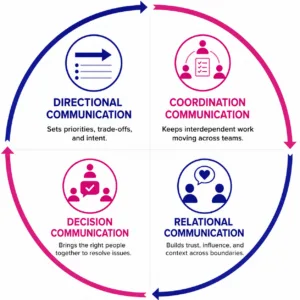
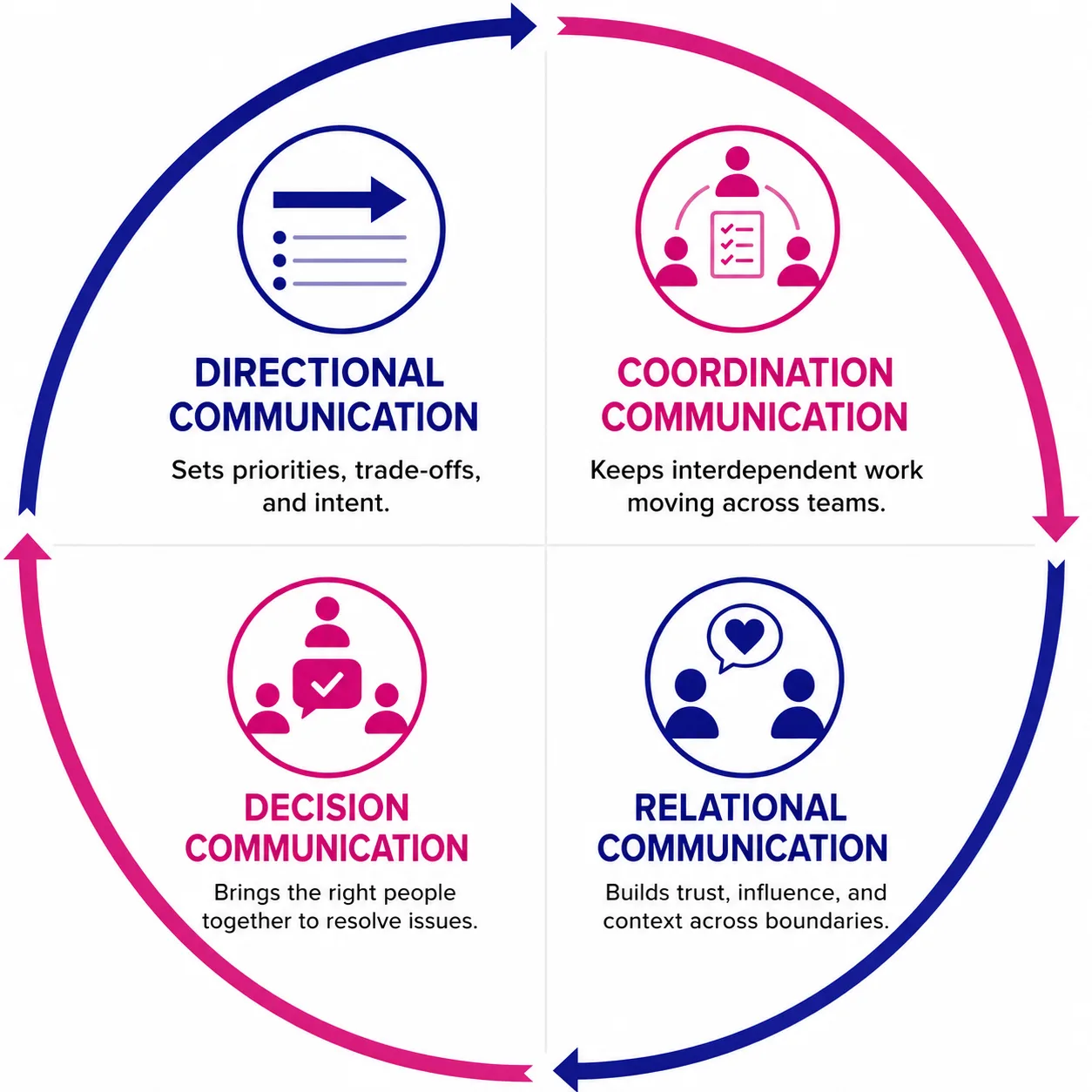
Once leaders distinguish these four types, the diary becomes easier to manage. Weekly team meetings do not need to carry every issue. Some matters belong in short cross-functional coordination forums. Others require a decision meeting with a defined owner and timeframe. Many are better handled asynchronously through a short written update or a “boundary artefact” such as a shared dashboard or document. And a few need a one-to-one conversation because deeper influence and trust will not be built in a crowded meeting.
Leadership behaviors that improve communication cadence across multiple teams
- Be explicit about the purpose of each forum. If a meeting exists, people should know why it exists. Is it for coordination, decisions, or problem solving? If the answer is “a bit of everything,” the meeting is probably doing too much. Leaders who manage communication cadence well give each forum a job and defend that boundary. One principle from our effective meetings training is that updates never require a live meeting start by taking updates out of your meetings and providing them asynchronously.-
- Match the rhythm to the work, not to habit. Some teams need a fast weekly coordination cycle. Others only need a monthly review and a clear escalation path. Do not run the same cadence everywhere because it feels tidy. In matrix work, the tempo should reflect interdependence, risk, and decision frequency.
- Reduce attendance. Many meetings are painful because too many people are there. If everyone is invited “just in case,” communication becomes passive and slow. A better discipline is to clarify who decides, who contributes, and who simply needs an outcome summary afterwards. A good rule of thumb is that once a meeting exceeds 5 to 7 people quality tends to decline.
- Use asynchronous communication more intelligently. Leaders often say they want fewer meetings, then continue to use live meetings for information sharing that could have been done by email. A short pre-read, a brief status note, a shared dashboard, or a disciplined action summary can remove a surprising amount of diary pressure.
- Build predictable touchpoints with key peers. In multiple-team environments, many breakdowns happen between teams rather than within them. A short regular touchpoint with a peer leader can prevent hours of downstream confusion. These conversations are not bureaucracy. They are maintenance for the horizontal system.
- Close the loop every time. Nothing damages cadence faster than uncertainty about what was agreed, who owns the next step, or when the issue will be revisited. Strong matrix leaders end conversations with clarity on decisions rights and involvement, actions, owners, and timing. They do not assume shared understanding. They make it visible.
- Discuss multiple cadences at leadership levels. But leaders are established in you team in particular it’s important to beware if the existing communication commitments of team members. This is a useful topic to discuss at kickoff meetings. We should also align with other leaders who are driving part of the time of our team members to help simplify frequency of meetings in particular
- Give team members the choice. A leader cannot be fully up to date with every goal and priority of an individual working on their team who also sits on three or four other teams. We have to trust and enable these individuals to manage their own priorities and trade-offs. We should expect them to explain why they’re doing this but we should recognise that they are the best people to exercise the choice on which meeting to attend. If that choice consistently goes against you then it’s valid to understand whether those priorities are accurate – and you should do this discussion with their line manager if it is not you.
A quick audit for leaders
If your diary feels out of control, start here. Ask yourself:
- Which recurring meetings directly support decisions or coordination?
- Where am I using live meetings for information that could be shared asynchronously?
- Which cross-functional relationships need a more regular rhythm?
- Where do my teams leave discussions unclear on ownership or timing?
- Which forums contain too many people and too little accountability?
- Where do I really need to be involved and what could you delegate to others?
You might also find our guide on how to have fewer, better meetings useful.
Where this fits in the bigger picture
For a more complete framework, see our full guides on matrix management and cross-functional teams. Communication cadence matters, but it works best when combined with clearer decision rights, stronger peer alignment, and better leadership across boundaries.
If your leaders are overloaded by meetings, struggling to align across functions, or finding that cross-functional execution is slower than it should be, it may be time to build these skills more deliberately. We help organizations create practical leadership development pathways for matrix management and cross-functional collaboration. You might also find it useful to have a conversation with one of our leadership development specialists to see what other leading organisations are doing in this area.
Explore our training programs to see how we can help.
Virtual Teams Training People and purpose Training Matrix Management Training Cross functional teams Training Agile & Digital TrainingEducate yourself further with a few more of our online insights:
30 years of experience learning with a range of world class clients
We work with a wide range of clients from global multinationals to recent start-ups. Our audiences span all levels, from CEOs to operational teams around the world. Our tools and programs have been developed for diverse and demanding audiences.

Tailored training or off the shelf modules for your people development needs
We are deep content experts in remote, virtual and hybrid working, matrix management and agile & digital leadership. We are highly flexible in how we deliver our content and ideas. We can tailor content closely to your specific needs or deliver off the shelf bite sized modules based on our existing IP and 30 years of training experience.
For more about how we deliver our keynotes, workshops, live web seminars and online learning.