Managing constant change in matrix and cross‑functional organizations?
In matrix and cross‑functional organizations, change no longer arrives in discrete programs with a clear start and finish. Instead, leaders operate in an environment of overlapping strategic shifts, evolving structures, accelerating technology, and rising collaboration demands. This article explains why managing constant change is inherent to matrixed environments, why traditional change models fail, how change itself has transformed over the last decade, and what leaders must do differently—especially when transitioning to a matrix structure. See more about the challenges of matrix management in our definitive guide.
What problem are leaders facing when managing constant change?
In matrix and cross‑functional organizations, leaders are not struggling with too much change in the abstract. They are struggling with too many simultaneous, interconnected changes occurring across strategy, structure, systems, and skills.
Unlike functionally siloed organizations, matrix environments amplify change because:
- Priorities flex constantly between the needs of business units, functions, geographies and the need to balance the global and the local
- Work flows across multiple teams, priorities, and stakeholders
- Authority is distributed rather than centralized
- Dependencies are higher and more visible
- Decisions require alignment rather than command
As a result, even small changes ripple quickly across the organization—slowing decisions, creating accountability gaps, and increasing friction between functions.
This is why managing constant change is not a “change management” issue. It is a core leadership and collaboration challenge in matrix and cross‑functional work.
Managing constant change fails when leaders treat change as an event rather than an operating condition.
It persists because:
- Strategy no longer stabilizes long enough to anchor change and trends like AI do not have a known destination, just an imperative to get started and learn.
- Structural reorganization is overused as a proxy for progress and causes change ripples of its own.
- Technology is now driving strategy and enabling new waves of opportunity and change.
- People capability has not kept pace with the pace of change
Effective leaders respond by:
- Shifting from programmatic change to capability‑based leadership, experimentation and fast adaptation.
- Leading through influence, alignment, and prioritization
- Developing collaboration skills during change, not after it
- Treating matrix capability as the primary stabilizer in a dynamic system
Why is constant change more intense in matrix and cross‑functional structures?
Because matrix organizations multiply dependencies
Matrix structures are designed to increase integration, speed, and resource efficiency. However, they also multiply points of dependency, which means any change—strategic, structural, or technological—has wider and faster impact.
In practice, this means:
- Strategy changes affect multiple teams simultaneously
- Structural shifts create overlapping role and priority ambiguity
- System changes alter workflows across functions
- Skills gaps surface immediately in execution
This is not a design flaw. It is the price of operating at scale in complex, interconnected environments. The more connected we are, the more every change creates knock-on change for others.
Managing constant change therefore requires leaders who can work across the matrix, not just within their vertical.
Why traditional change models no longer work
Most classic change models assume:
- A stable “current state”
- A defined “future state”
- A linear transition between the two
That assumption no longer holds.
According to the traditional Four Waves of Change framework, strategy, structure, systems, and skills develop and are aligned sequentially one after the other. Today they are evolving simultaneously and constantly.
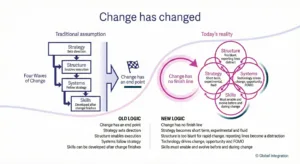
The old change logic breaks down because:
| Traditional assumption | Matrix reality |
| Change has an end point | Change has no finish line |
| Strategy sets direction | Strategy becomes short term, experimental and fluid |
| Structure enables execution | Structure is too blunt for rapid change, reporting lines become a distraction |
| Systems follow strategy | Technology drives change, opportunity and FOMO |
| Skills can be developed after change finishes | Skills must enable and evolve before and during change |
This is why leaders experience “change fatigue” even when individual initiatives are well‑designed. The issue is not resistance—it is cognitive and coordination overload.
How has change itself changed in the last 10 years?
The last decade has fundamentally altered the nature of organizational change.
Wave 1: Strategy has become fluid and experimental
Strategy is no longer a multi‑year, stable anchor. It is shorter‑term, iterative, and constantly adjusted in response to market shifts, digital pressure, and AI‑driven possibilities.
For leaders, this means:
- A lack of clarity on the final destination (who knows where AI may lead) together with an urgency to get started and learn
- Fewer clear “big change moments”
- Constant experiments and course changes as we iterate and learn
- More frequent priority resets
- Ongoing trade‑off decisions in the matrix
Wave 2: Structure is overused—and under‑delivers
As strategy becomes fluid, organizations repeatedly restructure. However, constant reorganization creates churn without solving underlying coordination issues.
In matrix environments, this often increases:
- Role ambiguity
- Decision delays and unclear decision rights
- Power struggles between functions
- Network disconnects
Structural change is too slow and imprecise to deliver the collaboration we need. Fixating on structure and control can be a distraction in getting things done
Wave 3: Systems are now driving strategy
Investment in enterprise systems, collaboration platforms, data, and AI has accelerated dramatically, with technology increasingly shaping what organizations can do strategically and constantly opening up new possibilities.
Change is no longer optional or gradual—it is embedded in the tools people use every day.
The promise of opportunities and fear of missing out is driving huge investments in generative AI, systems spending has tripled as a percent of revenue in the last 10 years.
Wave 4: Skills have not kept pace
Despite massive change, investment in leadership capability has remained comparatively low and has remained at less than 1.5% of turnover for the past 10 years (compared to 8.5% on systems in 2025.
This has created a change and AI adoption gap that now limits transformation more than strategy or technology.
Some companies have already stated to delay further investments in AI as they are not seeing the adoption rates and productivity changes that justify the expense. This is not a technology problem it is limited by the willingness and capability of people to adopt and adapt the tools.
This is where managing constant change succeeds—or fails.
What does managing constant change require from leaders?
Managing constant change is not about motivating people through disruption. It is about reducing friction while direction keeps shifting.
In matrix environments, effective leaders focus on:
- Prioritization across competing demands
- Alignment without formal authority
- Decision clarity in shared ownership
- Progress without full certainty
Traditional authority‑based leadership fails because leaders cannot “own” all the variables. Influence, negotiation, and collaboration become the primary levers.
How do we manage the transformation to a matrix structure: from structural change to operating capability
Transforming to a matrix structure is often treated as a structural redesign. In practice, it is a permanent shift in how change shows up in the organization.
The Four Waves framework makes this explicit: structure is only one of four forces changing simultaneously. When organizations move to a matrix without addressing strategy fluidity, system acceleration, and people capability, the result is constant instability rather than constant performance.
Why do matrix transformations amplify constant change
A matrix does not just increase complexity; it exposes complexity that already exists.
Once work is distributed across functions, geographies, and priorities:
- Strategy changes propagate faster because more teams are connected to the same outcomes
- Structural ambiguity becomes visible rather than hidden in silos
- Systems changes alter workflows across multiple reporting lines at once
- Skills gaps surface immediately in execution, not years later
This is why leaders experience matrix transitions as “never finished.” The matrix removes buffers that previously absorbed change.
The most common misdiagnosis: “we need more clarity”
During matrix transformations, leaders often respond to friction by doubling down on:
- Role descriptions
- RACI models
- Governance layers
- Escalation paths
These tools can help—but they cannot stabilize a system where strategy, systems, and priorities are constantly shifting. Instead we need to get 80% clear and 100% committed.
The Four Waves framework highlights a critical insight: structure is now too blunt an instrument to manage rapid change, yet organizations repeatedly reorganize because it creates the feeling of progress.
In matrix transitions, this leads to re‑organizing churn rather than improved execution.
What changes when you move to a matrix?
A matrix transformation fundamentally alters four leadership realities:
1. Strategy becomes harder to translate
Strategy is now shorter‑term, more experimental, and more frequently reset. In a matrix, leaders must interpret strategy across multiple dimensions simultaneously, without waiting for stability that never arrives.
2. Authority is replaced by negotiated alignment
Matrix leaders cannot rely on hierarchy to drive execution. Progress depends on influencing peers, trading priorities, and resolving conflicts in real time.
3. Systems drive behavior faster than structure
Investment in enterprise systems, collaboration platforms, data, and AI has accelerated dramatically and is now shaping how work gets done.
In matrix environments, systems redefine workflows across functions overnight—often faster than leaders can adapt.
4. Skills become the limiting factor
Despite this acceleration, investment in people capability has lagged. We have systematically underinvested in skills during a period of massive change, creating a growing change and AI adoption gap.
The hidden risk: treating matrix capability as “post‑change”
Many organizations assume they can:
- Implement the matrix
- Take time to align the structure
- Let people adjust
- Develop collaboration skills later
The Four Waves framework directly challenges this assumption. It states that organizations cannot wait for strategy, structure, and systems to stabilize before developing people capability.
In a matrix, that stabilization never comes.
As a result, leaders are asked to operate in constant change without the skills to manage trade‑offs, shared accountability, or influence at scale.
People in the midst of a matrix transformation who do not have the matrix management capabilities to lead the new ways of working can fall back on counterproductive legacy ways of leading and working.
It’s not surprising that some conclude they will keep their heads down and wait for the next reorganisation to come along in a couple of years.
What successful matrix transformations do differently
Organizations that manage constant change well during a matrix transition shift their focus from design to operating capability.
They explicitly develop leaders to:
- Make prioritization decisions across competing functional goals
- Hold boundary‑spanning conversations rather than escalate conflict
- Agree “good enough” decisions in ambiguous conditions
- Maintain momentum when roles, teams, and priorities are fluid
Rather than trying to remove ambiguity, they teach leaders how to work with it.
Reframing the goal of a matrix transformation
The real objective of a matrix transformation is not clarity, stability, or control.
It is to build an organization that can:
- Absorb frequent strategic rebalancing
- Integrate system‑driven change
- Coordinate across functions at speed
- Perform without waiting for certainty
From this perspective, managing constant change is not a side effect of the matrix—it is the core leadership requirement the matrix makes unavoidable.
This is why matrix transformations succeed or fail based on leadership capability, not organizational design.
Leadership and collaboration behaviors that enable constant change
In matrix and cross‑functional environments, managing constant change depends less on resilience rhetoric and more on specific, observable behaviors.
High‑impact leadership behaviors include:
- Context setting over instruction – explaining “why now” rather than “what to do”
- Explicit trade‑off conversations – naming what will not be done
- Boundary management – actively coordinating across functions
- Decision framing – clarifying who decides, who contributes, and who executes
- Progress signalling – reinforcing momentum without false certainty
These behaviors reduce noise, not change itself.
How AI is reshaping constant change in matrix organizations
AI is accelerating constant change in three critical ways:
- Strategy cycles are shortening further as AI enables rapid experimentation
- System‑driven workflows are redefining how work moves across functions
- Skill obsolescence and reinvention are happening simultaneously
- AI enables new work we hadn’t imagined or had time for before
For matrix leaders, AI increases the need for:
- Cross‑functional sense‑making
- Faster alignment decisions
- Ongoing capability development
- Understanding the right questions to ask
- Applying critical thinking to AI outputs
- Learning to augment their human capabilities with AI support
AI does not simplify change—it raises the premium on implementation capability.
How this fits into the broader challenge of managing constant change
Managing constant change is one component of effective leadership in complex organizations.
For a complete framework that connects matrix management and cross‑functional execution, see our full guide on matrix management.
A consultative next step for leaders and L&D teams
Organizations do not fail at managing constant change because they lack intent. They fail because leadership capability has not evolved as fast as the environment.
If you are:
- Experiencing constant re‑prioritization and collaboration overload
- Investing in systems faster than people capability
- Transitioning to or operating in a matrix structure
Then the next step is not another change initiative—but a structured leadership development pathway designed for constant change.
Speak with a leadership training advisor to explore how to build matrix‑ready leadership capability that holds under constant change.

Explore our training programs to see how we can help.
Cross functional teams Training Agile & Digital Training Matrix Management Training People and purpose Training Virtual Teams TrainingEducate yourself further with a few more of our online insights:
30 years of experience learning with a range of world class clients
We work with a wide range of clients from global multinationals to recent start-ups. Our audiences span all levels, from CEOs to operational teams around the world. Our tools and programs have been developed for diverse and demanding audiences.

Tailored training or off the shelf modules for your people development needs
We are deep content experts in remote, virtual and hybrid working, matrix management and agile & digital leadership. We are highly flexible in how we deliver our content and ideas. We can tailor content closely to your specific needs or deliver off the shelf bite sized modules based on our existing IP and 30 years of training experience.
For more about how we deliver our keynotes, workshops, live web seminars and online learning.