How to influence without authority – getting things done in complex organizations
As formal power becomes increasingly diffuse, leaders must rely on trust, clarity, expertise, and networks rather than positional control. This guide explores why authority is no longer sufficient, what effective influence looks like in complex systems, and the practical behaviors leaders use to move people and work without relying on hierarchy. Influence without authority is the defining leadership capability in today’s matrix management and cross‑functional organizations
Why is influence without authority so critical today?
Most leaders in matrix, cross‑functional, or virtual environments cannot rely on traditional power structures to get work done. Reporting lines are ambiguous, decision‑making is distributed, and teams are spread across geographies and competing priorities. Although titles still exist, real execution depends less on who people report to and more on how effectively leaders navigate relationships, networks, and shared goals.
Stakeholder identification & analysis methods for complex organizations (Bryson, 2004)
Influence is more powerful than authority in day-to-day management
Inside complex organizations, leaders frequently find themselves accountable for outcomes delivered by people who do not report to them, stakeholders whose objectives diverge from theirs, and teams they only influence indirectly. In these contexts, relying on authority slows work down, creates friction, and encourages escalation. Teams wait for direction that may never come, stakeholders disengage when they feel pressured, and decisions stall when leaders depend on formal powers that do not map to real‑world interdependencies.
Even on the occasions where we do have access to formal or authority the exercise of power tends to create resistance. We may be able to force people to do something, but this won’t bring their best work. Even when we do have power, influence may be a better choice.
This challenge is structural, not personal. Matrix and cross-functional organizations intentionally separate “who people work for” from “what they work on.” While this design allows for agility and cross‑boundary collaboration, it also means leaders must persuade rather than instruct. When role clarity is inconsistent, when priorities compete, and when functional, geographic, and customer demands overlap, influence becomes the only reliable leadership tool.
For deeper context on how organizations operate in this environment, explore our broader guide to matrix management.
Influence without authority is not just a useful skill; it is a survival capability for leaders tasked with delivering results across boundaries and functions—often with limited control, multiple bosses, and an overextended stakeholder network.
Without this skill, leaders experience decision bottlenecks, conflicts over resources, slow execution, and unclear accountability. With it, they unlock speed, alignment, and distributed ownership in environments designed around collaboration rather than command.
Why is influence without authority difficult for experienced leaders?
The difficulty does not stem from a lack of competence. Instead, it comes from the mismatch between traditional leadership models and the realities of modern organizational design. For decades, leaders were taught to rely on positional authority, decision rights, and role‑based clarity. In today’s systems, these assumptions do not hold.
Three enduring factors make influence without authority a persistent challenge:
- Authority is often ambiguous or shared.
Many leaders operate where responsibility is high, but authority is limited. They must convince rather than command, align rather than assign, and negotiate rather than direct. - Relationships shape outcomes more than structures do.
Work flows through networks—formal, informal, cross‑functional, and interpersonal. Leaders who fail to understand these networks struggle to create movement. Those who invest in relationships gain access, support, and alignment when it matters.
Read this classic, widely‑cited paper on network ties spreading information and influence across groups.
- Many leaders default to the wrong tactics under pressure.
When deadlines loom or stakeholders resist, even experienced leaders often revert to authority‑based behaviors, particularly if they have never been trained in the alternatives: insisting, escalating, or instructing. In matrix systems, these behaviors backfire. They diminish trust, weaken cooperation, and push stakeholders toward avoidance.
What do effective leaders do differently?
Research consistently highlights what differentiates high‑influence leaders:
- They invest early in “good enough” clarity—about goals, roles, expectations, and success criteria.
- They map their network and intentionally build relationships with influential stakeholders.
- They adapt their influencing tactics to the individual, the context, and the moment.
- They understand multiple sources of power—personal, expert, relationship‑based, informational, and normative—and use them with intention.
- They shape proposals in ways that align with others’ goals, motivations, and values.
- They influence indirectly through allies, advocates, and strategic sequencing when direct influence is not possible.
- They practice persuasive communication
These leaders succeed because they understand how modern organizations actually function: through cooperation, not compliance.
What specific barriers block leaders from influencing effectively?
Why do traditional authority‑based approaches fail?
Authority‑based leadership assumes the ability to set priorities, allocate resources, define roles, and determine timelines. But in matrix environments, leaders rarely own all—or even most—of these levers. When they attempt to use authority they do not fully possess, stakeholders resist, delay, or disengage. The illusion of formal control collapses when people realize decisions are distributed across functions, geography, or specialties.
Traditional approaches fail for several reasons:
- They create defensiveness. Stakeholders feel pressured or overridden.
- They highlight the leader’s lack of real control. This weakens credibility.
- They ignore the interdependent nature of modern work. Influence must extend both sideways and diagonally, not just downward.
- They reduce collaboration. Peers do not respond well to attempts at hierarchy.
- They stall decisions. People escalate disagreements rather than solving them.
- They create resistance – nobody likes to feel controlled
What skill gaps appear most often?
Lack of clarity
Leaders cannot influence effectively if they are unclear about what they need others to know, do, or feel.
Limited understanding of stakeholder motivations
Influence begins with empathy. Many leaders skip the step of learning what each person values.
Weak network intelligence
Some leaders do not recognize who truly shapes decisions or how influence flows across the system.
Overreliance on rational arguments
Facts alone rarely shift behavior. Influence requires a wider range of tactics: emotional appeal, shared goals, social proof, credibility, and values.
Inconsistent follow‑through
Stakeholders choose to support leaders who demonstrate reliability, fairness, transparency, and consistency over time.
What leadership behaviors strengthen influence without authority?
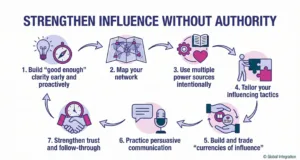
1. Build “good enough” clarity early and proactively
Influence strengthens when expectations are explicit. Effective leaders:
- Establish shared outcomes and success measures
- Surface assumptions instead of letting them harden into misunderstanding
- Clarify interdependencies before execution begins
- Align timelines, decision rights, and responsibilities
Clarity prevents conflict, reduces rework, and minimizes the need for escalation.
2. Map your network to understand how work really moves
Stakeholder network mapping is one of the most powerful influence tools available. It helps leaders:
- Identify allies, blockers, decision‑makers, and informal influencers
- Understand hidden power structures or informal coalitions
- Prioritize time and effort based on network leverage
- Sequence influence strategically rather than reacting in real time
A clear influence map turns a complex system into an actionable landscape.
3. Use multiple power sources intentionally
Internal frameworks identify several sources of power beyond positional authority:
- Expert power (credibility through knowledge)
- Personal power (trust, integrity, authenticity)
- Relationship power (connection, shared experience)
- Information power (access to data or insights)
- Normative power (values, expectations, cultural alignment)
- Reward or recognition power (offering support, visibility, opportunity)
This HBR article looks at the power of liking, reciprocity, social proof, authority, consistency and scarcity.
Exceptional leaders do not rely on a single source; they combine and adapt them thoughtfully.
4. Tailor your influencing tactics to the individual and the moment
Influence is situational. Leaders who succeed adjust their approach by asking:
- What does this person care about?
- How do they prefer to receive information?
- What are their goals, pressures, and concerns?
- What will make cooperation easy or attractive for them?
Effective tactics include:
- Shared goals and alignment frames
- Storytelling and emotional resonance
- Credibility‑based persuasion
- Strategic use of data
- Coalition‑building and indirect influence
- Framing proposals in terms of others’ priorities
No single tactic works universally; influence requires range.
5. Build and trade “currencies of influence”
Currencies of influence are the things people value—speed, autonomy, recognition, learning, risk reduction, or visibility. Leaders who understand and trade these currencies generate cooperation without using authority. When leaders make it easier or advantageous for others to say yes, influence accelerates.
6. Practice persuasive communication
Learn the principles of persuasive communication and apply them to your messages
- Start with the other person’s priorities, not your own
- Frame messages in terms of shared goals and mutual benefit
- Be clear, concise, and concrete about what you’re asking for
- Use evidence and examples that matter to your audience
- Balance logic with emotion, credibility and trust
- Anticipate concerns and address them openly
- End with a clear, actionable next step
7. Strengthen trust and follow‑through
Trust amplifies influence. It comes from:
- Consistency over time
- Delivering on commitments
- Demonstrating fairness
- Treating stakeholders with respect
- Sharing credit rather than hoarding it
In environments where authority is limited, trust becomes the most stable form of power.
These principles form the framework for the influencing without authority module within our matrix management learning path.
How does influence without authority fit into the bigger picture of leadership?
Influence without authority is only one part of the broader capability set needed to lead complex organizations. It connects directly to decision speed, clarity, accountability, network design, and cross‑functional collaboration. When leaders master influence, they contribute to a system where decisions happen closer to the work, teams take shared ownership, and organizations move with greater agility.
Learn how influence plays out in cross‑boundary collaboration in our guide to cross-functional teams..
What practical steps can leaders take next to strengthen their influence?
1. Diagnose your influence challenge
Identify whether your barrier is clarity, credibility, network position, stakeholder alignment, or prioritization conflict.
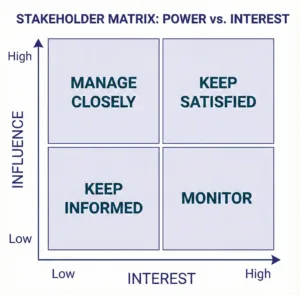
2. Build or refresh your stakeholder map
List each stakeholder’s goals, pressures, motivations, preferred communication styles, and potential influence. Update this map monthly or when priorities shift.
Don’t forget to prioritize how you will manage these stakeholders
3. Select influence tactics intentionally
Avoid defaulting to the same style of rational argument every time. Match tactics to people, context, and timing.
4. Connect your goals to theirs
Frame proposals in ways that help others achieve their objectives. Influence grows when your success supports theirs.
5. Invest in relationships before you need them
Influence is like a bank account; deposits must come before withdrawals. Build credibility and trust through small, consistent behaviors.
6. Practice influence on real work
Use current initiatives as live influence laboratories. This builds skill, resilience, and judgment far faster than theory alone.
How can AI strengthen our influence without authority
AI does not replace the human skills at the heart of influence—judgment, trust, empathy, and credibility—but it can significantly enhance how leaders apply them in complex organizations. Used well, AI acts as a force multiplier for clarity, insight, and consistency.
Improving stakeholder and network intelligence
By synthesizing inputs from documents, meetings, messages, and plans, AI can support leaders in spotting patterns: who is involved, where dependencies sit, which concerns recur, and where influence or resistance is likely to emerge. This strengthens stakeholder mapping and helps leaders sequence influence more intentionally.
Tailoring messages to different stakeholders
Influence improves when messages land in ways that matter to the recipient. AI can assist leaders in adapting language, emphasis, and framing for different audiences—helping translate the same proposal into versions that speak to functional priorities, risk concerns, or strategic goals without diluting intent.
Enhancing persuasive communication
AI can help leaders test arguments, surface counter‑points, and strengthen narratives before conversations happen. By pressure‑testing logic, evidence, and emotional resonance in advance, leaders arrive better prepared for dialogue rather than debate.
Supporting follow‑through and consistency
Influence compounds through reliability. AI can help leaders track commitments, summarize agreements, and maintain continuity across complex initiatives—reducing dropped threads and reinforcing trust through consistent follow‑up.
Freeing capacity for human judgment and relationships
Perhaps most importantly, AI reduces cognitive and administrative load. By handling synthesis, drafting, and analysis, it gives leaders more time and energy for the work AI cannot do: building relationships, reading the room, exercising judgment, and making principled choices under uncertainty.
Used thoughtfully, AI can strengthen influence not by adding authority, but by increasing clarity, responsiveness, and credibility—exactly the capabilities leaders need when authority alone is no longer enough.
If you or your teams are navigating influence challenges in matrixed, cross‑functional, or hybrid environments, we help leaders develop the skills to succeed without relying on authority. Speak with a leadership training advisor or explore our detailed guide to matrix management.

Explore our training programs to see how we can help.
Cross functional teams Training Agile & Digital Training Matrix Management Training People and purpose Training Virtual Teams TrainingEducate yourself further with a few more of our online insights:
30 years of experience learning with a range of world class clients
We work with a wide range of clients from global multinationals to recent start-ups. Our audiences span all levels, from CEOs to operational teams around the world. Our tools and programs have been developed for diverse and demanding audiences.

Tailored training or off the shelf modules for your people development needs
We are deep content experts in remote, virtual and hybrid working, matrix management and agile & digital leadership. We are highly flexible in how we deliver our content and ideas. We can tailor content closely to your specific needs or deliver off the shelf bite sized modules based on our existing IP and 30 years of training experience.
For more about how we deliver our keynotes, workshops, live web seminars and online learning.