A practical guide to cross‑functional team working
Cross‑functional team working is now the operating system of modern enterprises. As organisations become more global, digital, and interdependent, success increasingly depends on the ability to coordinate across boundaries: functions, geographies, products, time zones, and cultures. This guide explains what cross‑functional working really requires and offers practical strategies for accountability, decision‑making, influence, alignment, leadership, culture and incentives. If you need to build the skills of your cross-functional leaders and teams see our cross-functional teams training.
Why is cross-functional team work so common?
Cross‑functional team working is the ability of people from different functions, disciplines, and business units to collaborate effectively to meet shared goals.
While many organisations talk about “breaking down silos,” the reality is more complex: people today must work across more boundaries than ever before. They collaborate with colleagues they do not manage, who have different priorities, incentives, and cultures, and who may be dispersed across multiple time zones and working with different systems and technologies. Cross‑functional working is no longer a “nice‑to‑have”—it is the central mechanism through which modern enterprises create value and it requires specific capabilities.
Three major shifts have made cross‑functional work essential:
- Work has outpaced hierarchy.
Traditional command‑and‑control structures cannot keep up with the speed of digital transformation, customer expectations, and global competition. Work now flows across functions faster than authority does. - Most professionals operate in a matrixed way of working —even if not part of a formal matrix structure.
A matrix is no longer limited to having more than one boss. It includes anyone who works in multiple teams or with multiple stakeholders. If you work in multiple teams, you effectively have multiple bosses and completing goals. This is now the default environment for most professional and managerial work. - Enterprise‑level value and outcomes require cross‑functional collaboration.
Everything from innovation to customer experience to transformation depends on functions aligning rather than competing. Real added value business outcomes don’t fit neatly within our traditional silos and complex products and solutions require multidisciplinary inputs to develop and operate.
Yet despite this reality, many organisations still struggle. Projects stall, decisions slow, accountability evaporates, and teams get trapped in endless alignment meetings. The solution is not to “fix the structure” but to build cross‑functional capability—a set of skills, systems, and shared behaviours that allow teams to work effectively across boundaries.
This requires building new skills, ways of working and cultures and traditional team building approaches tend to ignore many of the most critical challenges that more complex cross functional teams face.
This guide unpacks the key elements of cross‑functional excellence and provides practical, evidence‑based tools leaders can apply immediately.
If your cross-functional working is in a matrix organization here are some additional matrix management challenges.
Why is accountability so difficult in cross‑functional teams?
Few leaders are trained to manage accountability without control, yet this is a defining challenge of cross‑functional work. Cross-functional leaders are responsible for results, but do not own the people, the resources, or the priorities. The functions that form part of your team may have other urgent demands and priorities.
Escalation is often unclear. Decision rights are ambiguous. Cross-functional communication brings additional challenges. Leaders caught in the middle feel squeezed from all sides.
Cross-functional team members need to understand the impact of the work they do and the accountabilities they deliver as part of an overall value chain with shared accountability. This is challenging when, in many organisations, goals are still set by the functional lines.
Cross‑functional accountability breaks down when
- No one is sure who owns what.
- People focus only on deliverables they control.
- Functions protect their own priorities rather than enterprise goals.
- Escalation routes are political rather than criteria‑based.
- Commitments are tracked inconsistently or buried in email threads.
These issues are not signs of incompetence—they are systemic, built into the design of cross‑functional work.
The fact that many cross-functional teams are also virtual teams adds complexity.
To build accountability without control, teams need:
- An acceptance that accountability without control is normal and healthy – it takes team members out of their silos and keeps them focused on the overall deliverables of the team. This should be embedded an individual’s goals, measures of success and rewards.
- Clarity of ownership where we can (A light touch use of RACI or similar frameworks – although shared ownership is normal in cross functional teams).
- Objective escalation rules (“Escalate when X, Y, Z conditions are met”).
- Transparent commitment‑tracking (one shared source of truth).
- Agreed service levels between functions (response times, deliverable quality).
- A shared understanding of enterprise priorities that outweigh local optimisation.
What is a typical cross-functional team alignment failure scenario?
We worked with a cross functional team in a pharmaceutical company affiliate which was responsible for the launch of a new drug. Each of the functional members had met their goals for the year but the drug didn’t get launched. Everyone had met their functional goals but only the team leader had a clear accountability and set of goals around the timing of the launch.
It was only when everyone had a shared launch accountability built into their goals, recognised in their key metrics and forming part of the performance evaluation that the team really got focused on the launch.
You may also face challenges with managing a blend of generalists and specialists from different disciplines.
How can a team charter help?
One of the simplest and most powerful tools is the Cross-Functional Team Charter, which defines:
- Shared accountabilities embedded into people’s goals, metrics and rewards
- Roles
- Governance
- Decision‑rights
- Expected behaviours
- Escalation rules
- Communication rhythms
Teams that invest the time to define these things early outperform those that rely on informal relationships and “good intentions.”
How do you speed up decision‑making across functions?
When decision‑making spans functions, everything slows down: information sits in silos, stakeholders disagree, meetings proliferate, and no one knows who gets the final say. The result is decision drift—a common failure mode in cross‑functional and matrix organisations.
Decision drift occurs when:
- Everyone is consulted, but no one is accountable.
- Functions have conflicting KPIs or priorities.
- Information is fragmented across tools or teams.
- People escalate too quickly—or not quickly enough.
- Decisions are made repeatedly because they were not documented.
Successful cross‑functional teams adopt a decision‑making architecture—a clear and repeatable system for how decisions get made.
The most common frameworks include:
- RACI (Responsible, Accountable, Consulted, Informed)
- DACI (Driver, Approver, Contributor, Informed)
- RAPID (Recommend, Agree, Perform, Input, Decide)
Each has advantages. DACI works well for projects; RAPID suits large transformations; RACI adds clarity to operational processes.
The key is to use them at the right level, it’s easy to spend months on a detailed RACI analysis that is out of date when it’s launched from that nobody uses. Instead use these tools at a high level to establish principles and to solve specific problems. Don’t use them as an excuse not to get started and learn.
A powerful addition is the Decision Log: a living record of what was decided, by whom, when, with which rationale. Decision logs reduce rework, speed onboarding, and eliminate “shadow decisions” that undermine trust.
It’s also useful if decisions get regularly revisited (which can happen in cross functional teams) you can then go back and look at why the decision was revisited and whether that is a regular problem. This can give valuable pointers on whether you are consulting and informing people appropriately around your decisions or whether you are using the right information.
How do you influence without authority in cross‑functional teams?
In cross‑functional work, influence is the currency of progress. Because leaders rarely control people or priorities directly, they must lead through relationships, credibility, negotiation, and value exchange.
This can be challenging but enables cross-functional managers to become better leaders. In general people prefer to be led through influence rather than hierarchy.
One of the most robust models is the Cohen‑Bradford “Currencies of Influence” framework, which identifies six categories of influence currency:
- Inspiration‑related currencies (purpose, meaning, vision)
- Task‑related currencies (resources, information, support)
- Position‑related currencies (recognition, reputation)
- Relationship‑related currencies (inclusion, personal connection)
- Personal currencies (gratitude, respect)
- Principle‑related currencies (shared values, fairness)
Cross‑functional teams succeed when leaders match the “currency” to the person and context. For example, influencing a Finance director may require data and clarity; influencing Marketing may require vision and creativity; influencing Engineering may require technical respect.
Influence‑without‑authority also depends on stakeholder mapping—identifying:
- Who has power over the outcome
- Who has interest or exposure
- Who needs to be consulted
- Who may resist
- Where alliances or leverage points exist
Many cross‑functional initiatives fail not because they lack process, but because they lack relationship capital—the trust required to collaborate across boundaries.
See more on influence without authority.
How do you create cross‑functional team alignment that sticks?
Cross‑functional alignment is not about getting everyone to agree 100%. It is about creating enough shared clarity that people can move forward at speed, even when their incentives, cultures, and priorities differ.
Some of our clients use the phrase “80% aligned, 100% committed”.
Many leaders attempt alignment through meetings alone—endless conversations that feel productive in the moment but rarely change behaviour. Real alignment requires structure, shared outcomes, and repeatability.
Alignment often breaks down in cross‑functional teams for predictable reasons:
- Competing or conflicting goals between functions (e.g., Sales wants speed; Risk wants certainty).
- No shared accountabilities or prioritisation model, so every function pushes its own agenda.
- Vague or competing definitions of success, often shaped by local KPIs.
- Lack of visibility into interdependencies, capacity, or constraints.
- Slow information flows between functions, especially when tools don’t integrate.
To build alignment that survives pressure, leaders must create three types of clarity: strategic, operational, and behavioural.
In a high change environment priorities could change several times in a year so this can’t be an annual process, it needs to generate check-ins when things change.
Strategic clarity: What are we trying to achieve, and why?
Cross‑functional teams need a clear, shared purpose. This is not a slogan; it is an explicit definition of what matters most at the enterprise level, expressed in language that all functions understand. One powerful tool is the Shared OKR (Objectives and Key Results) model.
Shared OKRs enforce alignment because:
- They define success collectively, not functionally.
- They force clarity on outcomes rather than tasks.
- They show how each function contributes to enterprise value.
For example:
Objective: Reduce customer onboarding time globally.
Key Results:
- Reduce handoff delays between Sales, Product, and Operations from 10 days to 3.
- Implement single‑view customer tracker across regions.
- Increase cross‑functional SLA adherence from 65% to 90%.
OKRs like these promote collaboration because no single function can achieve them alone.
Operational clarity: Who does what, when, and how?
Operational alignment is where teams often fail. They agree on “what” but not “how”. This is why cross‑functional teams benefit from tools such as:
- Dependency maps (visualising where one team relies on another).
- Handoff checklists (ensuring work transitions smoothly).
- Service‑level agreements (SLAs) between functions.
- Operating rhythms (cadences for updates, reviews, escalations).
A cross‑functional dependency map typically includes:
- Key workstreams
- Deliverables
- Required contributors
- Risks associated with delays
- Escalation thresholds
This prevents the classic scenario in which one function quietly deprioritises a project while others assume progress is happening.
Behavioural clarity: How will we work together?
Even the best processes fail if behaviours do not support them. Cross‑functional teams need explicit agreements on:
- Communication norms
- Decision timelines
- Escalation etiquette
- Expected responsiveness
- Conflict‑handling rules
Psychological safety is essential but often misunderstood. Safety does not mean comfort; it means people can raise concerns without fear of political consequences. Cross‑functional work depends on it because information sits in pockets across the organisation—if people withhold it, decisions degrade rapidly.
2026 cross-functional working themes
Most organisations now operate in a fast-moving environment where work is spread across functions, locations and systems. In that context, it is no longer enough to focus only on behaviours.
Many cross-functional teams still underperform, not because people lack capability, but because the way the work is set up makes success difficult. Decision rights are unclear. Priorities conflict. Information sits in multiple places. People spend too much time “syncing” rather than moving work forward.
People are encouraged to deliver enterprise goals but often still rewarded on optimizing their silos. We need to align goal setting, key metrics and rewards with our system-wide goals.
Effective cross-functional teams in 2026 look a bit different. They combine strong collaborative behaviours with simple, well-designed ways of working. There is clarity on who decides what. There is a shared “home” for the work. Teams are deliberate about when to meet and when to work asynchronously.
In practice, this means leaders need to focus as much on designing the team’s operating model as they do on building the team itself. When both are in place, collaboration becomes easier, faster and far more consistent.
What cross‑functional team leadership skills matter most today?
Cross‑functional leadership requires a different skillset from traditional vertical leadership. When you do not control people, budgets, or priorities, your influence comes from credibility, clarity, process excellence, and relationship strength.
Here are six core cross‑functional leadership capabilities:
- Enterprise thinking
Cross‑functional leaders must see beyond their own function. They need to understand how decisions in one part of the organisation affect outcomes elsewhere. They recognise interdependencies, anticipate unintended consequences, and balance local optimisation with enterprise value.
- Influence without authority
Persuasion replaces positional power. Leaders must negotiate resources, build alliances, exchange value, and understand what motivates each stakeholder. Emotional intelligence is essential—not as a soft skill, but as a performance multiplier.
- Decision orchestration
Leaders must be able to coordinate information, align stakeholders, surface disagreements, and drive decisions to closure. They must know when to consult widely and when to protect speed.
- Conflict fluency
Cross‑functional work creates friction—between functional cultures, priorities, and personalities. Leaders must be able to diagnose conflict (task, process, or relationship), depersonalise disagreement, and mediate solutions quickly.
- Accountability design
Because cross‑functional teams operate without clear lines of authority, leaders must design accountability into the system—through charters, frameworks, metrics, and follow‑through mechanisms.
- Enterprise communication
Leaders must communicate clearly across levels, functions, and geographies. They must articulate why cross‑functional priorities matter, navigate functional cultural differences and continually reinforce the enterprise lens.
These capabilities are not innate; they can be taught, practiced, and embedded through structured leadership development.
When should you use a cross‑functional team vs. a matrix?
Many organisations confuse cross‑functional teams with matrix structures but strictly speaking they serve different purposes.
Cross‑functional teams
- Temporary or semi‑permanent
- Formed around a project, customer journey, or business outcome
- Members remain in their home functions
- Useful for transformation, product launches, customer experience initiatives
Matrix management
- Permanent organisational design
- People work with multiple stakeholders, priorities, or teams
- Used in global organisations where expertise must be shared across regions, products, and functions
- Introduces a formal “two boss” model
The key question is: Do you need structural integration or collaborative integration?
- If the challenge is repeated and requires ongoing shared ownership, a matrix is appropriate.
- If the challenge is bounded in time or scope, a cross‑functional team is sufficient.
- If you do not have clarity, start with a cross‑functional team; structure is expensive to change.
Matrix maturity matters
Many organisations operate in an informal matrix but do so unintentionally. They suffer from:
- Unclear governance
- Overlapping priorities
- Competing scorecards
- Friction between project and functional demands
A matrix maturity assessment helps diagnose whether the organisation has the capability, culture, and systems to operate effectively. It evaluates:
- Role clarity
- Decision rights
- Leadership capabilities
- Escalation processes
- Relationship strength
- Goal alignment
High‑maturity matrices deliver speed, customer centricity, and innovation. Low‑maturity matrices produce politics, burnout, and rework.
What causes cross‑functional team collaboration to break down?
Cross-functional collaboration problems are not random; they are predictable and diagnosable. The most common issues include:
- “Meeting tax” and collaboration overload
People spend too much time aligning and too little time executing. Meetings multiply because information is fragmented, not because the work requires more collaboration.
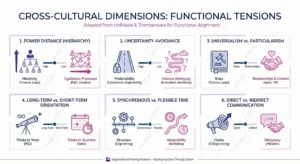
- Functional culture clashes
Sales, Finance, Engineering, HR, and Marketing operate with different values, risk appetites, and communication styles. Misunderstandings escalate quickly when functional cultural norms collide.
- Ambiguous decision rights
Teams loop endlessly because no one knows who has the authority to decide. This leads to escalation theatre or delayed action.
- Handover failures
Work moves across functions but is not packaged, explained, or validated consistently. This leads to rework, delays, and friction.
- Silo‑based incentives
When functional KPIs outweigh enterprise goals, people default to protecting their own performance metrics—even if the result harms cross‑functional outcomes.
- Lack of shared tools
When information sits in multiple systems, teams struggle to access a unified view of progress, blockers, or priorities.
Each of these failure modes is solvable with targeted interventions.
How do you overcome the most common cross‑functional collaboration challenges?
Cross‑functional teams face a predictable pattern of failure modes. These patterns surface across industries, geographies, and organisational structures, whether teams operate virtually, hybrid, or on‑site. Research and real‑world experience show that many of these challenges are systemic, not personal. When leaders diagnose the underlying causes rather than the symptoms, cross‑functional performance rapidly improves.
Based on 30 years of cross‑functional training and organisational diagnostics, the most recurring obstacles include a lack of shared accountabilities, unclear roles, functional cultural differences, decision‑making dilemmas, and communication barriers. These issues appear consistently in cross‑functional team research and leadership programs.
Let’s examine the most common challenges and how to fix them.
Why do unclear roles and responsibilities break cross‑functional teams?
Role ambiguity is the number‑one cause of cross‑functional friction. When people do not know “who owns what,” work slows down, decisions get revisited, and teams default to escalation—or worse, avoidance. Cross‑functional teams bring together people with diverse expertise, but also with different assumptions about ownership, decision rights, and priorities. This ambiguity is one of the most cited problems in cross‑functional training programs and leadership assessments.
Symptoms of unclear roles include:
- Work gets duplicated or dropped entirely.
- Teams revisit decisions because they were never clearly assigned.
- Functions set their own priorities and timelines.
- People become overly dependent on escalation.
Solutions that work:
- Create a “light touch” RACI early – or when a lack of clarity slows things down.
The absence of a basic accountability model leads to confusion and rework. Every project should start with £good enough” clarity on Responsibility, Accountability, Consultation, and Information flows. - Define what “ownership” actually means.
In cross‑functional work, ownership rarely means control. Instead, it means stewardship—coordinating, aligning, escalating, and ensuring shared outcomes across boundaries. - Assign a single-threaded leader wherever possible.
Someone must hold the thread of coordination of the “horizontal” team, even if they lack direct authority. - Use a shared work tracker.
One transparent source of truth (e.g., a program board or workstream tracker) reduces misunderstandings and provides visible accountability.
How do functional cultural differences influence collaboration?
Each function Attracts different types of people, trains them differently and has its own language, priorities, risk appetite, and workflow patterns. These differences enrich organisations but also create predictable friction. Function‑specific behaviours—often deeply ingrained—can appear irrational to outsiders.
Common cultural differences include:
- Sales prioritises speed, persuasion, and customer experience.
- Finance prioritises control, predictability, and risk minimisation.
- Engineering/Technical teams prioritise accuracy, rigour, and long‑term viability.
- HR prioritises fairness, process integrity, and employee experience.
- Marketing prioritises creativity, positioning, and demand generation.
What typically goes wrong:
- Teams talk past each other.
- Experts don’t communicate their expertise in a way that can be understood by their colleagues
- Disagreements become personal rather than structural.
- Functions protect their own metrics.
- Teams escalate prematurely due to misaligned expectations.
Solutions that work:
- Get trained in a model for understanding and managing functional cultural differences.
Help each function explains its own style, thinking, priorities, pressures, success metrics, and common constraints, and understand those of their colleagues. This dramatically reduces friction. - Create a shared language glossary.
Misunderstandings often stem from terminology. A simple glossary accelerates alignment. - Use structured communication templates.
For example:- Engineering prefers structured problem statements with data.
- Marketing responds to narrative-based framing.
- Finance engages when there is clarity on costs, risks, and ROI.
- Reinforce enterprise‑level KPIs.
When the whole team optimises for enterprise outcomes, functional differences become assets rather than battle lines.
How do you reduce cross‑functional meeting overload?
The “meeting tax” is one of the most pervasive cross‑functional pain points. Collaboration overload happens when teams confuse communication with coordination.
According to cross‑functional team research meeting overload stems from:
- Holding meetings to discuss issues that don’t require meeting or could be handled asynchronously
- Unnecessary participants attending meetings
- Too much focus on information sharing rather than making decisions and acting
- Fragmented information
- Unclear decision rights
- Excessive consensus‑seeking
- Poorly designed operating rhythms
Fixing meeting overload requires two shifts:
- Redesigning the operating rhythm
A good rhythm defines:
- When updates occur
- Who attends
- What decisions are made in each forum
- When escalation is appropriate
Most cross‑functional teams need fewer meetings, not more—but each one must have a specific purpose and outcome.
- Replacing status meetings with asynchronous updates
Shared dashboards, trackers, and decision logs remove the need for synchronous alignment. Meetings should be reserved for:
- Decisions
- Risks
- Trade‑offs
- Escalations
- Innovation or problem‑solving
If information can be written, it should be written. This also helps reduce the amount of time ticket in meetings on information sharing that could be done another way.
In our book Kill Bad Meetings and training programs around Fewer, better meetings we help organisations to halve the number of meetings, and at the same time improve collaboration.
How can cross‑functional teams improve handovers and workflow continuity?
Handover failures are one of the biggest drivers of rework, delay, and frustration in cross‑functional environments. They occur when work is not packaged, explained, scoped, or validated consistently.
Best practices include:
- Shared templates for handovers
- Minimum viable documentation
- Clear acceptance criteria
- SLA expectations
- Validation checklists
A cross‑functional team is only as strong as its weakest handover.
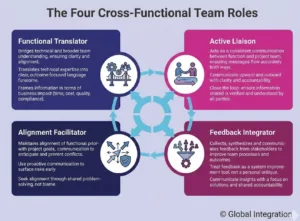
What are the critical roles in cross-functional communication?
Because we are often working with other specialists we need some additional communication roles in our cross-functional teams.
How do you choose a cross‑functional training provider that improves performance?
As cross‑functional working becomes the default operating system for modern enterprises, organisations increasingly recognise that traditional leadership or functional training alone cannot solve the systemic challenges teams face. The question for many L&D, HR, and transformation leaders is no longer “Should we invest in cross‑functional capability?” but rather “Which provider can actually build the skills, systems, and behaviours our teams need?”
Choosing the right cross‑functional training partner is a strategic decision. The wrong provider will deliver generic leadership content that fails to address the complexities of matrixed, multi‑team, multi‑stakeholder environments. The right provider can unlock significant improvements in execution speed, alignment, engagement, and enterprise‑level outcomes.
Here are the criteria organisations should consider when selecting a partner—and what differentiates high‑impact providers from those offering surface‑level solutions.
What expertise should a cross‑functional training provider have?
Cross‑functional work is not merely collaboration or teamwork. It is a specialised discipline that sits at the intersection of:
- matrix management
- systems thinking
- influence without authority
- cross‑functional decision‑making
- multi‑team alignment
- functional culture navigation
- accountability without control
- enterprise‑wide goal setting
A strong provider must be expert not just in leadership theory but in how work actually flows across functions. They should demonstrate deep knowledge of issues such as:
- decision rights ambiguity
- competing priorities across functions
- multi‑boss tensions
- cross‑functional meeting overload
- functional culture misunderstandings
- unclear ownership and role boundaries
- incentive and KPI misalignment
A high‑quality provider will address these systemic realities directly—not through generic motivation or team‑building content, but through frameworks, operating models, and practical tools.
Evidence‑based models
The provider should reference research, diagnostics, or proprietary tools that reflect real‑world data.
Experience with global, complex organisations
Cross‑functional work is most challenging in:
- multinationals
- matrix organisations
- multi‑product and multi‑region environments
- hybrid or virtual‑first teams
Ensure the provider has experience that mirror your complexity.
The ability to tailor content to your ecosystem
Cross‑functional challenges vary depending on:
- functional cultures
- industry dynamics
- organisational maturity
- team structure
- leadership expectations
Avoid providers offering “one‑size‑fits‑all” programs. High‑performing providers tailor to your culture and priorities:
A strong provider can adjust content to match the organisation’s matrix maturity and functional context.
How do you know when your organisation is ready for cross‑functional training?
Cross‑functional training is often introduced when:
- multiple teams complain about rework, delays, or misalignment
- functional leaders escalate issues frequently
- decision rights are unclear at project or program level
- cross‑functional meetings dominate calendars
- functional KPIs conflict with enterprise priorities
- employees report frustration about “being pulled in different directions”
- transformation, growth, or digital initiatives are slowing down because functions are not aligned
These symptoms appear frequently across your organisation’s internal cross‑functional materials and diagnostic frameworks.
When these patterns emerge, training is not simply a development initiative—it becomes an organisational necessity.
Progressive organisations look to build this capability before the problems arise and show up as negatives in climate and opinion surveys.
What role can AI play in helping managers operate in cross‑functional environments?
Current AI technology cannot “fix” cross-functional team leadership and collaboration, but it can materially reduce many of the systemic friction points that undermine cross‑functional performance when authority, accountability and information are fragmented.
Improving clarity and accountability
One of the core challenges of matrix and cross‑functional work is accountability without control, where ownership is unclear and commitments are buried in meetings or emails. AI‑enabled work assistants can help by consolidating actions, decisions and commitments from meetings, documents and collaboration tools into a single, shared view. This supports transparent commitment tracking and makes ownership visible without adding new governance layers.
Reducing decision drift
Decision‑making across functions often slows down because information is fragmented, roles are ambiguous and decisions are repeatedly revisited. AI can support decision discipline by maintaining decision logs, summarising prior rationale, and highlighting when decisions are being reopened without new data. This reinforces decision‑making architectures such as RACI, DACI or RAPID without turning them into bureaucratic exercises.
Lowering the “meeting tax”
Cross‑functional teams frequently overload themselves with meetings to compensate for poor information flow. AI can replace much of this synchronisation by generating concise updates, surfacing risks and dependencies, and enabling asynchronous progress tracking. This allows meetings to focus on decisions, trade‑offs and escalation rather than status reporting.
Supporting alignment across functions
Alignment breaks down when goals, incentives and priorities remain siloed. AI can help leaders maintain strategic and operational clarity by continuously mapping how workstreams, dependencies and KPIs connect to shared enterprise outcomes, reinforcing the “enterprise lens” required for effective matrix working.
Augmenting influence without authority
Influence, not hierarchy, is the currency of progress in cross‑functional teams. AI can support this by providing leaders with better stakeholder insight, highlighting misaligned expectations, and helping tailor messages to different functional perspectives—strengthening credibility and relationship capital rather than replacing human judgement.
A critical caveat
AI is most effective when it reinforces good cross‑functional design—clear charters, decision rights, escalation rules and shared priorities. Used without this foundation, it risks accelerating confusion rather than reducing it. As with cross-functional management itself, AI is a performance multiplier: it amplifies clarity where it exists, and dysfunction where it does not.
Conclusion: Building a future‑ready cross‑functional organisation
Cross‑functional team working is no longer optional. It is the mechanism through which complex organisations innovate, operate, and grow. Yet cross‑functional work introduces challenges that traditional structures, incentives, and leadership models were never designed to handle.
This guide has explored the foundations of cross‑functional excellence:
- accountability without control
- cross‑functional decision‑making
- influence without authority
- alignment through shared clarity
- cross‑functional leadership skills
- cross-functional communication
- matrix maturity and operating models
- collaboration challenges
- functional culture navigation
- shared incentives and enterprise‑level KPIs
- choosing the right training provider
Cross‑functional capability is the differentiator that separates organisations that merely restructure from those that truly integrate. With the right systems, tools, behaviours, and training partners, organisations can accelerate execution, improve collaboration, reduce rework, and build a culture where cross‑functional working becomes a competitive advantage rather than a daily struggle.
If you need to build or improve your capabilities in cross-functional team leadership or collaboration, see more about our cross-functional teams training or talk to an expert

Explore our training programs to see how we can help.
Cross functional teams Training Agile & Digital Training Matrix Management Training People and purpose Training Virtual Teams TrainingEducate yourself further with a few more of our online insights:
30 years of experience learning with a range of world class clients
We work with a wide range of clients from global multinationals to recent start-ups. Our audiences span all levels, from CEOs to operational teams around the world. Our tools and programs have been developed for diverse and demanding audiences.

Tailored training or off the shelf modules for your people development needs
We are deep content experts in remote, virtual and hybrid working, matrix management and agile & digital leadership. We are highly flexible in how we deliver our content and ideas. We can tailor content closely to your specific needs or deliver off the shelf bite sized modules based on our existing IP and 30 years of training experience.
For more about how we deliver our keynotes, workshops, live web seminars and online learning.