The complete guide to virtual team working and leadership
What is virtual team working?
Virtual team working refers to the practices, structures, and leadership approaches that enable individuals who are distributed across locations, time zones, and work patterns to collaborate effectively, often through technology. Done well, virtual team work increases autonomy, engagement, performance, talent access, cost efficiency and sustainability. Done poorly, it amplifies overload, misalignment, disengagement, invisibility, weak collaboration and burnout. This guide synthesizes more than 30 years of Global Integration research and practice on remote, hybrid and matrix working, combined with the latest academic studies, to outline the skills, behaviours, tools and frameworks needed for sustainable and high‑performing distributed organisations. If you need to build the capabilities of your virtual team members and leaders see our virtual teams training.
Why does virtual team working matter today?
The COVID‑19 pandemic accelerated what had already been a decades‑long trend toward remote and flexible work. Pre‑2020, only around 4% of employees in many countries worked remotely full‑time; by mid‑2020 this jumped to 40%, and even now, leading analysts estimate 20–30% of roles can operate remotely three to five days per week.
Fully remote work is still relatively uncommon (about 10% of companies offer fully remote work).
However most professionals and managers spend at least part of their time working in a virtual team with colleagues on other locations so virtual teams capability is an essential part of the modern leaders toolkit.
Hybrid working (where people spend part of the time in the office and the rest working virtually) has emerged as the preferred model for most professionals: surveys by Adecco and Gallup show employees want roughly 50% of their week remote, with the highest engagement found in those working 60–80% remotely.
Recent research also confirms that hybrid working significantly improves innovation, because engagement is a critical antecedent to innovative behaviour. A 2020 Gallup study and a meta‑analysis of 214 academic papers both show clear links between engagement and innovative performance.
How has the nature of work changed?
When Global Integration developed the world’s first workshops for remote and virtual teams training in 1994 it was driven by the increase in the number of international virtual teams as European and global businesses started to become more integrated internationally.
Virtual work is no longer a niche practice; it is a foundational skill. Modern organisations are:
- Matrixed, with individuals working across multiple reporting lines
- Cross-functional as problems, products and services become too complex and integrated for any single function to provide.
- Global, requiring coordination across cultures and time zones
- Digital, with work happening asynchronously through platforms and cutting across the old silos
- Project‑based, requiring rapid alignment and re‑alignment across temporary teams
- Multiple, professionals today typically work on multiple teams at the same time
Global Integration’s three decades of experience show that distributed work requires explicit skills that proximity previously supplied “for free”: visibility, trust, alignment, connection, collaboration, psychological safety, and boundary‑setting.
See our detailed additional guide if your virtual teams need to work in a formal matrix management structure.
What are the core principles of effective virtual team work?
The Global Integration Virtual Teams framework emphasises two fundamental distinctions that shape distributed work design:
- Star group vs spaghetti team collaboration (Individual vs collective work)
- Asynchronous vs synchronous work
Understanding these principles helps teams minimise unnecessary meetings, increase productivity, and cluster collaboration at the right times.
Many virtual teams operate across several functions – learn how cross functional working has an impact on collaboration and communication.
Star group vs spaghetti team – what level of interdependence do we have?
- Star groups are coordinated by a central “hub” (usually the manager). Work is mostly individual and independent.
- Spaghetti teams involve deep interdependence and frequent collaboration and coordination.
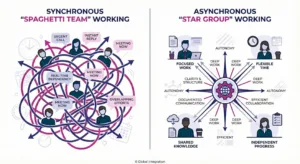
Most virtual team challenges are in spaghetti/collective collaboration which is more challenging when it has t be done through technology and across cultures and time zones.
Luckily most teams do not need to operate as spaghetti teams for much of the time. By using more individual and asynchronous work, virtual teams can minimize this more challenging work mode and focus on collective collaboration only where truly necessary.
Research from BCG during the COVID-19 period of home working (2020) found 75% of employees maintained or increased productivity on individual tasks when remote, but only 51% did so for highly collaborative tasks.
Remote work is an amplifier: it boosts focus-driven tasks but can complicate shared ones unless teams are well trained in virtual facilitation, communication and collaboration.
Virtual team leaders should therefore start by simplifying collaboration.
- Push as much work as possible into individual streams
- Reserve collective time for true interdependence
- Avoid meetings that are merely updates, status reports or announcements
This principle alone can save the average team member one day per week by cutting unnecessary meetings.
Asynchronous vs synchronous work – when do we need to be “together”?
Asynchronous working is where individuals do not need to be available at the same time and place to deliver the work. It allows distributed teams to move faster by reducing bottlenecks. Examples include using:
- Shared documents
- Recorded short videos
- Chat-based collaboration
Synchronous time (when we are all together either face to face or at an online meeting) should be used sparingly for activities that genuinely require simultaneous presence (e.g., decision-making, trust-building, collective problem-solving). Overusing synchronous time leads to meeting overload, fatigue, disengagement and switching costs.
How should virtual and hybrid teams decide what work happens where?
Hybrid teams must match the location to the nature of the work:
Table: Matching Work Type to Best Location (Hybrid Teams)
| Work Category | Best Location / Mode | Examples |
| Individual-focused work | Home / Remote | Individual tasks; Deep-focus activities; Planning; Creative incubation; Analysis |
| Asynchronous work | Home / Remote | Tasks that don’t require simultaneous collaboration; Document reviews; Chat- or tool-based coordination |
| Star‑group coordination | Home / Remote | Hub‑and‑spoke coordination led by a central manager; Work that doesn’t require frequent interaction |
| Highly interdependent work (“spaghetti work”) | Office / Synchronous | Continuous collaboration; Rapid back‑and‑forth alignment |
| Conflict resolution | Office / Synchronous | Sensitive or emotionally charged conversations that benefit from in‑person cues |
| Trust‑building | Office / Synchronous | Relationship development; Deeper interpersonal connection |
| Creativity evaluation / integration | Office / Synchronous | Synthesizing ideas; Joint evaluation of creative outputs |
| Onboarding & role transitions | Office / Synchronous | New joiner integration; Learning norms; Building early relationships |
Repeated studies in the 2020s have shown people want flexibility but also value face-to-face collaboration for social contact, creativity, and relationship-building.
How can individuals on virtual teams manage boundaries, transitions and work–life balance effectively?
Individuals when working from home virtually have to manage three major boundary challenges: roles, space and time.
1. Managing role transitions
Without the commute and physical separation, people struggle to switch between work and home roles. Research from Harvard and NYU showed remote workers logged 48 more minutes of connected time daily, often unintentionally.
What works:
- Rituals to “enter” and “exit” work
- Short walks before/after work
- Consistent routines
- Clear communication with household members
2. Setting boundaries in space
Few people have a dedicated home office. The risk: constant accessibility. Solutions include:
- A regular workspace
- No “overflow” of work into personal areas
- Packing away equipment at day’s end
- Managing visible cues to prevent “just one more task”
3. Setting boundaries in time
Remote work allows flexibility — but only if consciously designed.
- Define start/finish times
- Schedule breaks (every 90–120 minutes)
- Limit notifications
- Use delayed delivery on after-hours emails
- Discuss expectations with colleagues
How do virtual teams collaborate effectively?
Collaboration in distributed environments requires intentional design.
1. Fewer, better virtual meetings
Meeting overload grew after 2020. NBER research showed:
- Meetings increased 12.9%
- Attendees increased 13.5%
- Length decreased 20.1%
- Total meeting time fell 11.5%
Use the Global Integration “Kill Bad Meetings” principles:
- Only meet for synchronous-spaghetti topics
- Remove unnecessary participants
- Use check sheets to reveal contribution patterns
- Replace broadcast topics with asynchronous channels
2. Facilitate engaging virtual team meetings
To hold attention:
- Interact every 3–5 minutes
- Use multi-channel engagement (chat, polls, emojis)
- Plan participation deliberately
- Bring multiple voices into the conversation
- Use probability questions, not yes/no
- Operate like a radio host: call people in, amplify outliers
- Ensure equality of contribution (Google’s Project Aristotle)
How do people stay visible and connected when working remotely?
Visibility is not politics; it is ensuring others understand your value, priorities and progress. The PIE model (Performance, Image, Exposure) highlights that exposure accounts for up to 60% of perceived effectiveness in distributed environments.
Remote workers must:
- Proactively communicate progress
- Use video to build rapport (turn your camera on or you are literally invisible!)
- Develop strong networks
- Schedule regular check-ins and virtual coffees
How should remote leaders manage expectations and alignment?
Leaders must create explicit clarity where they can around:
- Priorities
- Time boundaries
- Availability
- Escalation routes
- Roles and responsibilities
- Decision rights
Hybrid leaders must also guard against proximity bias, where visible office‑based colleagues receive disproportionate influence, opportunity or recognition.
The Six Cs of complex collaboration model
Our Virtual Teams Training framework spans the 6 key areas of complex collaboration.
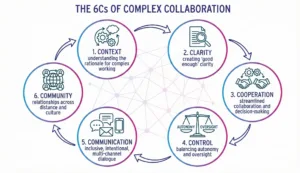
These virtual leadership and collaborations capabilities are highly interdependent; gaps in one area produce strain across all six.
How do leaders balance trust and control remotely?
Trust is based on capability and character. Leaders must:
- Create early trust-building steps (quick wins, short deliverables)
- Give people autonomy progressively
- Relax control as confidence grows
- Address trust breaches rapidly and fairly
Spyware-style oversight destroys trust and talent retention. Instead, distributed control closer to the action increases speed and accountability — provided alignment is strong.
How can virtual leaders run effective remote performance conversations?
Remote performance management differs because:
- Inputs/processes are less visible
- Performance must focus on outputs & outcomes
- Communication must be more intentional
- Feedback must be more frequent
- Context (workspace, boundaries, wellbeing) affects performance
Use a rhythm of:
- Weekly check-ins
- Monthly 1:1s
- Quarterly retrospectives
- Annual development conversations
Strengths-based coaching and the GROW model (Goal, Reality, Options, Will) work extremely well in virtual contexts.
How do virtual teams create psychological safety remotely?
Psychological safety — the ability to take interpersonal risks — is the strongest predictor of team performance, according to Google’s People Analytics “Project Aristotle”.
To create it virtually:
- Leaders speak last
- Encourage dissent
- Amplify outlier views
- Acknowledge mistakes and learning
- Use inclusive meeting practices
- Build strong one-to-one relationships
- Reduce status signals on video
How do we ensure diversity, equity and inclusion in virtual meetings?
Virtual environments can democratise participation if designed well.
Key practices:
- Use chat or polls before discussion to avoid anchoring of opinions and capture different opinions
- Rotate facilitation
- Use smaller breakout rooms
- Avoid fast consensus
- Encourage different thinking styles (introverts, cultures, languages)
- Use parallel channels to let quieter voices contribute
Recent DEI research shows that remote/hybrid work increases participation among underrepresented groups by reducing microaggressions, status cues and travel barriers.
How does a virtual team innovate effectively?
The myth that creativity requires collocated brainstorming has been debunked repeatedly.
Key findings from research:
- Individuals generate more and better ideas alone than in groups (due to reduced anchoring, domination, groupthink).
- Hybrid workers are more engaged, leading to more innovation.
- Serendipity can be engineered intentionally, not left to chance.
- Remote work supports deep work and incubation, essential for breakthrough thinking.
The creative process (James Webb Young)
- Define and research the problem
- Hard thinking
- Incubation (remote work is ideal)
- Eureka insight
- Evaluation and integration (best done synchronously)
How to engineer collective creativity virtually
- Enable individual, asynchronous idea generation
- Use online tools like Miro to cluster and prioritize ideas
- Create thematic breakouts
- Invite diverse participants (easier at virtual meetings rather than just engaging the people on your own location)
- Use rotating groups
- Capture ideas in shared canvases (Miro/Mural)
- Use asynchronous ideation followed by synchronous synthesis
What does a healthy communication heartbeat look like?
Distributed teams need a rhythm of communication that balances:
- High-intensity peaks (kick-offs, retrospectives)
- Regular pulses (1:1s, team meetings, updates)
- Informal micro‑touches (chat messages, social threads)
- Silent focus periods
MIT’s Thomas Allen found that communication volume decays rapidly with distance unless intentionally maintained – the Allen Curve.
“Bursty communication,” where teams collaborate intensely then disperse to execute, correlates with 24% higher performance.
What did virtual teams learn about ways of working from the pandemic experience?
Keep doing:
- Relationship-building focus
- Social rituals
- Psychological safety
- Team-based problem solving
- Mentoring and informal development
Change:
- Over-reliance on synchronous time
- Meeting-heavy processes
- Local-only networks
- Visibility via presenteeism
- Traditional performance monitoring
What are the practical steps to implement high‑performing hybrid working?
1. Decide the right hybrid pattern
Consider:
- Nature of work
- Personal preferences
- Corporate constraints
- Customer expectations
2. Build the team agreement
Co-create clarity on:
- Availability
- Meeting norms
- Tools and channels
- Collaboration patterns
- Escalation
3. Redesign meetings and collaboration
- Replace status meetings with async updates
- Use structured agendas (OPPT: Outcomes, Process, Participation, Time)
- Create participation plans
4. Strengthen trust, autonomy and accountability
- Use quick wins for early trust
- Push decision-making closer to the action
- Focus on output-based goals
5. Support wellbeing and sustainable productivity
- Encourage breaks
- Monitor workload
- Model healthy boundaries
6. Invest in virtual leadership and skills
- Video communication
- Digital facilitation
- Cross-cultural competency
- Virtual coaching
- Influence without authority
What are the additional barriers to global virtual team working

What are the common pitfalls — and how can they be avoided?
Pitfall 1: Too many synchronous meetings
Solution: Use asynchronous tools and “no meeting” periods.
Pitfall 2: Proximity bias
Solution: Equal access to information, opportunities and visibility.
Pitfall 3: Lack of alignment across multiple teams
Solution: Clear priorities, shared calendars, explicit trade-offs.
Pitfall 4: Slow decision-making
Solution: Clarify decision rights; consult widely, decide narrowly.
Pitfall 5: Invisible workloads
Solution: Transparent work boards; regular check-ins.
Pitfall 6: Isolation and disengagement
Solution: Structured social connection; community heartbeat.
What does the future of virtual work look like?
Trends that will shape the next decade:
- AI-driven augmentation of communication, coaching, workflow and knowledge flow
- More sophisticated asynchronous collaboration systems
- Higher globalisation of talent markets
- More modular, networked organisations
- Flexible offices designed as collaboration studios
- Hybrid leadership as a core leadership competency
How can AI help with virtual team leadership and collaboration?
Current AI technologies can act as force multipliers for many of the virtual team challenges outlined in this guide by making good practice easier, more consistent, and less cognitively demanding for managers. Used well, AI does not replace leadership judgement or relationships; it augments them where distance, overload and complexity get in the way.
AI can reduce meeting overload and poor collaboration design by analysing calendars, agendas and participation patterns, helping leaders distinguish between work that should be asynchronous and work that genuinely requires synchronous “spaghetti” collaboration, and by supporting the redesign of meetings toward clearer outcomes and participation plans.
It can support alignment and visibility by summarising work progress across shared documents, chats and projects, surfacing priorities, dependencies and risks that are otherwise invisible in distributed environments, and helping managers communicate progress and context more consistently across locations and time zones.
AI can also strengthen trust, psychological safety and performance conversations by prompting more frequent, output‑focused check‑ins, helping leaders spot imbalance in voice or workload, and supporting reflective coaching questions rather than surveillance-style control. This aligns with the shift from input monitoring to outcome-based leadership required in virtual and hybrid teams.
Finally, AI enables more effective asynchronous collaboration and innovation by supporting individual idea generation, synthesis and integration across time and distance—reinforcing the principle that virtual work works best when collective time is used deliberately and sparingly.
Conclusion: what must leaders and virtual teams do now?
Virtual work can be more productive, more human, and more sustainable than traditional office-based models — but only if designed intentionally.
The most successful organisations:
- Build capability around the virtual team 6Cs
- Create clarity and psychological safety
- Reduce unnecessary collaboration
- Strengthen relationships and visibility
- Balance autonomy with alignment
- Leverage technology intelligently
- Embed community before activity
This guide provides some of the models, tools and research-backed practices leaders need to build high-performing distributed teams that thrive today — and are ready for tomorrow’s complexity. If you need to build your virtual team capability see our virtual teams training.
Explore our training programs to see how we can help.
Cross functional teams Training Agile & Digital Training Matrix Management Training People and purpose Training Virtual Teams TrainingEducate yourself further with a few more of our online insights:
30 years of experience learning with a range of world class clients
We work with a wide range of clients from global multinationals to recent start-ups. Our audiences span all levels, from CEOs to operational teams around the world. Our tools and programs have been developed for diverse and demanding audiences.

Tailored training or off the shelf modules for your people development needs
We are deep content experts in remote, virtual and hybrid working, matrix management and agile & digital leadership. We are highly flexible in how we deliver our content and ideas. We can tailor content closely to your specific needs or deliver off the shelf bite sized modules based on our existing IP and 30 years of training experience.
For more about how we deliver our keynotes, workshops, live web seminars and online learning.