Balancing Control and Empowerment in Complex Teams – How leaders find the right balance in matrixed, cross-functional, and virtual environments)
Achieving the right balance of control and empowerment is one of the most persistent challenges in complex organizations. Too much control slows decisions and creates dependency; too little creates chaos, misalignment, and risk. Leaders in matrixed, cross‑functional, and virtual teams must deliberately calibrate where control is essential and where empowerment unlocks speed, ownership, and innovation. This article explains the challenge and outlines practical behaviors for leaders navigating this tension. For more on matrix management see our definitive guide
What makes control and empowerment such a difficult balance to strike?
Modern organizations operate in environments defined by matrix structures, multiple stakeholders, virtual collaboration, and shared decision ownership. In these conditions, leaders rarely have full authority, yet they remain accountable for outcomes. Th discomfort this can cause for leaders creates a pull toward centralizing control, even when empowerment would deliver better results.
However, empowerment is not the absence of control — it is the strategic redistribution of it. Done well, empowerment increases autonomy, speed, and engagement while maintaining clarity and safeguards. Done poorly, it generates confusion, rework, and risk.
Empowerment does not mean we don’t have control, it means we distribute that control further done the organization, and control is often improved if it is closer to the action.
Because control and empowerment sit in tension, leaders must navigate them with intention, not instinct.
Why does this tension matter in matrix, cross‑functional, and virtual teams?
Complex teams experience unique version of the control–empowerment dilemma:
- Decision speed is easily slowed by control bottlenecks
Multiple stakeholders and dotted lines often mean no one wants to act without permission. This results in escalations, dependency, and senior leaders becoming unintentional bottlenecks.
- Ambiguous ownership increases the temptation to “pull control upward”
When responsibilities are unclear, people can default to escalation. Leaders respond by tightening approvals, adding checkpoints, or requiring visibility — all of which reduce empowerment further.
- Virtual distance amplifies leaders’ fear of losing control
Without physical visibility, some leaders add extra meetings, status checks, or detailed oversight. These are often rooted in personal uncertainty, not organizational necessity.
- Complex governance can restrict autonomy
Governance bodies, compliance requirements, and global processes can either clarify decision rights or unintentionally suppress empowerment when mandates expand or approvals proliferate.
- Cultural and functional diversity changes expectations of control
Not all functions or cultures view autonomy the same way. What feels empowering in one group may feel unsafe or overly loose in another.
Leaders who understand these dynamics are better equipped to create empowerment without sacrificing strategic alignment or risk protection.
This academic meta‑analysis confirms that empowerment significantly improves task performance, creativity, and organizational citizenship behavior.
Executive Summary: What leaders need to know
Why this challenge undermines control and empowerment
In matrix and cross‑functional team environments, work flows across boundaries. Without calibrated empowerment, teams experience slow decisions, unclear ownership, rework, and reliance on senior leaders to “clear the path.” Excessive control blocks learning, reduces initiative, and suppresses distributed accountability.
Why the problem persists
- Leaders carry legacy habits from hierarchical £command and control” environments.
- Ambiguity makes people risk‑averse and more likely to escalate.
- Governance mechanisms accumulate over time but rarely get removed.
- Virtual working reduces visibility and increases anxiety about performance.
- Decision rights are often implicit, not explicit.
“Empowerment can fail when organizational culture, power dynamics, and legacy control habits conflict with distributed authority.”
What effective leaders do differently
- Establish clear waterlines — where involvement is required and where it is not.
- Push control closer to where the knowledge resides.
- Build capability so people can operate confidently without escalation.
- Use principles‑based rather than rule‑based controls where possible.
- Treat escalations as data — indicators of where capability, clarity, or confidence is missing.
- Create trust through transparency, communication, and modelling empowerment behaviors.
- Use non-directive coaching to support individuals taking responsibility themselves.
- Gently push back an inappropriate escalation
- Lead their people individually on a journey to build capability, confidence and the right level of support
Deep Dive: How control and empowerment actually work in complex environments
What do we mean by “control” in a matrix or cross-functional team?
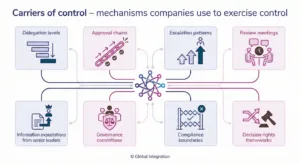
Control is not always about micromanagement; it is the set of formal and informal mechanisms that determine how decisions get made, how work is governed, and how risk is managed. These mechanisms include:
- Delegation levels
- Approval chains
- Escalation patterns
- Review meetings
- Information expectations from senior leaders
- Governance committees
- Compliance boundaries
- Decision rights frameworks
These “carriers of control” determine whether teams feel trusted to act or obligated to defer.
In our matrix management training we closely link behavioural empowerment with the dismantling or delegation of these formal controls.
Why traditional control approaches fail here
Traditional control assumes:
- Clear hierarchy
- Stable, predictable workflows
- Proximity between leader and team
- A single “owner” of decisions
Matrixed and virtual teams violate all four. With multiple bosses, distributed ownership, and remote work, relying on top‑down control leads to slowdown, duplication, or disempowerment.
What does empowerment actually require?
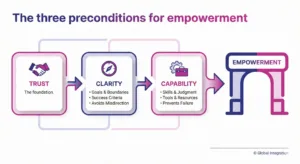
Empowerment is not simply “letting go.” It requires three preconditions that repeatedly surface in internal training and governance materials:
- Clarity (alignment on the “what”)
People need “clear enough” goals, boundaries, and success criteria. Without clarity, empowerment becomes misdirection.
- Capability (the “how”)
Empowerment without skills, judgement, or tools leads to failure and re‑escalation.
- Confidence and Trust (the belief they can act)
Even skilled people hesitate when the risk of being wrong feels high or when leaders unintentionally signal they want involvement.
When clarity, capability, and confidence are all present, empowerment becomes safe and sustainable.
Key question: How do leaders know when to empower vs. when to retain control?
A practical way to decide is to consider task complexity, novelty, and risk:
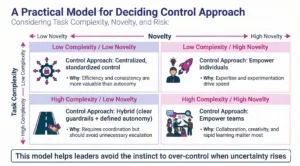
This model helps leaders avoid the instinct to over‑control when uncertainty rises.
What leadership behaviors enable effective control and empowerment?
1. Define your waterline — and make it explicit
A “waterline” is the boundary between issues that require your involvement and those that do not.
Effective leaders:
- Clearly communicate where they want to be involved and why
- Reduce their involvement over time as capability grows
- Avoid requiring updates that signal hidden control
- Distinguish between “staying informed” and “needing permission”
This creates predictable autonomy.
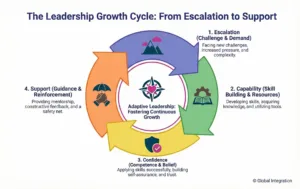
2. Treat escalations as development opportunities
Escalations are not failure — they are data.
Leaders should ask:
- Why did this get escalated?
- Is capability missing?
- Is clarity missing?
- Is confidence missing?
- Is governance or control too strict?
Then they build the conditions so future issues stay at the right level.
Once you have developed capability and confidence, relax your control, establish new support levels and if something new comes along escalation may start again.
3. Push control closer to where knowledge resides
Empowerment becomes real when teams own decisions end‑to‑end.
Leaders can:
- Reduce approval steps where risk is low
- Push review meetings down a level
- Cap unnecessary escalations to senior leaders
- Delegate authority with clear boundaries and principles
This increases speed and ownership.
4. Replace rule-based control with principle-based control
Principles provide alignment without rigidity.
Examples include:
- “Freedom within a framework”
- “Clear decision rights, transparent governance”
- “We escalate only when the consequence or uncertainty exceeds our threshold”
Principles scale better across geographies, functions, and virtual environments.
5. Build trust deliberately
Trust is the foundation that reduces the need for heavy control. Leaders build trust by:
- Demonstrating consistency in standards and expectations
- Being transparent about decision criteria
- Delegating visibly and celebrating autonomous success
- Avoiding “accidental micromanagement”
- Encouraging upward feedback
Where trust is high, empowerment accelerates. This is particularly critical in distributed teams where trust needs to be built more purposefully.
6. Model empowered leadership behaviors
Teams watch leaders closely. Empowerment takes root when leaders:
- Admit when they do not need to decide
- Actively step back during team problem‑solving
- Ask instead of tell
- Encourage experimentation and accept reasonable risk
- Avoid re‑taking control after a mistake
Culture changes when senior leaders show the way.
How can leaders redesign their systems to support empowerment?
Empowerment isn’t just behavioural — it must be supported by redesigned systems. Internal governance and control frameworks offer several levers:
1. Rationalize approval processes
Remove redundant signature steps, simplify workflows, and automate wherever possible.
2. Clarify decision rights
Use structured decision categories (e.g., Type I/II/III decisions, RACI‑like models, or “Decide/Advise/Recommend/Execute”) to define ownership.
3. Review governance bodies
Ensure committees unblock rather than gatekeep. Their role is to maintain alignment, not create bottlenecks.
4. Audit controls regularly
Ask whether each control protects value, mitigates risk, or simply persists due to legacy practices.
5. Shift from oversight to enablement
Governance should create transparency and support teams — not reduce autonomy.
What does good empowerment look like in practice?
When control and empowerment are balanced effectively:
- Decisions happen at the level with the most information
- Teams solve issues before they reach senior leaders
- Leaders spend more time on strategy, less on approvals
- Trust increases across functional and geographic boundaries
- Teams develop capability faster
- People feel ownership of both problems and solutions
- Escalations become rare — and meaningful
Empowerment is not a soft concept; it has measurable business impact.
We help leaders and teams succeed in complexity through practical tools, targeted capability building, and real‑world organizational experience.
See more about the challenges of matrix management in our guide.
If your organization needs to strengthen empowerment, streamline control mechanisms, or develop leaders who can thrive in matrixed, cross‑functional, and virtual environments why not speak directly with a leadership training advisor about your team’s needs

Explore our training programs to see how we can help.
Cross functional teams Training Agile & Digital Training Matrix Management Training People and purpose Training Virtual Teams TrainingEducate yourself further with a few more of our online insights:
30 years of experience learning with a range of world class clients
We work with a wide range of clients from global multinationals to recent start-ups. Our audiences span all levels, from CEOs to operational teams around the world. Our tools and programs have been developed for diverse and demanding audiences.

Tailored training or off the shelf modules for your people development needs
We are deep content experts in remote, virtual and hybrid working, matrix management and agile & digital leadership. We are highly flexible in how we deliver our content and ideas. We can tailor content closely to your specific needs or deliver off the shelf bite sized modules based on our existing IP and 30 years of training experience.
For more about how we deliver our keynotes, workshops, live web seminars and online learning.