Matrix Monday: Matrix management case studies – insights from HBR
Matrix organizations remain one of the most widely used — and widely misunderstood — organizational models. Designed to balance functional, geographic, product, or customer priorities, matrix management promises integration and agility yet often delivers complexity and tension.
In this blog we focus exclusively on matrix management case studies published by Harvard Business Review and Harvard Business Publishing. These cases offer rigorously researched, real-world examples of how global organizations have designed, implemented, and struggled with matrix structures.
Why Focus on HBR Matrix Management Case Studies?
Much of our own matrix work with clients is confidential and protected by non-disclosure agreements, limiting our ability to publish detailed case studies. Harvard’s case library therefore provides one of the most reliable and credible sources of documented learning on matrix management.
While the case study methodology has limitations — every organization has its own culture, history, and constraints — HBR case studies consistently surface recurring matrix challenges, including:
- Dual reporting and role clarity
- Conflicting priorities across dimensions
- Performance management in a matrix
- Decision rights and escalation mechanisms
- Leadership capability in complex organizations
When read critically, these case studies help leaders anticipate issues and design more robust matrix operating models.
See our curated broader list of matrix management case studies and articles.
Harvard Business Publishing Case Studies on Matrix Management
Note: Access to Harvard Business Publishing case studies may require purchase or institutional access.
ABB’s Relays Business: Building and Managing a Global Matrix
🔗 https://hbsp.harvard.edu/product/394016-PDF-ENG
This well-known case examines ABB’s global matrix structure and the complexity of managing performance targets across business units, regions, and functions. It highlights internal allocation conflicts, governance challenges, and the constraints imposed by highly complex matrix designs.
Eli Lilly – Emerging Global Organization (B)
🔗 https://hbsp.harvard.edu/product/399174-PDF-ENG
This case explores Eli Lilly’s strategic and organizational challenges as it evaluated the effectiveness of a focused matrix supported by cross-functional teams. It raises important questions about when a matrix is appropriate and how much complexity an organization can absorb.
Novartis Pharma: The Business Unit Model
🔗 https://hbsp.harvard.edu/product/101030-PDF-ENG
Novartis’ case focuses on a major organizational reconfiguration and examines how matrix-like business unit structures affect leadership roles, coordination, and accountability during large-scale transformation.
Procter & Gamble: Organization 2005
https://www.hbs.edu/faculty/Pages/item.aspx?num=34016
This case analyses Procter & Gamble’s long evolution toward a global matrix organization, examining the trade-offs between different organizational designs and the implementation challenges created by multiple reporting lines and decision layers.
Philips Versus Matsushita: A New Century, a New Round
https://hbsp.harvard.edu/product/302049-PDF-ENG
While not solely a matrix case, this study provides valuable insight into how Philips’ complex global structure — including matrix elements — affected strategic responsiveness and coordination compared to competitors.
Classic Harvard Business Review Articles Closely Linked to Matrix Case Studies
Although not formal case studies, these HBR articles are frequently taught alongside matrix cases and provide essential conceptual grounding.
Matrix Management: Not a Structure, a Frame of Mind
🔗 https://hbr.org/1990/07/matrix-management-not-a-structure-a-frame-of-mind
This article emphasizes that successful matrix management depends less on organizational charts and more on leadership mindset, shared goals, and collaborative behaviors.
Problems of Matrix Organizations
🔗 https://hbr.org/1978/05/problems-of-matrix-organizations
A foundational article identifying nine recurring vulnerabilities in matrix organizations, many of which are illustrated repeatedly in HBR matrix management case studies.
What These Matrix Management Case Studies Consistently Show
Across Harvard’s matrix management case studies, several themes recur:
- Matrix structures increase coordination demands, not clarity
- Role ambiguity is inevitable without explicit governance mechanisms
- Performance management becomes more complex in dual-reporting systems
- Leadership capability and conflict resolution skills are critical
- Matrix organizations require continual adjustment, not one-time design
These lessons appear repeatedly — whether in ABB’s global matrix, P&G’s evolving structure, or Novartis’ reorganization.
These, and more are outlined in our definitive guide to matrix management.
Using HBR Matrix Management Case Studies Effectively
When applying lessons from matrix management case studies:
- Treat them as diagnostic tools, not blueprints
- Focus on decision rights, accountability, and behaviors, not just structure
- Adapt insights to your organization’s culture and maturity
- Be wary of adding matrix complexity without leadership capability to match
Final Thoughts
Harvard Business Review’s matrix management case studies make one thing clear: matrix organizations can deliver strategic advantage, but only when supported by disciplined governance, capable leaders, and a shared understanding of how work gets done.
Used thoughtfully, these case studies provide invaluable insight for leaders designing, implementing, or improving matrix organizations — and a reminder that matrix management is as much about people and mindset as it is about structure.
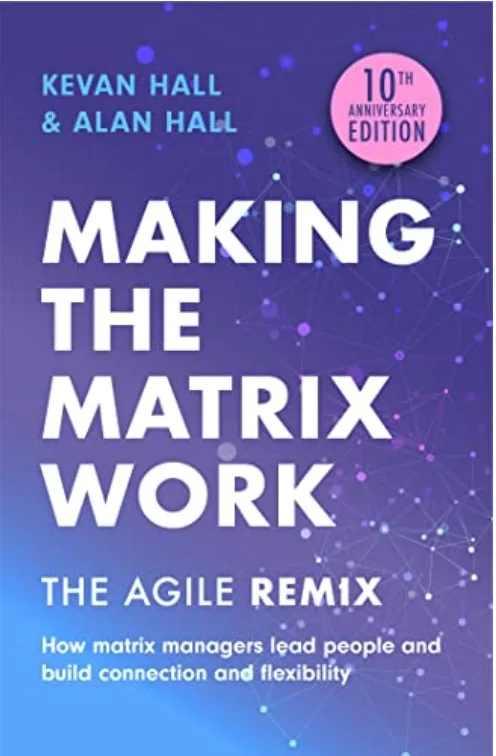
See more on the specific challenges and solutions of matrix management in our practical guide
Explore our training programs to see how we can help.
Cross functional teams Training Agile & Digital Training Matrix Management Training People and purpose Training Virtual Teams TrainingEducate yourself further with a few more of our online insights:
30 years of experience learning with a range of world class clients
We work with a wide range of clients from global multinationals to recent start-ups. Our audiences span all levels, from CEOs to operational teams around the world. Our tools and programs have been developed for diverse and demanding audiences.

Tailored training or off the shelf modules for your people development needs
We are deep content experts in remote, virtual and hybrid working, matrix management and agile & digital leadership. We are highly flexible in how we deliver our content and ideas. We can tailor content closely to your specific needs or deliver off the shelf bite sized modules based on our existing IP and 30 years of training experience.
For more about how we deliver our keynotes, workshops, live web seminars and online learning.