Mapping your network – a practical way to build influence in matrix organizations
In matrix organizations, leaders rarely fail because they lack technical expertise. They struggle because they do not have enough reach, credibility, or influence across the people who shape outcomes. That is why mapping and analysing your network matters. It helps leaders see where their current relationships support fast execution and where gaps, bottlenecks, or overdependence are slowing them down. In practice, network mapping gives leaders a more useful picture than the organization chart because it shows how decisions, information, and support really move. This is a core capability in our matrix management guide because success depends less on formal authority and more on influence across functions, geographies, and priorities.
Why network visibility improves execution
Many capable leaders underperform in matrix structures because they rely on the wrong network. They stay too close to their own function, depend on a few familiar contacts, or overlook the informal influencers who accelerate alignment. This problem persists because formal structures suggest clarity while real work happens through informal relationships.
Effective leaders do something different. They map who really gets things done – decisions, advice, resources, challenge, and sponsorship. Then they test whether that network is broad enough, balanced enough, and strategic enough to support delivery. The result is better decision speed, stronger alignment, clearer accountability, and fewer surprises when cross-functional work becomes politically complex.
Network mapping is one the tools we use in our matrix management training on influence without authority.
The business problem: why leaders in matrix structures need a better view of influence
In a traditional hierarchy, leaders can often get things done through position, process, and direct control. In a matrix, that approach breaks down. Priorities compete. Resources are shared. Decisions need input from multiple stakeholders who do not report to the same leader. In that environment, influence is not a soft skill. It is part of execution.
When leaders do not understand their networks, several predictable problems follow. Decision making slows because the right people are involved too late. Alignment suffers because functions interpret priorities differently. Accountability becomes blurred because nobody has enough visibility or support to move the work across boundaries. Outcomes suffer because leaders underestimate how much depends on trust, access, and informal sponsorship.
Research and practice in organizational network analysis show that the real pathways of collaboration and influence are often very different from the formal reporting lines on the chart.
Mapping your network: what leaders should actually look for
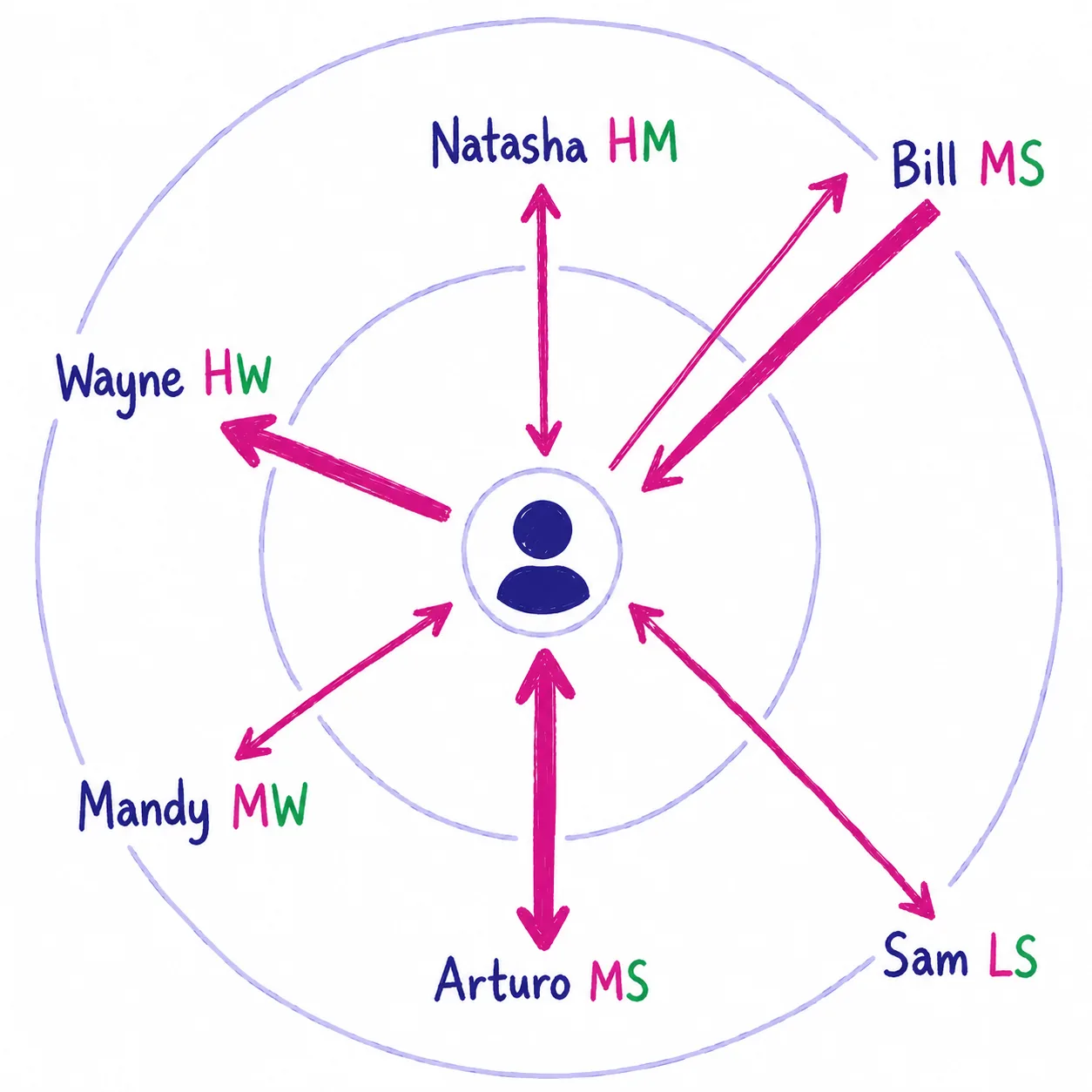
A useful network map is simple enough to use and sharp enough to reveal patterns. Start by listing the people you rely on in five categories: decision makers, information sources, problem-solvers, sponsors, and challengers. Then ask a harder question: are these people mostly from your own function, geography, level, or background? If they are, your network may feel efficient but still be too narrow for matrix leadership.
Good network analysis reveals four practical issues.
- It shows concentration risk: too much dependence on one or two well-connected people.
- It eposes blind spots: missing links to key functions, regions, or stakeholder groups.
- It highlights bottlenecks: people who control information or access and unintentionally slow progress.
- It identifies bridging relationships: the people who connect otherwise disconnected groups and help ideas travel across boundaries. These informal bridges matter because matrix execution depends on people who can connect agendas, translate priorities, and mobilize support beyond their own team. Network Mapping is specifically designed to make these hidden patterns visible.
This is also where traditional authority-based leadership fails. A leader may have formal responsibility for a result but still lack the relationships needed to secure cooperation, challenge assumptions, or get rapid access to expertise.
In complex organizations, influence comes from relevance, reciprocity, trust, and credibility as much as it does from title. That is why power mapping and network analysis are becoming more important leadership tools. They help leaders move from hoping the right people will engage to intentionally building the relationships that make execution possible. Power mapping offers a useful way to identify central individuals and critical connectors who shape decisions beyond the formal hierarchy.
Leadership behaviors that strengthen influence networks
The first behavior is deliberate relationship planning. Strong matrix leaders do not leave their networks to chance. They review who they need around key priorities, where they lack access, and which relationships need more depth. They also distinguish between operational contacts and strategic influence relationships. Both matter, but they serve different purposes.
The second behavior is building across boundaries before there is a crisis. Leaders who only reach out when they need something create transactional networks. Leaders who invest early build trust that can be used when priorities collide. This is especially important in cross-functional team working, where collaboration depends on credibility across specialist groups rather than on one leader’s authority alone.
The third behavior is asking for different kinds of input. Many leaders build networks full of supporters and information providers but too few constructive challengers. That creates false confidence and weaker decisions. A better network includes people who will test assumptions, bring external perspective, and point out risks early.
The fourth behavior is maintaining network diversity. If your strongest ties are all with people similar to you in function, tenure, or geography, your perspective will narrow. Diverse networks improve information flow and increase the chances of earlier problem detection, broader alignment, and smarter trade-offs.
For senior leaders and L&D teams, this matters because development programs should not just teach influencing skills (though these are important too). They should help leaders diagnose the network patterns that shape whether those skills will work in practice.
Common mistakes when leaders map their networks
The most common mistake is treating network mapping as a static exercise. Networks change with strategy, restructuring, and leadership moves. A map that was useful six months ago may now hide new risks. Another mistake is focusing only on senior stakeholders. In many organizations, influence sits with project leads, long-tenured specialists, executive assistants, or respected peers who connect teams informally.
Leaders may also make the mistake of measuring relationship volume rather than relationship value. A large network is not always a useful one. What matters is whether the network helps you move decisions, surface concerns, and coordinate action across complexity.
From network visibility to better matrix leadership
Mapping your network is not an academic exercise. It is a practical leadership discipline for seeing how influence really works in your organization. Once leaders can visualize their current network, they can strengthen weak connections, reduce overdependence, and build the relationships that support faster, better execution.
This challenge is one component of effective decision making in complex organizations. For a complete framework, see our full guide on matrix management.
If your leaders need to build stronger influence across functions, regions, or stakeholder groups, a structured development pathway can help. Our leadership training programs focus on the practical skills required to lead in matrix organizations and cross-functional teams, including influence, alignment, role clarity, and collaboration. If you want to explore what that could look like for your organization or how to learn techniques for network mapping and matrix management, speak with a leadership training advisor.
Explore our training programs to see how we can help.
Cross functional teams Training Agile & Digital Training Matrix Management Training People and purpose Training Virtual Teams TrainingEducate yourself further with a few more of our online insights:
30 years of experience learning with a range of world class clients
We work with a wide range of clients from global multinationals to recent start-ups. Our audiences span all levels, from CEOs to operational teams around the world. Our tools and programs have been developed for diverse and demanding audiences.

Tailored training or off the shelf modules for your people development needs
We are deep content experts in remote, virtual and hybrid working, matrix management and agile & digital leadership. We are highly flexible in how we deliver our content and ideas. We can tailor content closely to your specific needs or deliver off the shelf bite sized modules based on our existing IP and 30 years of training experience.
For more about how we deliver our keynotes, workshops, live web seminars and online learning.