Functional cultures: how leaders can navigate deep-rooted professional identities in cross‑functional teams
Functional cultures are powerful, deeply ingrained professional identities that shape how people think, collaborate, and make decisions. In cross‑functional, matrix, and hybrid environments, these differences create predictable tension—and often slow down alignment, decision‑making, and accountability. Effective leaders recognize, decode, and work with these cultural patterns rather than fighting them. This article explores how functional cultures operate and how leaders can manage them for stronger cross‑functional performance. For more on cross-functional team challenges see our detailed guide.
What problem do functional cultures create in complex organizations?
In large organizations—particularly those operating with cross‑functional team working—the biggest collaboration challenges are rarely technical or structural. They are cultural. Functional cultures shape how people see the world, define success, process information, and decide what “good” looks like. When a finance specialist, an engineer, and a marketer come together, they don’t just bring different expertise—they bring different professional identities.
Functional cultures are formed through education, professional norms, rewards, and long-term exposure to functional role models. They determine risk appetite, communication style, time orientation, and decision‑making preferences.
In cross‑functional teams, these differences can slow down progress because:
- People interpret the same information differently.
- Functions reward different outcomes.
- Teams default to their own “tribal logic.”
- Conflict often stems from cultural clashes, not personal issues.
- Communication is shaped by cultural preferences and norms
In today’s matrix management, interconnected, and hybrid workplaces, these tensions are amplified because teams depend on each other without having hierarchy as a fallback. Cross‑functional projects stall not because people resist collaboration, but because they are using fundamentally different cultural operating systems.
This creates issues such as:
- Delayed decisions due to conflicting priorities
- Misunderstandings about risk vs. speed
- Uneven engagement in meetings
- Frustration around accountability and ownership
- Power struggles between functions and cross‑functional teams
While organizations have invested heavily in cross‑functional work They haven’t invested accordingly in building cross functional team capability, most cultural power still sits inside the functions, making collaboration across boundaries difficult.
Why does this challenge persist—and what do effective leaders do differently?
Functional cultures persist because they are rewarded and reinforced by the system. Goals, performance evaluations, and career progression are controlled primarily by functions, shaping behaviour over time.
This creates a loop:
- People are attracted to a function based on interests, identity, aptitude, or sometimes even family tradition.
- The function reinforces their identity, shaping language, priorities, and worldview. See this 20‑year longitudinal study on Big Five personality and job characteristics.
- Rewards and role models strengthen loyalty, creating “tribal” alignment. Leaders need to balance horizontal and vertical loyalties and reinforce cross‑functional collaboration.
- Cross‑functional interactions highlight differences, creating friction.
Individuals from different functions have widely different stories and experiences and professional identities become filters that shape how individuals judge collaboration, risk, creativity, and value.
Effective leaders do not attempt to erase functional identities. Instead, they:
- Treat functional differences as predictable—not personal
- Translate between functional logics
- Create environments where differences become complementary
- Build shared goals that bridge functional priorities
- Identify which tensions are aligned, different, or genuinely in conflict
This approach converts functional diversity from a source of conflict in a matrix organization into an asset.
What are functional cultures—and why do they matter so much?
Functional cultures are not superficial differences; they are acquired professional identities built through years of study, socialisation, and feedback. They create:
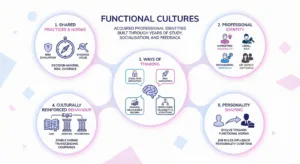
1. Shared practices and norms
How a function makes decisions, evaluates risk, or values evidence.
2. Professional identity
How people see their role and purpose. Marketing sees possibility; Legal sees risk, Engineering sees precision; HR sees impact on people.
3. Ways of thinking
Each function has its own logic, assumptions, and default preferences.
For example:
- Legal focuses on risk mitigation
- R&D focuses on innovation
- Finance focuses on measurable return
- Operations focuses on reliability and structure
4. Culturally reinforced behaviour
Long-standing traditions in professions—such as law, medicine, engineering, and accounting—create stable norms that transcend companies.
5. Personality shaping
Longitudinal research (as mentioned in your document) shows that job roles influence personality traits over time. People evolve toward the behavioural norms of their function.
- Cultural Attraction Theory (CAT)
People gravitate toward roles that resonate with deeper identity patterns, reinforcing functional tribes.
In short:
Functional cultures are powerful because they shape how people behave, interpret, and collaborate—not just what they do.
Where do functional differences show up in cross‑functional work?
In our training we have adapted five core dimensions from cross-cultural research (inspired by Hofstede and Trompenaars) that show up in functional tensions:
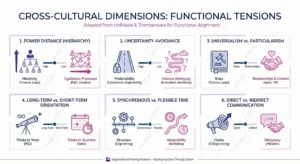
1. Power Distance (Hierarchy)
Some functions expect clear hierarchy (Finance, Legal), while others prefer egalitarian processes (R\&D, Creative).
2. Uncertainty Avoidance
Compliance and Engineering want predictability; Innovation and Marketing tolerate ambiguity.
3. Universalism vs. Particularism
Finance and Legal emphasize rules.
Sales and HR prioritize relationships and context.
4. Long‑Term vs. Short‑Term Orientation
R&D thinks in years; Sales thinks in quarters.
5. Synchronous vs. Flexible Time
Engineering prefers structure; Marketing prefers adaptability.
6. Direct vs. Indirect Communication
IT/Engineering prefer clarity; HR/Sales prefer diplomacy.
How do functions differ on key collaboration dimensions?
| Dimension | Functions High on This | Functions Low on This |
| Power distance | Finance, Legal | R&D, Creative |
| Uncertainty avoidance | Compliance, Engineering | Innovation, Marketing |
| Universalism vs particularism | Finance, Legal | Sales, HR |
| Long‑term vs short‑term orientation | R&D | Sales |
| Synchronous vs flexible time | Engineering | Marketing |
| Direct vs indirect communication | IT, Engineering | HR, Sales |
These dimensions create predictable patterns of misunderstanding, for example tensions between innovation and control, which leaders must navigate intentionally rather than reactively.
We know the brief summaries above can fall into stereotypes and not all finance people or salespeople are the same, but these dimensions do influence behaviour in general and are useful to drive understanding of the differences people observe every day.
How can leaders manage functional cultural differences more effectively?
There are several practical tools for diagnosing and navigating functional differences that we use in our cross-functional teams training.
1. The Functional Mirror Tool
This tool highlights that what we notice in others is a reflection of ourselves.
If you think a function is “risk‑averse,” they may see you as a “risk‑taker.”
Leaders can use this tool to:
- Identify their biases
- Understand how they are perceived
- Reframe tensions as reciprocal, not one‑sided
2. The Functional Culture Abacus
This model helps teams map their differences across the six dimensions above to reveal:
- Direction of the gap
- Size of the gap
- Which gaps matter
- Where strengths can be combined
Teams use it to build shared awareness rather than make assumptions.
3. The Five Choices Model
Leaders often face dilemmas, not simple choices. This model outlines five possible responses: Choose option A, choose option B, compromise, do nothing, or integrate both.
It is especially useful in situations like:
- Risk vs. speed
- Rules vs. relationships
- Innovation vs. stability
By consciously selecting the right quadrant, leaders avoid knee‑jerk decisions and find more creative reconciliations.
4. The ADC Model (Aligned, Different, or in Conflict)
Before labelling something as “conflict,” leaders should identify:
- What we are already aligned on
- What is simply different
- What is genuinely in conflict
This reduces unnecessary escalation and creates more productive cross‑functional dialogue.
What practical leadership behaviours improve collaboration across functional cultures?
These leadership behaviours are essential for navigating functional diversity:
1. Acknowledge and value differences
Do not treat one functional worldview as “better.” Treat them as complementary.
2. Clarify roles and expectations
Ensure each function knows how its strengths contribute to the shared goal.
3. Facilitate open, structured communication
Direct communicators and indirect communicators need different approaches.
4. Use mixed metrics and rewards
Different functions value different outcomes; align them carefully.
5. Become a cultural translator
Bridge the gap between functional logics and reduce misinterpretation.
6. Encourage peer coaching
Pair colleagues with opposite profiles to build mutual capability.
Checklist for leaders managing functional cultural differences
- Identify your own functional lens
- Map cultural gaps using the Abacus model
- Clarify shared goals and cross‑functional metrics
- Establish explicit decision‑making rules
- Use structured communication protocols
- Provide cross‑functional coaching
- Reinforce both vertical and horizontal loyalty
Why functional cultures are a critical element of cross‑functional team effectiveness
This challenge is one component of effective cross‑functional team working—but not the whole picture. Understanding functional cultures helps leaders anticipate tensions, set clearer expectations, and design collaboration practices that align diverse professional identities.
If your leaders struggle with functional tension, collaboration friction, or matrix‑related misalignment, we can help.
For a complete framework, see our full guide on cross‑functional team working., or consider speaking with one of our advisors about building functional cultural intelligence across your teams.

Explore our training programs to see how we can help.
Cross functional teams Training Agile & Digital Training Matrix Management Training People and purpose Training Virtual Teams TrainingEducate yourself further with a few more of our online insights:
30 years of experience learning with a range of world class clients
We work with a wide range of clients from global multinationals to recent start-ups. Our audiences span all levels, from CEOs to operational teams around the world. Our tools and programs have been developed for diverse and demanding audiences.

Tailored training or off the shelf modules for your people development needs
We are deep content experts in remote, virtual and hybrid working, matrix management and agile & digital leadership. We are highly flexible in how we deliver our content and ideas. We can tailor content closely to your specific needs or deliver off the shelf bite sized modules based on our existing IP and 30 years of training experience.
For more about how we deliver our keynotes, workshops, live web seminars and online learning.