Conflict in Matrix Organizations: why it happens and how can we harness it.
Conflict in matrix organizations is a natural and frequent occurrence where employees report to multiple managers and juggle competing priorities, and the matrix is explicitly designed to be more productive by opening shared resources to a broader audience. This blog explains why conflict arises in matrix structures, how to recognize its symptoms, what deeper causes drive it, and—most importantly—how leaders can turn conflict into a source of innovation and engagement. We will also explore when conflict is positive and healthy and provide practical tools for managers to address it effectively.
What is conflict in matrix organisations?
Conflict in matrix organisations refers to the friction, disagreements, and tensions that arise when employees work across multiple reporting lines, functions, and geographies or compete for shared resources. Unlike traditional hierarchies, matrix structures are designed to break down silos and foster collaboration—but this very complexity often leads to competing goals, unclear roles, and power struggles.
The matrix also exposes the resources formerly locked up in silos to the broader organisation and allows for resources to be reallocated. As a result, competition over resource allocation tightness to increase, usually this results in improved overall productivity.
These tensions in a matrix management can cause a number of symptoms
Why does conflict happen in matrix organisations?
What Are the Main Triggers of Conflict?
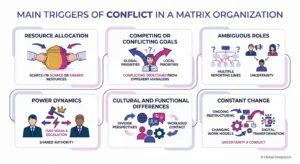
- Resource allocation: Competition for scarce or shared resources.
- Competing or conflicting goals: Employees may receive conflicting objectives from different managers, teams, or stakeholders (e.g., global vs. local priorities).
- Ambiguous roles: Multiple reporting lines create uncertainty about who is responsible for what.
- Power dynamics: Shared authority can lead to turf wars and escalation – Although the transparency of the matrix can make this less prevalent than in traditional hierarchical functional organisations.
- Cultural and functional differences: Diverse teams bring different perspectives, values, and communication styles and are pushed more into contact through increased use of cross functional and international teams.
- Constant change: Ongoing restructuring, digital transformation, and changing work models add to the uncertainty. The matrix is meant to be dynamic and to respond quickly to change, and change can cause conflict.
Table 1: Common Triggers of Conflict in Matrix Organisations
| Trigger | Example Scenario |
| Resource allocation | Multiple priorities from distinct parts of the organization competing for limited resources and attention |
| Competing or Conflicting Goals | Global Marketing wants global consistency; local sales wants agility individual customer needs |
| Ambiguous Roles | Two managers assign different priorities to the same employee |
| Power Dynamics | Disagreement over budget ownership |
| Cultural and Functional Differences | Different identities, ways of thinking and languages cause misunderstandings |
| Constant Change | New reporting lines after a reorg |
Where does a matrix organization reduce conflict?
Although matrix organizations experience more overall conflict because of ambiguity, shared authority, and competing goals, they also reduce certain types of friction that are common in traditional hierarchical structures.
In particular, the matrix lowers conflict at the boundaries between functions, regions, and specialist teams—areas where classic siloed organizations often struggle. By design, matrix working improves horizontal collaboration, resource sharing, and global–local integration, so while it increases conflict in some areas, it simultaneously prevents the silo‑based disputes that are even more entrenched in purely vertical models.
What are the symptoms of conflict in a matrix team?
How can leaders spot conflict early?
- Escalation of Issues: Frequent upward escalation instead of peer resolution.
- Decision Paralysis: Delays because no one feels empowered to decide.
- Blame Games: Unclear accountability leads to finger-pointing.
- Meeting Overload: Endless alignment meetings with little progress.
- Siloed Behaviour: Teams focus on their own goals, neglecting the bigger picture.
- Low Engagement: Frustration, burnout, or disengagement among staff.
- Functional cultural differences cause regular misunderstandings.
What are the deeper causes of conflict in matrix organisations?
Is it about structure?
No. While structure plays a role, the deeper causes are often cultural and behavioural:
- Over-reliance on structure: Organisations hope that new org charts will solve problems, but real change requires new skills and mindsets.
- Lack of skills for ambiguity: Many managers are trained for clarity and control, not for navigating ambiguity and influence without authority.
- Insufficient trust: Without trust, people revert to control, escalation, and defensive behaviours.
- Misaligned incentives: If rewards are tied to functional or local goals, collaboration suffers.
- Capability to resolve conflict: Conflict is healthy only if we have the skills to resolve it, otherwise it keeps reemerging.
What does recent research say about matrix conflict?
Research in the last 5 years has identified that conflict in matrix organizations shows up less as “people problems” and more as structural frictions:
- Role conflict and priority conflict in dual leadership (two leaders, two sets of demands) and relationship quality in the leadership dyad are real, evidence-backed levers for reducing felt conflict (not just “soft advice”)
- Ambiguous authority / unclear decision rights, can lead to power struggles and slow decisions
- Communication load and coordination overhead can be either a conflict amplifier (when weak) or a conflict dampener (when strong and structured) note – this link leads to a pdf.
When is conflict positive and healthy in a matrix organisation?
Yes—when managed well, conflict can:
- Surface hidden problems and spark innovation
- Drive better decisions through constructive debate.
- Build resilience and adaptability.
- Prevent groupthink by encouraging diverse viewpoints.
Table 2: Healthy vs. Unhealthy Conflict
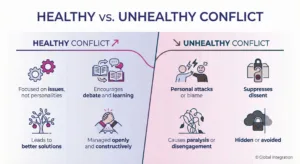
| Healthy Conflict | Unhealthy Conflict |
| Focused on issues, not personalities | Personal attacks or blame |
| Encourages debate and learning | Suppresses dissent |
| Leads to better solutions | Causes paralysis or disengagement |
| Managed openly and constructively | Hidden or avoided |
“Sometimes our clients ask us to help them reduce conflict in the organisation. To be honest I worry more about companies that have too little conflict as this usually means that people have given up or do not care enough about the business. Conflict is generally good provided we have the skills to resolve it. “ Kevan Hall
How can leaders turn conflict into a positive force?
What practical tools and techniques work?
- Embrace “Good Enough” Clarity
- Do not chase perfect clarity. Create “islands of clarity” where possible and empower employees to clarify their own goals and roles.
- Develop Skills for Ambiguity and Influence
- Invest in training for managing ambiguity, influencing without authority, and negotiating trade-offs.
- Build Trust Deliberately
- Prioritize relationship-building, quick wins, and regular, open communication.
- Clarify Decision Rights
- Use ARCI (Accountable, Responsible, Consulted, Informed) analysis for recurring issues.
- Align Incentives
- Ensure performance management and rewards reinforce collaboration, not just functional achievement.
- Encourage Healthy Dissent
- Use frameworks like ADC (Aligned, Different, Conflict) to distinguish between alignment, legitimate differences, and true conflict.
Instead of pursuing perfect agreement, perfect clarity, perfect alignment, or perfect buy in to a decision try asking “Can you live with it”. You will often find that people can and it is not worth the time of pursuing that lost 10% of perfection.
What are the best practices for managing conflict in matrix organisations?
Checklist: Conflict Management for Matrix Leaders
- Regularly review and clarify roles and goals.
- Train managers in conflict resolution and influence skills
- Foster a culture of open feedback and psychological safety.
- Use structured decision-making tools (e.g., ARCI)
- Align incentives with collaborative behaviours.
- Celebrate constructive conflict and learning from mistakes.
What Are the Key Takeaways for Corporate Leaders?
- Conflict is inevitable in matrix organisations—but it can be harnessed for good.
- The root causes go beyond structure: relationships, skills, trust, and incentives matter most.
- Healthy conflict drives innovation, engagement, and better decisions.
- Leaders must invest in skills, clarify decision rights, enable conflict resolution, and align incentives.
- Practical tools like ARCI and ADC, plus a culture of trust, are essential.
Internal Links
- For more on matrix management skills, see our Matrix Leadership Training (internal link).
Practical Model: The Conflict Resolution Process
A typical conflict resolution process follows a structured path that helps people move from disagreement to a workable solution. While it can be formal (e.g., workplace mediation) or informal (e.g., personal conflicts), the core steps are usually similar:
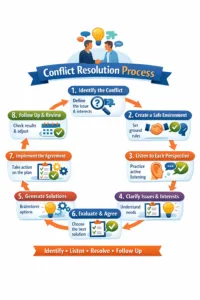
- Identify the Conflict: Clarify what the conflict is actually about. Distinguish between positions (“I want X”) and interests (“I need fairness/respect/time”). Agree that a conflict exists and needs attention.
- Create a Safe Environment: Set ground rules (respectful language, no interruptions). Choose an appropriate time and place. Ensure all parties feel heard and not threatened.
- Listen to Each Perspective: Each party explains their viewpoint without interruption. Practice active listening (paraphrasing, asking clarifying questions). Acknowledge emotions as well as facts.
- Clarify Issues and Interests: Identify underlying needs, values, or concerns. Separate people from the problem. Focus on what matters rather than who is right.
- Generate Possible Solutions: Brainstorm options collaboratively. Avoid judging ideas too early. Look for win–win or compromise solutions.
- Evaluate and Agree on a Solution: Assess options for fairness, feasibility, and impact. Agree on specific actions, responsibilities, and timelines. Confirm mutual understanding and commitment.
- Implement the Agreement: Put the solution into action. Communicate clearly about next steps. Document the agreement if appropriate.
- Follow Up and Review: Check whether the solution is working. Adjust if needed. Reinforce positive changes and learning.
What does the Tuckman team development model say about conflict?
Tuckman Said the after you form the team you must go through a period of storm where conflict is high and issues are resolved before you can go on to develop team norms and finally move through to high performance.
How can AI strengthen our ability to manage conflict in the matrix
Early identification of emerging conflict
AI can analyse patterns in digital communication to highlight early signals of rising tension, disengagement, or repeated escalation—allowing leaders to intervene before conflict becomes personal, formal, or disruptive.Making hidden conflict visible
In matrix organisations, conflict is often indirect or avoided. AI can surface recurring friction points, unresolved issues, or repeated breakdowns across teams that may not be raised explicitly but are driving frustration and inefficiency.Supporting structured conflict resolution conversations
AI‑based prompts and guides can help managers and employees work through conflict using a consistent structure—clarifying issues, interests, and options—rather than relying on instinct or avoidance.Reducing emotional escalation during conflict
AI tools can assist individuals in drafting difficult messages, reframing emotionally charged language, and separating facts from assumptions—lowering the risk of misunderstandings escalating into personal conflict.Improving fairness and perceived neutrality
In matrix settings where authority is shared, AI can act as a neutral reference point by summarising perspectives objectively and ensuring all voices are captured, reducing perceptions of bias or power imbalance.Scaling conflict management capability
AI enables organisations to provide consistent conflict‑management support at scale, rather than relying solely on HR or a small number of skilled leaders—particularly important in large or global matrices.Reinforcing healthy conflict behaviours
By normalising structured debate, surfacing differences constructively, and documenting resolutions, AI helps shift conflict from being avoided or personalised to being treated as a legitimate and manageable part of work.Identifying systemic sources of recurring conflict
Over time, AI can highlight patterns showing where conflict repeatedly arises—such as specific interfaces, roles, or incentives—allowing leaders to address root causes rather than repeatedly resolving the same disputes.Freeing leaders to focus on judgement and relationships
By reducing the administrative, analytical, and emotional load associated with conflict, AI allows leaders to focus on what matters most: trust, credibility, and constructive resolution.
Creating a storm is a legitimate team building technique, but it does require the skills to move on from the conflict to develop domes, agreements ways of working for the future, otherwise the underlying causes will not be resolved, and the storm will come back.
Conflict is only one of the challenges in matrix management, for more on matrix management challenges, see our comprehensive matrix management guide
FAQ
Q: Why is conflict so common in matrix organisations?
A: Because employees report to multiple managers and must balance competing goals, and scarce resources leading to ambiguity and tension.
Q: How can leaders manage conflict constructively?
A: By clarifying roles, building trust, developing influence and conflict resolution skills, and aligning incentives.
Q: When is conflict healthy?
A: When it surfaces genuine issues, drives better decisions, and is managed openly and constructively.
Final Thoughts
Conflict in matrix organisations is not a problem to be eliminated, but a dynamic to be managed. With the right mindset, skills, and tools, leaders can turn conflict into a catalyst for growth, innovation, and engagement. As a next step why not explore a customized leadership development pathway on matrix management skills or speaking with one of our advisors about building functional cultural intelligence across your teams.

Explore our training programs to see how we can help.
Cross functional teams Training Agile & Digital Training Matrix Management Training People and purpose Training Virtual Teams TrainingEducate yourself further with a few more of our online insights:
30 years of experience learning with a range of world class clients
We work with a wide range of clients from global multinationals to recent start-ups. Our audiences span all levels, from CEOs to operational teams around the world. Our tools and programs have been developed for diverse and demanding audiences.

Tailored training or off the shelf modules for your people development needs
We are deep content experts in remote, virtual and hybrid working, matrix management and agile & digital leadership. We are highly flexible in how we deliver our content and ideas. We can tailor content closely to your specific needs or deliver off the shelf bite sized modules based on our existing IP and 30 years of training experience.
For more about how we deliver our keynotes, workshops, live web seminars and online learning.